

On this page
Statement and match-the-list formats appear in recent JEE Main papers. Here are eight original Rotational Motion ones, easy to hard, none repeating our solved JEE Main Rotational Motion set.
Which Rotational Motion topics do these questions cover?
Unit 5 of the NTA's Syllabus for JEE (Main) - 2027 includes torque, angular momentum, moment of inertia and the axes theorems. Values follow Table 6.1 of NCERT Class 11 Physics, Chapter 6 (Reprint 2026-27), which omits the axes theorems. See our guide to preparing Rotational Motion for JEE Main.
Statement questions
Options for Q1 and Q3: (1) Both statements correct (2) Both incorrect (3) I correct, II incorrect (4) I incorrect, II correct.
Q1 (easy, statements). A wheel accelerates uniformly from rest to 300 rpm in 5 s. Statement I: It turns 12.5 revolutions. Statement II: A rim point (r = 0.2 m) has constant net acceleration.
Answer: (3). I: average 2.5 rev/s × 5 s = 12.5 rev. II is false: tangential αr ≈ 1.26 m/s² is constant; centripetal ω²r grows from 0 to about 197 m/s².
Trap: (1), forgetting the centripetal part.
Q2 (medium, statements). A uniform square plate (mass M, side a) has I = Ma²/12 about an in-plane central line parallel to a side. Which are correct?
A. Perpendicular axis through the centre: Ma²/6.
B. A diagonal: Ma²/12.
C. Perpendicular axis through a corner: 2Ma²/3.
D. An edge: Ma²/12.
E. The perpendicular axes theorem also works for a cube.
(1) A, C and D only (2) A, B and C only (3) A, B, C and E only (4) B, C and D only
Answer: (2). A: perpendicular axes, Ma²/12 + Ma²/12. B: the equal diagonals share Ma²/6. C: Ma²/6 + M(a/√2)². D is false: shifting a/2 gives Ma²/3. E is false: the theorem needs a planar body.
Trap: (1), not shifting to the edge.
Q3 (medium, statements). A motor delivers 2.0 kW to a shaft turning steadily at 1200 rpm. Statement I: The torque on the shaft is about 16 N m. Statement II: At the same power, halving the speed to 600 rpm doubles the torque.
Answer: (1). I: ω = 1200 × 2π/60 ≈ 125.7 rad/s, so τ = P/ω ≈ 15.9 N m. II: τ = P/ω, so halving ω doubles τ to about 31.8 N m.
Trap: (4), putting ω = 1200 in rpm, which gives about 1.7 N m.
Q4 (hard, statements). A 0.5 kg puck circles a smooth table at 2 rad/s, radius 0.4 m, on a string through a central hole. It is pulled slowly to radius 0.2 m. Which are correct?
A. Angular momentum about the hole is conserved.
B. Final angular speed: 8 rad/s.
C. Kinetic energy is conserved.
D. The pull does 0.48 J of work.
E. Tension is unchanged.
(1) A, B, C and D only (2) A, B and E only (3) B, D and E only (4) A, B and D only
Answer: (4). A: tension points at the hole, giving no torque. B: mr²ω is constant, so ω quadruples. C is false: K = L²/2I rises from 0.16 J to 0.64 J, the pull's work (D). E is false: mω²r rises from 0.8 N to 6.4 N.
Trap: (1), conserving energy too.
Match-the-list questions
Q5 (easy, match). A flywheel (I = 2 kg m²) starts from rest under a 10 N m torque. Match SI values at 4 s.
List-I: (A) Angular acceleration (B) Angular speed (C) Angle turned (D) Work done by the torque
List-II: (I) 400 (II) 5 (III) 40 (IV) 20
(1) A-II, B-III, C-IV, D-I (2) A-IV, B-II, C-III, D-I (3) A-II, B-IV, C-I, D-III (4) A-II, B-IV, C-III, D-I
Answer: (4). A: τ/I = 5 rad/s². B: αt = 20 rad/s. C: ½αt² = 40 rad. D: τθ = 400 J = ½Iω².
Trap: (1), using θ = αt.
Q6 (medium, match). Each body is 4 kg; radius 0.5 m, rod length 1.5 m. Match moments of inertia (kg m²).
List-I: (A) Rod, perpendicular axis through an end (B) Ring, tangent in its plane (C) Ring, tangent perpendicular to its plane (D) Solid sphere, tangent
List-II: (I) 1.4 (II) 2.0 (III) 3.0 (IV) 1.5
(1) A-III, B-IV, C-II, D-I (2) A-III, B-II, C-IV, D-I (3) A-IV, B-III, C-II, D-I (4) A-III, B-IV, C-I, D-II
Answer: (1). Parallel axes. A: ML²/12 + M(L/2)² = 3.0. B: MR²/2 + MR² = 1.5. C: MR² + MR² = 2.0. D: 2MR²/5 + MR² = 1.4.
Trap: (2), using the wrong ring axis.
Q7 (medium, match). For fixed-axis rotation (moment of inertia I, kinetic energy K, angular momentum L), match each dependence.
List-I: (A) K at fixed L (B) L at fixed K (C) Torque for a fixed angular acceleration (D) A uniform disc's I against radius R (fixed thickness and density)
List-II: (I) R⁴ (II) I (III) 1/I (IV) √I
(1) A-IV, B-III, C-II, D-I (2) A-III, B-IV, C-I, D-II (3) A-III, B-IV, C-II, D-I (4) A-III, B-II, C-IV, D-I
Answer: (3). A: K = L²/2I. B: L = √(2IK). C: τ = Iα. D: mass grows as R², so MR²/2 grows as R⁴.
Trap: (1), swapping A and B.
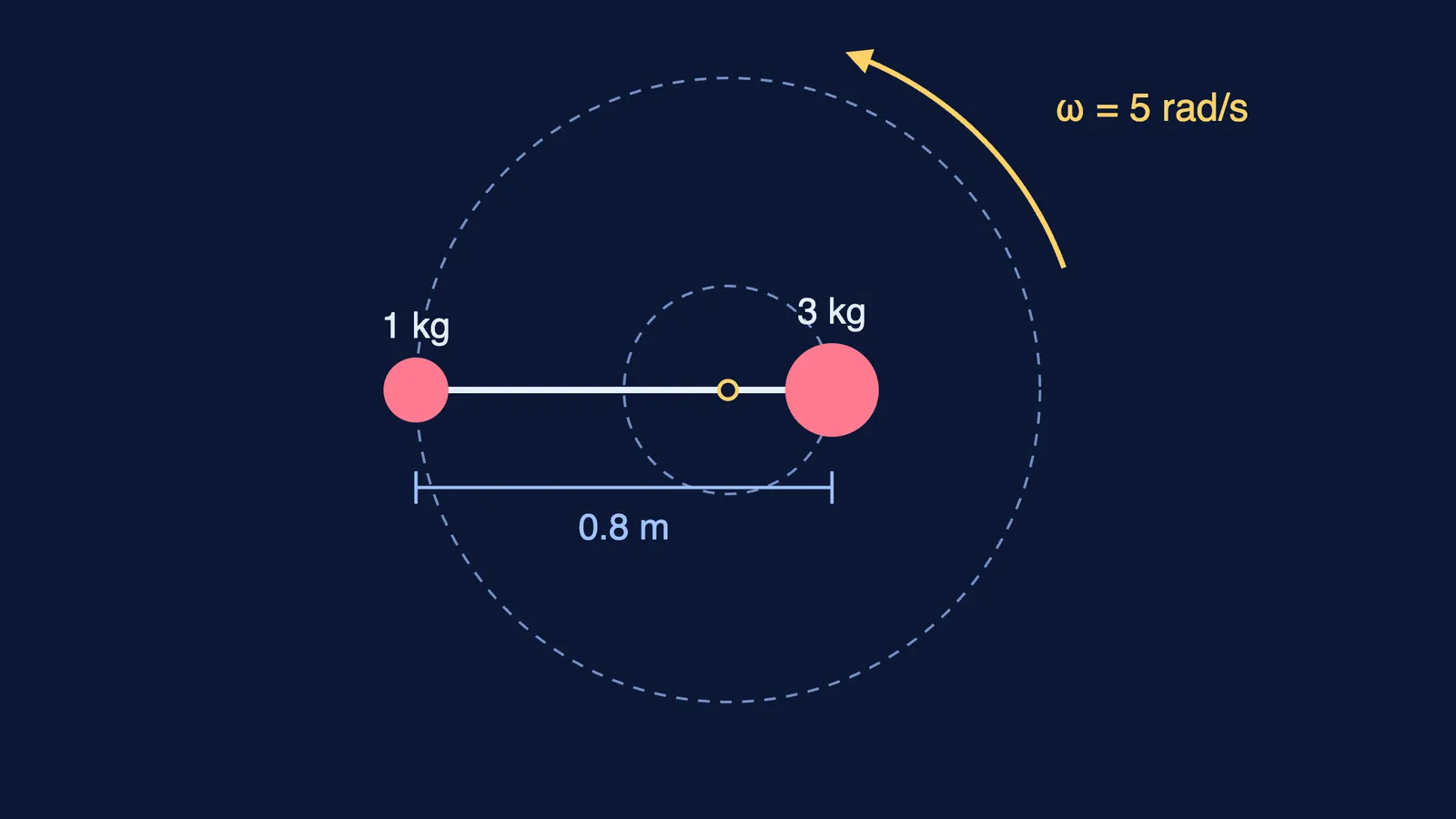
Q8 (hard, match). Balls of 1 kg and 3 kg on a light 0.8 m rod spin at 5 rad/s on a smooth table about their centre of mass. Match SI values.
List-I: (A) Moment of inertia (B) Angular momentum (C) Kinetic energy (D) Rod tension
List-II: (I) 2.4 (II) 15 (III) 0.48 (IV) 6.0
(1) A-III, B-IV, C-I, D-II (2) A-III, B-I, C-IV, D-II (3) A-I, B-III, C-IV, D-II (4) A-III, B-I, C-II, D-IV
Answer: (2). The centre of mass is 0.6 m and 0.2 m from the balls. A: 1(0.6)² + 3(0.2)² = 0.48 kg m². B: Iω = 2.4 kg m² s⁻¹. C: ½Iω² = 6.0 J. D: mω²r = 1 × 25 × 0.6 = 15 N; the 3 kg ball agrees.
Trap: (1), swapping L and K.
How do you work these faster?
Write the axis beside every I (Q2, Q6).
Under a central force, conserve L; get K from L²/2I (Q4).
Check a pair two ways (Q5: τθ = ½Iω²).
Anchor on your surest pair; Q8's A-III removes (3).
Unsure why Q4's puck gains energy? The Fermi Problem Library has worked problems with a step-by-step solver that explains the reasoning rather than printing an answer.


