

On this page
Here are 8 original rotational motion numericals, easy to hard, each with a worked solution and the wrong number most students reach. Take g = 9.8 m/s² and give every answer to the nearest integer.
Every topic used sits in Unit 5, Rotational Motion, of the NTA syllabus for JEE (Main) 2027, including both axes theorems. New to the chapter? Start with our guide on how to prepare rotational motion for JEE Main.
How do numerical-value questions work in JEE Main?
According to the JEE (Main) 2027 information bulletin, Physics has 20 multiple-choice questions in Section A and 5 numerical-value questions in Section B. A correct numerical answer earns +4 and a wrong one costs −1. You enter an integer on an on-screen keypad, and the answer should be rounded off to the nearest integer.
Allow 25 minutes for all eight, and commit to a number before reading each solution.
Easy: kinematics, moment of inertia and tipping
Q1 (easy). A lathe chuck speeds up uniformly from 600 rpm to 1800 rpm while turning through 100 revolutions. Find its angular acceleration in rad/s², to the nearest integer.
Answer: 25. ω₀ = 20π rad/s, ω = 60π rad/s, θ = 200π rad. From ω² = ω₀² + 2αθ, α = (3600π² − 400π²)/(400π) = 8π ≈ 25.1 rad/s².
Trap: 158, from putting θ = 100 instead of converting revolutions to radians.
Q2 (easy). Four identical uniform thin rods, each 0.6 m long and of mass 2 kg, are joined into a square frame. Find its moment of inertia about an axis through the centre, perpendicular to the frame, in units of 10⁻² kg m².
Answer: 96. Each rod's centre is 0.3 m from the axis, so ML²/12 + M(0.3)² = 0.06 + 0.18 = 0.24 kg m². Four rods give 0.96 kg m².
Trap: 72, from dropping each rod's own ML²/12.
Q3 (easy). A uniform 25 kg crate, 0.9 m tall and 0.6 m wide, stands on a floor rough enough to stop sliding. Find the least horizontal force, in N, applied at its top edge that just starts to tip it over its far bottom edge, to the nearest integer.
Answer: 82. At tipping the floor pushes only at the far edge; take moments there: F × 0.9 = 25g × 0.3, giving F ≈ 81.7 N.
Trap: 163, from using the full 0.6 m width as the weight's lever arm.
Medium: centre of mass and angular momentum
Q4 (medium). A 20 cm square is cut from one corner of a uniform 40 cm square sheet. How far, in mm, is the remaining sheet's centre of mass from the original centre, to the nearest integer?
Answer: 47. The cut piece has a quarter of the mass, centred 10√2 cm from the centre, so the remainder's centre of mass shifts the other way by (1/4)(10√2)/(3/4) = 10√2/3 ≈ 4.71 cm.
Trap: 35, from dividing by the full mass instead of the remaining three quarters.
Q5 (medium). A 0.3 kg ball is thrown horizontally at 5 m/s from the top of a 20 m tower. Find the magnitude of its angular momentum about the foot of the tower 1 s later, in kg m²/s, to the nearest integer.
Answer: 37. At 1 s the ball is at x = 5 m, y = 15.1 m, moving with vₓ = 5 m/s and v_y = −9.8 m/s. L = m(xv_y − yvₓ) = 0.3(−49 − 75.5), so |L| ≈ 37.4 kg m²/s.
Trap: 30, which is 0.3 × 5 × 20, the angular momentum at launch. Gravity's torque about the foot changes L.
Q6 (medium). A uniform 4 kg disc of radius 0.5 m is at rest on a frictionless axle through its centre. A tangential force F = 3t N (t in s) acts on its rim for 4 s. Find its angular speed at t = 4 s, in rad/s.
Answer: 24. I = ½MR² = 0.5 kg m². Angular impulse = R∫F dt = 0.5 × 24 = 12 kg m²/s = Iω, so ω = 24 rad/s.
Trap: 48, from using the final force, 12 N, as if it acted for all 4 s.
Hard: two bodies and an instant after release
Q7 (hard). A 50 kg person stands on the rim of a horizontal platform, a uniform disc of mass 200 kg and radius 2 m, free to turn on a frictionless vertical axle. From rest, the person walks once round the rim, relative to the platform, and stops. Through what angle, in degrees, has the platform turned?
Answer: 120. Angular momentum about the axle stays zero, so the angles turned satisfy mR²φ_person + Iφ_platform = 0, with mR² = 200 and I = 400 kg m². So φ_person = −2φ_platform. Relative to the platform the person turns 360°, so 3|φ_platform| = 360°.
Trap: 180, from measuring the person's 360° from the ground.
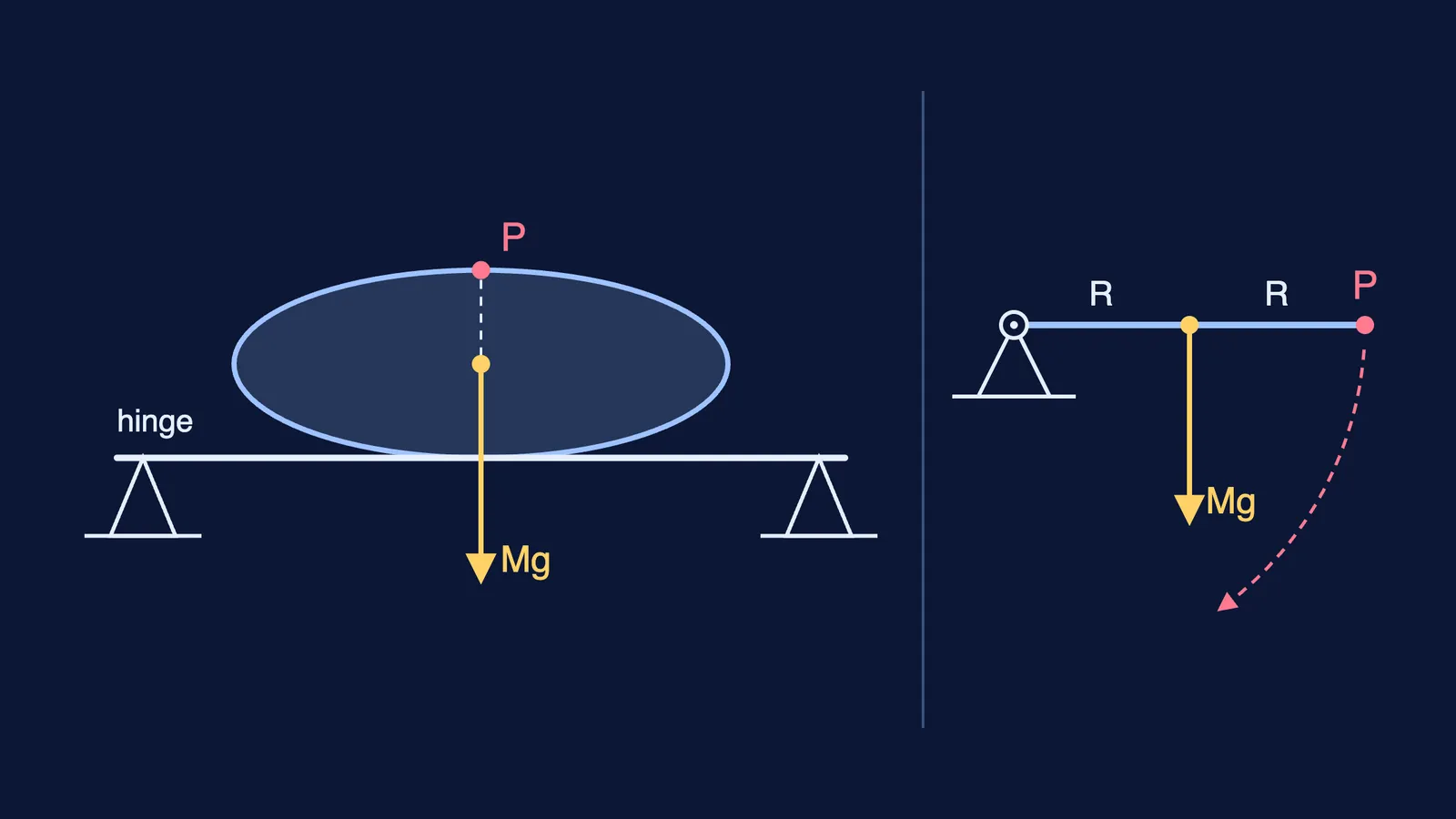
Q8 (hard). A uniform disc of radius 20 cm can turn about a fixed horizontal axis along a tangent in its own plane. It is released with its plane horizontal. Find the acceleration, in m/s², of the disc point P farthest from the axis just after release, to the nearest integer.
Answer: 16. About a diameter, I = MR²/4. The tangent is parallel at distance R, so I = MR²/4 + MR² = 5MR²/4. Torque MgR gives α = 4g/5R, and P, 2R from the axis, has a = 8g/5 ≈ 15.7 m/s², more than g.
Trap: 13, from starting with MR²/2, the value for the central axis perpendicular to the disc.
How do you get the number right?
Radians, always. Rotational kinematics needs rad and rad/s (Q1).
Start the parallel axis theorem at the centre of mass. It states I = I_cm + Md², with d measured from the axis through the centre of mass (OpenStax). For a flat body, the perpendicular axes theorem adds two in-plane axes through one point (HyperPhysics).
Fix a sign for angular momentum before adding contributions (Q5, Q7).
Round only at the end. Keep π and √2 exact until the last line.
Stuck on which axis or conserved quantity to use? The Fermi Problem Library has worked problems with a step-by-step solver that explains the reasoning rather than printing an answer.
For multiple-choice practice, try our rotational motion JEE Main practice questions.


