

On this page
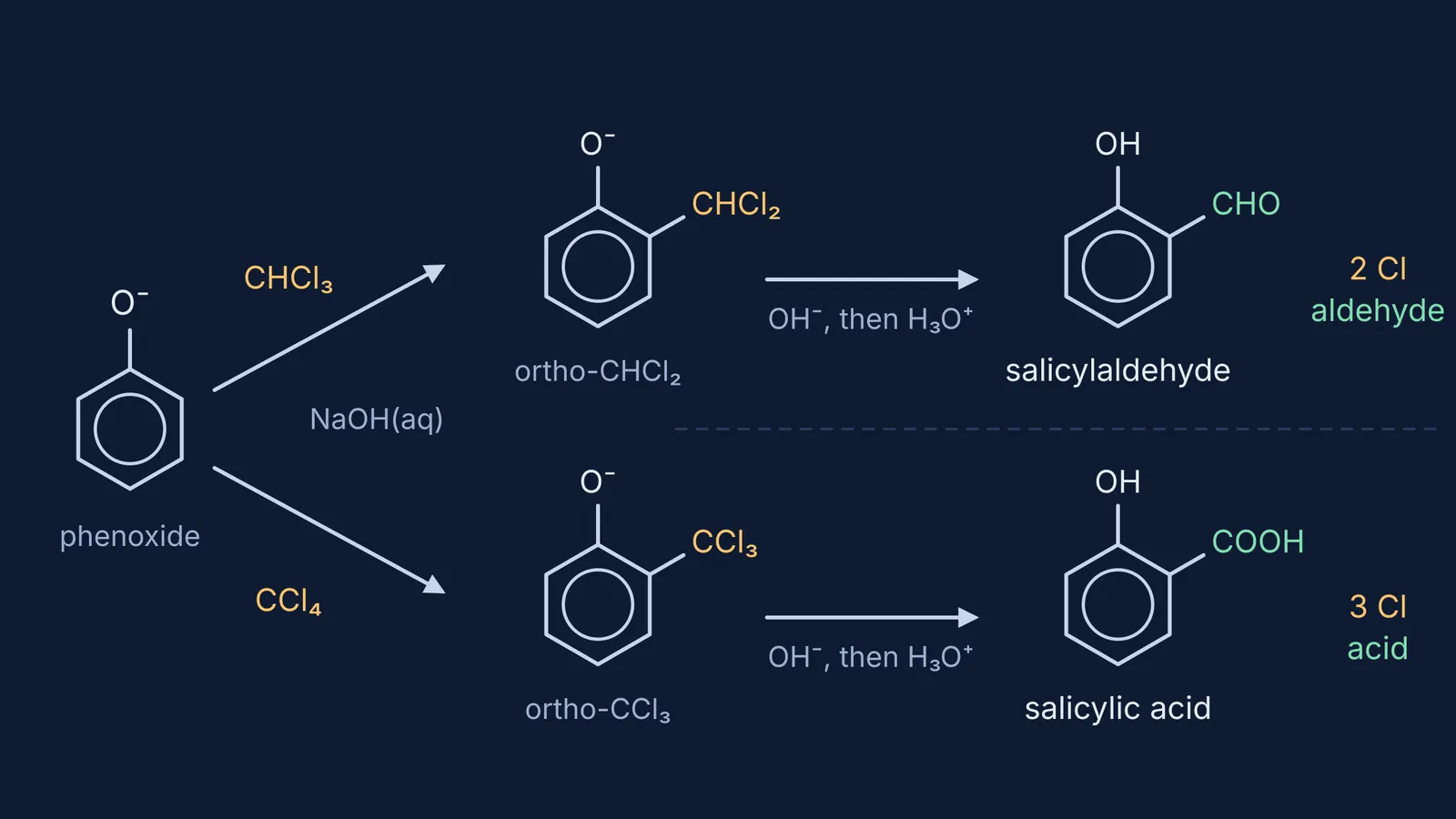
In the usual Reimer–Tiemann reaction, phenol, chloroform and aqueous NaOH give salicylaldehyde. Swap the chloroform for carbon tetrachloride and, after you acidify, the product is salicylic acid instead. JEE questions use this swap to check whether you know why the chloroform version stops at an aldehyde. Be clear about its status: the CCl₄ version is a JEE extension beyond NCERT, which shows only the chloroform reaction, and its mechanism is not fully settled. What you can rely on is the outcome and a simple chlorine-counting rule.
What does phenol give with CCl₄ and NaOH?
Phenol is heated with CCl₄ and aqueous NaOH. In the strongly basic mixture both the phenol OH and the new acid group are deprotonated, so the first product is disodium salicylate. Acidifying the solution gives salicylic acid (2-hydroxybenzoic acid).
C₆H₅OH + CCl₄ + 6NaOH → C₆H₄(ONa)COONa + 4NaCl + 4H₂O
C₆H₄(ONa)COONa + 2HCl → C₆H₄(OH)COOH + 2NaCl
Compare the chloroform reaction, which uses less base because one fewer chlorine has to be removed:
C₆H₅OH + CHCl₃ + 4NaOH → C₆H₄(ONa)CHO + 3NaCl + 3H₂O
Both equations balance in atoms and charge. Two practical points matter for exams. The ortho product dominates, but some para product (4-hydroxybenzoic acid) also forms. Yields are low, so this is not how salicylic acid is made in practice. The step-by-step chloroform mechanism, with dichlorocarbene, is covered in Reimer–Tiemann and Kolbe reactions of phenol, step by step, so it is not repeated here.
How does counting chlorines predict the product?
Look at the one carbon that ends up bonded to the ring. Before hydrolysis it still carries chlorines from the reagent. Hot aqueous base replaces each chlorine with OH. A carbon holding two or three OH groups is unstable and loses water.
1 Cl: –CH₂Cl → –CH₂OH, an alcohol.
2 Cl: –CHCl₂ → –CH(OH)₂ → –CHO, an aldehyde.
3 Cl: –CCl₃ → –C(OH)₃ → –COOH, an acid (present as –COO⁻ in base).
With chloroform, the ring picks up –CHCl₂, so you get an aldehyde. With CCl₄, the ring picks up –CCl₃, so you get an acid.
You have already used this rule on side chains. Benzal chloride, C₆H₅CHCl₂, hydrolyses to benzaldehyde, as shown in toluene to benzaldehyde via benzal chloride hydrolysis. Benzotrichloride goes one step further: C₆H₅CCl₃ + 2H₂O → C₆H₅COOH + 3HCl. Why two chlorines on one carbon give a carbonyl is explained in the difference between geminal and vicinal dihalides.
A second check uses oxidation states. Hydrolysis does not change the oxidation state of that carbon. In Ar–CHCl₂ it is +1, the same as in Ar–CHO. In Ar–CCl₃ it is +3, the same as in Ar–COOH. So three chlorines can only end up as an acid.
What mechanism is usually taught for the CCl₄ version?
With chloroform, OH⁻ removes the hydrogen from CHCl₃, the CCl₃⁻ ion loses Cl⁻, and dichlorocarbene (:CCl₂) attacks the ring. CCl₄ has no hydrogen, so this route is not available. Do not draw dichlorocarbene for the CCl₄ reaction.
The pathway commonly taught in JEE books is this:
The phenoxide ion pushes electron density into the ring, mainly at the ortho and para carbons.
An ortho carbon attacks the carbon of CCl₄ and a chloride ion leaves. Some books draw this as attack on a "CCl₃⁺" electrophile.
The ring loses H⁺ to become aromatic again, giving an o-(trichloromethyl)phenoxide.
Hot NaOH hydrolyses –CCl₃ to –COO⁻.
Treat this as a teaching model, not an established mechanism. A free CCl₃⁺ ion is not a reasonable species in hot aqueous alkali, and the detailed route for the CCl₄ reaction has not been settled. Exam questions test the product and the hydrolysis logic, and both are reliable.
Worked example: CHCl₃, CCl₄ and CH₂Cl₂
Question: phenol is heated with aqueous NaOH and (a) CHCl₃, (b) CCl₄, (c) CH₂Cl₂, and each mixture is then acidified. Predict the main product. Part (c) is a check on your logic.
Find the group that reaches the ring. (a) CHCl₃ gives :CCl₂, which ends up as –CHCl₂ on the ring: two chlorines. (b) CCl₄ ends up as –CCl₃: three chlorines. (c) If CH₂Cl₂ reacted the same way, it would leave –CH₂Cl: one chlorine.
Apply the hydrolysis rule. Two chlorines give –CHO, three give –COOH, one gives –CH₂OH.
Write the products after acidification. (a) Salicylaldehyde, o-HOC₆H₄CHO, molar mass about 122 g/mol. (b) Salicylic acid, o-HOC₆H₄COOH, about 138 g/mol. (c) The rule predicts salicyl alcohol, o-HOC₆H₄CH₂OH.
Reality check for (c). CH₂Cl₂ is far less acidic than CHCl₃ and does not form a carbene with aqueous NaOH, so do not write (c) as a real Reimer–Tiemann reaction. It only shows that the number of chlorines sets the oxidation level of the product.
Count the base. From the equations above, (a) uses 4 mol NaOH per mol phenol and (b) uses 6.
A quick mass check for (b): 9.41 g of phenol is 0.100 mol, so the theoretical maximum is 0.100 × 138 = 13.8 g of salicylic acid. Real yields are much lower, and part of the product is the para acid.
How does the CCl₄ route compare with Kolbe's reaction?
Kolbe's reaction, also called the Kolbe–Schmitt reaction, is the main route to salicylic acid. Sodium phenoxide is heated with CO₂ at about 400 K and 4–7 atm, and the product, sodium salicylate, is acidified. This is the route used to make salicylic acid for aspirin.
Source of the new carbon: CO₂ in Kolbe; CCl₄ in the Reimer–Tiemann variant.
Number of steps on the ring carbon: Kolbe adds the carboxylate directly. The CCl₄ route adds –CCl₃, which must then be hydrolysed.
Selectivity and yield: Kolbe gives mainly the ortho acid in useful yield under these conditions. The CCl₄ route gives low yields and an ortho–para mixture.
Syllabus status: Kolbe is in NCERT. The CCl₄ variant is a JEE extension.
If you want to practise more prediction questions of this kind, the Fermi Problem Library has a step-by-step solver that explains the reasoning, including where each carbon comes from.
Which mistakes cost marks here?
Drawing dichlorocarbene for CCl₄, which has no hydrogen to lose.
Writing salicylaldehyde as the CCl₄ product.
Forgetting the acidification step. Before acid, the product is disodium salicylate.
Calling the CCl₄ route the standard preparation of salicylic acid.
Ignoring the para product when a question asks about the mixture.
Quick checklist
CHCl₃ + NaOH puts –CHCl₂ on the ring, which hydrolyses to –CHO.
CCl₄ + NaOH puts –CCl₃ on the ring, which hydrolyses to –COOH.
Count chlorines: 1 → alcohol, 2 → aldehyde, 3 → acid.
No dichlorocarbene with CCl₄; the taught mechanism is a model, not a settled fact.
Acidify to get the free acid; expect some para product and a low yield.
Kolbe–Schmitt (CO₂, about 400 K, 4–7 atm) is the main route to salicylic acid.


