

On this page
If a question gives you toluene and asks for benzaldehyde, you have two textbook choices: the Etard reaction, or side-chain chlorination followed by hydrolysis. The NCERT Class 12 chapter on aldehydes and ketones gives both, but of the toluene routes in that section it calls only the second one "a commercial method of manufacture of benzaldehyde" (NCERT Chemistry Part II, Unit 8). Here is how it works and why it stops at the aldehyde.
What happens to toluene in each step?
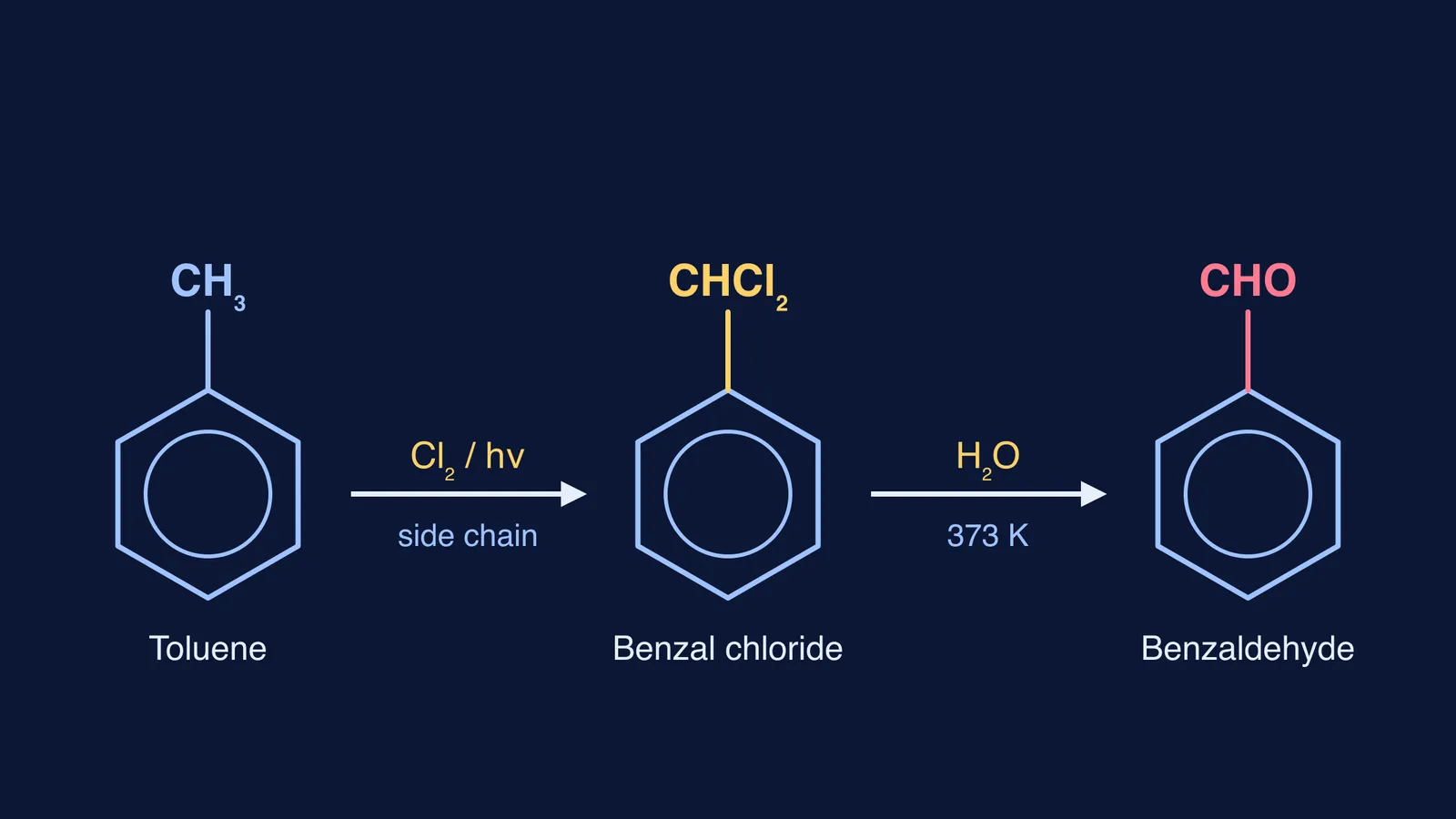
NCERT writes the route in two arrows: toluene with Cl2 and light (hν) gives benzal chloride, C6H5CHCl2, and benzal chloride with water at 373 K gives benzaldehyde (NCERT, section 8.2.2).
Chlorination (free radical). In light, chlorine radicals pull hydrogens off the methyl group, not the ring. Each pass swaps one C–H for one C–Cl: C6H5CH3 goes to C6H5CH2Cl (benzyl chloride), then to C6H5CHCl2 (benzal chloride). Overall: C6H5CH3 + 2Cl2 → C6H5CHCl2 + 2HCl.
Hydrolysis. Water replaces both chlorines on that carbon. Overall: C6H5CHCl2 + H2O → C6H5CHO + 2HCl.
PubChem's manufacturing notes describe benzal chloride as made by chlorinating toluene "in the presence of light" and without catalysts that promote ring chlorination (PubChem: benzal chloride). Add FeCl3 in the dark and chlorine goes onto the ring instead; our post on predicting toluene chlorination products in sunlight vs FeCl3 walks through that contrast.
Why does C6H5CHCl2 give an aldehyde, not an alcohol?
When water replaces both chlorines, the carbon briefly carries two OH groups, C6H5CH(OH)2. Two OH groups on one carbon are unstable, so this gem-diol loses a water molecule and leaves C=O. One chlorine would have given an alcohol; two give an aldehyde.
A quick check is to count the oxidation state of the side-chain carbon. Count each bond to H as −1 and each bond to Cl or O as +1:
CH3 in toluene: −3
CH2Cl in benzyl chloride: −1, and hydrolysis gives CH2OH (benzyl alcohol), also −1
CHCl2 in benzal chloride: +1, and CHO in benzaldehyde is also +1
CCl3 in benzotrichloride: +3, and COOH in benzoic acid is also +3
Hydrolysis does not change the oxidation state, so the number of chlorines decides the product. That is why over-chlorination is a real risk: PubChem notes that benzotrichloride hydrolyses in moist conditions to benzoic and hydrochloric acids (PubChem: benzotrichloride).
Worked example: how much benzaldehyde from one mole of toluene?
PubChem quotes a 70% yield of benzal chloride when about 2.0 to 2.2 moles of chlorine are used per mole of toluene (PubChem: benzal chloride). Take molar masses from PubChem: toluene 92.14 g/mol (PubChem: toluene), benzal chloride 161.03 g/mol (PubChem) and benzaldehyde 106.12 g/mol (PubChem: benzaldehyde).
Start with 92.14 g of toluene, which is 1.00 mol.
At 70% yield you get 0.70 mol of benzal chloride, or 0.70 × 161.03 = 112.7 g.
Hydrolysis is 1:1, so complete hydrolysis would give at most 0.70 mol of benzaldehyde, or 0.70 × 106.12 = 74.3 g.
Any toluene stopped at benzyl chloride or pushed on to benzotrichloride gives benzyl alcohol or benzoic acid on hydrolysis instead.
How is this different from the Etard reaction?
In the Etard reaction, chromyl chloride (CrO2Cl2) in CS2 oxidises the methyl group to a chromium complex, which is hydrolysed to benzaldehyde. NCERT also lists a second oxidation route, chromic oxide in acetic anhydride, which gives benzylidene diacetate first (NCERT, section 8.2.2). Both stop oxidation at the aldehyde by trapping the carbon in an intermediate that is hard to oxidise further.
The chlorination route avoids chromium reagents altogether and uses chlorine and water. PubChem's summary of manufacture says benzaldehyde "is produced principally by the hydrolysis of benzal chloride or the partial oxidation of toluene" (PubChem: benzaldehyde). The same page credits air oxidation of toluene with most synthetic benzaldehyde, so chlorination is one commercial route, not the only one. If you are revising all the aldehyde routes together, compare this with the Rosenmund, Stephen and Etard reactions and with the Gattermann-Koch route from benzene.
What should you check before answering an exam question?
Use this short checklist whenever toluene and chlorine appear in a question:
Condition: hν or heat means side chain; FeCl3 or AlCl3 in the dark means ring.
Count the chlorines: one gives benzyl alcohol, two give benzaldehyde, three give benzoic acid after hydrolysis.
Name the intermediate: C6H5CHCl2 is benzal chloride (IUPAC: dichloromethylbenzene).
Write the by-product: every C–Cl formed releases HCl, and hydrolysis releases more.
Pick the route asked for: the route NCERT calls "a commercial method" is chlorination plus hydrolysis; "chromyl chloride" points to Etard.
If a conversion question still trips you up, the Fermi Problem Library has worked problems with a step-by-step solver that explains the reasoning rather than printing an answer. To revisit free-radical substitution or gem-diols on their own, the Fermi Concept Library gives each chemistry concept its own lesson.


