

On this page
When you are studying organic chemistry for your exams, you frequently come across compounds containing two halogen atoms. These dihalides pop up everywhere in reaction sequences. The terminology tells you exactly where those halogens are attached on the carbon chain. The two most common spatial arrangements you need to know are geminal and vicinal dihalides.
What is the difference between geminal and vicinal dihalides?
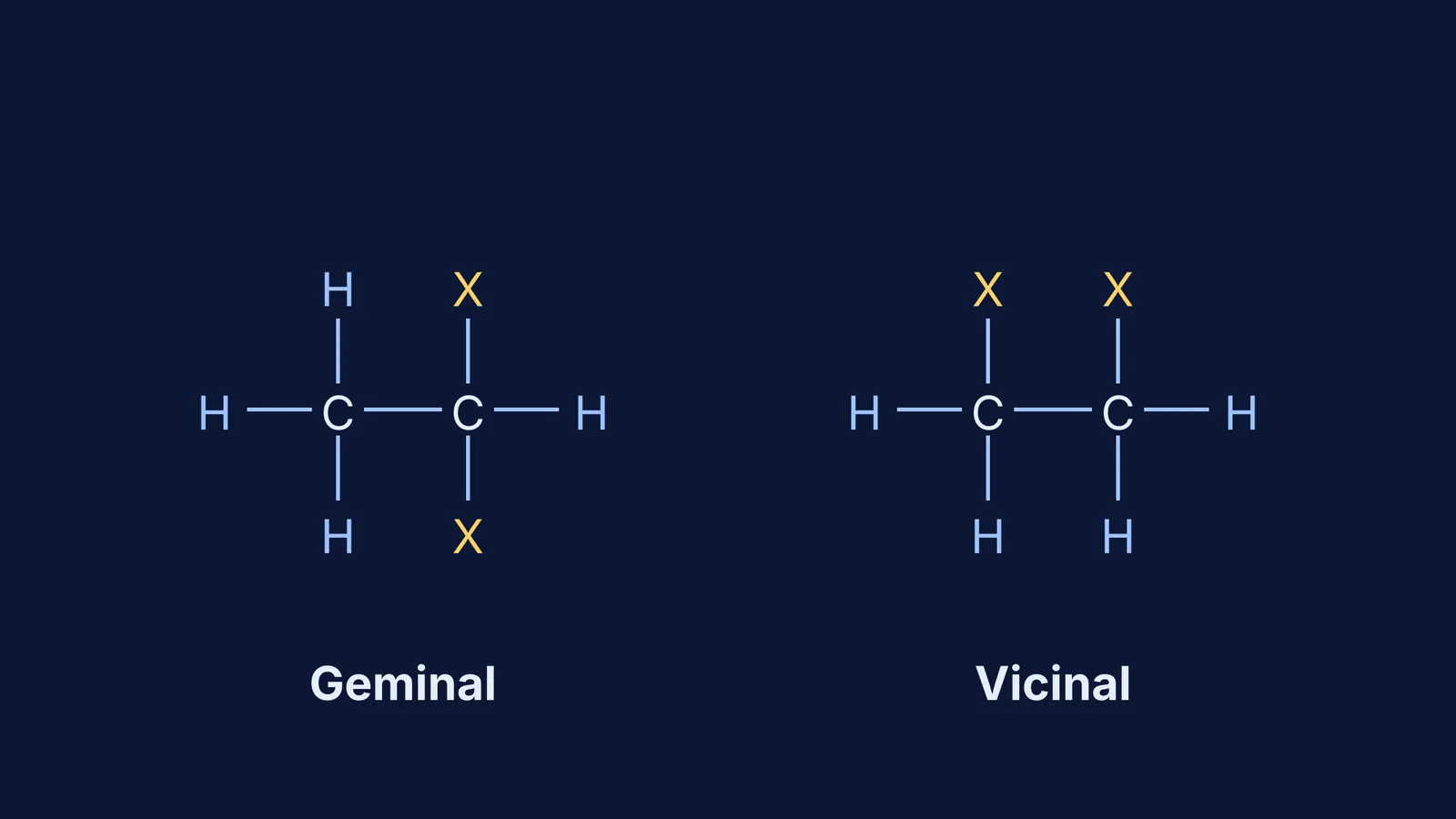
The core difference lies in the structural position of the two halogen atoms.
Geminal dihalides: Both halogen atoms are attached to the exact same carbon atom (source).
Vicinal dihalides: The two halogen atoms are attached to adjacent, neighbouring carbon atoms (source)).
Understanding this geometry is crucial. Functional groups attached to the same atom often behave very differently from when they are separated by a carbon-carbon bond.
What are their common names?
In standard IUPAC nomenclature, you simply use numbers to show the positions of the halogens. For example, 1,1-dichloroethane is a geminal dihalide, while 1,2-dichloroethane is a vicinal dihalide.
However, organic chemistry problems frequently use their common names, which follow a specific pattern that you need to memorise:
Geminal dihalides are commonly called alkylidene halides. For instance, 1,1-dichloroethane is known as ethylidene chloride.
Vicinal dihalides are commonly called alkylene dihalides. For example, 1,2-dichloroethane is called ethylene dichloride.
How are vicinal dihalides formed?
Vicinal dihalides are the classic product of a halogen addition reaction.
When you react an alkene with a diatomic halogen molecule (such as Br₂ or Cl₂), the carbon-carbon double bond breaks (source). One halogen atom attaches to each of the two adjacent carbons that originally formed the double bond. This electrophilic addition produces a vicinal dihalide.
For example, adding bromine to ethene yields 1,2-dibromoethane. This specific reaction is the chemistry behind the classic bromine water test used in the laboratory. When an alkene is present, the reddish-brown colour of the bromine disappears rapidly as it adds across the double bond to form the colourless vicinal dihalide.
How are geminal dihalides formed?
Unlike vicinal dihalides, geminal dihalides are usually prepared from alkynes rather than alkenes.
When you add two equivalents of a hydrogen halide (like HCl or HBr) to an alkyne, both molecules add across the triple bond to produce a geminal dihalide (source). In this reaction, the addition follows Markovnikov's rule twice. The hydrogen atoms attach to the carbon with more hydrogens, and both halogen atoms end up attaching to the more substituted carbon.
For instance, reacting propyne with two equivalents of HBr gives 2,2-dibromopropane.
Another common method to form geminal dihalides is by treating ketones or aldehydes with phosphorus pentachloride (PCl₅). This reaction replaces the carbonyl oxygen with two chlorine atoms on that same central carbon.
Applying this to your study plan
Organic chemistry can quickly feel like an endless list of definitions and reactions if you try to memorise everything in isolation. If you are struggling to keep track of these addition reactions or mechanism rules, the Fermi Concept Library maps out every concept in chemistry, showing exactly how alkynes and alkenes connect to these halide products. When you need to sit down and practice predicting the products of these reactions, the Fermi Problem Library acts as your AI tutor, explaining the reasoning at every step rather than just giving you the final answer.
Dihalide decision framework
When tackling a reaction pathway question in an exam, use this practical checklist to figure out which dihalide you are making or using:
Check the starting material: Is the reactant an alkene? If you add halogens to it, expect a vicinal dihalide. Is it an alkyne? Adding hydrogen halides will likely give you a geminal dihalide.
Check the reagent: Are you adding a pure halogen like Br₂ (points to vicinal)? Or are you adding excess HX like HBr (points to geminal)?
Verify the common name: If a question asks for "ethylidene chloride", look for the "-idene" suffix to know it is geminal. If it asks for "ethylene dichloride", the "-ene" suffix tells you it is vicinal.
Consider the elimination reaction: If you need to make an alkyne, treating either a geminal or a vicinal dihalide with a strong base (like sodium amide) will cause a double dehydrohalogenation to form the triple bond.
*Related articles:*


