

On this page
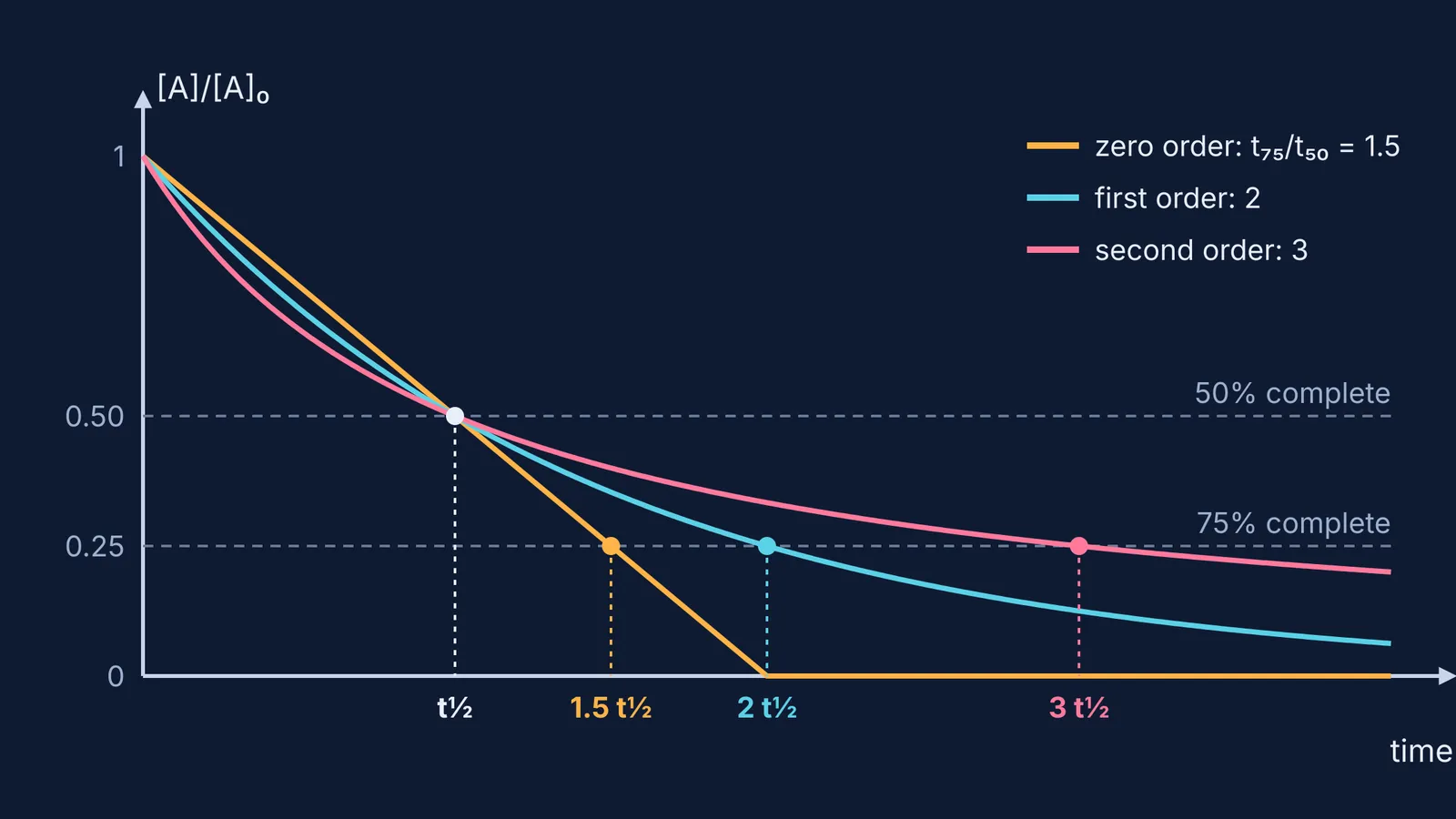
A favourite kinetics question gives you two times and nothing else: a reaction is 50% complete in 20 minutes and 75% complete in 40 minutes, so what is its order? You do not need a graph or a log table. Divide the 75% time by the 50% time. The answer is 1.5 for zero order, 2 for first order, 3 for second order and 5 for third order. This post shows where those numbers come from, works through an example and lists the cases where the trick fails.
What is the t₇₅/t₅₀ ratio for each reaction order?
Write t₅₀ (or t₁/₂) for the time to reach 50% completion and t₇₅ (or t₃/₄) for the time to reach 75% completion, both counted from the start of the reaction. For a reaction with one reactant, rate = k[A]ⁿ:
Zero order: t₇₅/t₅₀ = 1.5
First order: t₇₅/t₅₀ = 2
Second order: t₇₅/t₅₀ = 3
Third order: t₇₅/t₅₀ = 5
Any order n: t₇₅/t₅₀ = 2ⁿ⁻¹ + 1
"75% complete" means 75% has reacted and 25% is left. Read the question twice, because some setters write "75% remaining" to catch you out.
Where does the formula 2ⁿ⁻¹ + 1 come from?
For n ≠ 1, the integrated rate law is:
1/[A]ⁿ⁻¹ − 1/[A]₀ⁿ⁻¹ = (n − 1)kt
Let r be the fraction of A left, so [A] = r[A]₀. Rearranging gives:
t = (r¹⁻ⁿ − 1) ÷ [(n − 1)k[A]₀ⁿ⁻¹]
Everything in the bracket on the bottom is the same at both times, so it cancels when you take a ratio. Only the top survives.
At 50% complete, r = 1/2, so the top is 2ⁿ⁻¹ − 1.
At 75% complete, r = 1/4, so the top is 4ⁿ⁻¹ − 1.
Factorise. 4ⁿ⁻¹ − 1 = (2ⁿ⁻¹)² − 1 = (2ⁿ⁻¹ − 1)(2ⁿ⁻¹ + 1).
Divide. t₇₅/t₅₀ = 2ⁿ⁻¹ + 1.
Check zero order directly. The rate law is [A]₀ − [A] = kt, so t₅₀ = 0.5[A]₀/k and t₇₅ = 0.75[A]₀/k. The ratio is 1.5, matching 2⁻¹ + 1. A zero-order reaction is complete at exactly 2t₁/₂, so reaching 75% at 1.5t₁/₂ is well inside the reaction's lifetime. The shapes of these curves are compared in integrated rate law graphs, which reads order from straight lines rather than from two times.
Why is the ratio exactly 2 for a first-order reaction?
Put n = 1 into the unfactorised ratio and you get (4⁰ − 1)/(2⁰ − 1) = 0/0, which tells you nothing. Use the first-order law instead:
t = (1/k) ln([A]₀/[A])
So t₅₀ = ln 2/k and t₇₅ = ln 4/k = 2 ln 2/k. The ratio is ln 4/ln 2 = 2.
There is a plainer way to see it. A first-order half-life does not depend on concentration, so going from 100% to 50% takes one half-life and going from 50% to 25% takes another. That gives two half-lives to reach 75% complete, and by the same logic three half-lives to reach 87.5%. The same reasoning, pushed further, is in time for 99 percent completion of a first-order reaction.
Why does the ratio grow with order?
For orders above 1, the rate falls faster than the concentration does. Each successive half-life is longer than the last. For second order, t₁/₂ = 1/(k[A]₀), so when the concentration halves, the next half-life doubles. That gives t₇₅ = t₁/₂ + 2t₁/₂ = 3t₁/₂. For zero order it is the reverse: the next half-life is half as long, so t₇₅ = t₁/₂ + 0.5t₁/₂ = 1.5t₁/₂. How t₁/₂ depends on [A]₀ for every order is covered in half-life and initial concentration for any reaction order.
How do you find the order and k from two times?
Problem. A reaction A → products starts with [A]₀ = 0.100 mol L⁻¹ and is 50% complete in 20 min. Find the order and the rate constant if it is 75% complete at (a) 30 min, (b) 40 min, (c) 60 min.
Take the ratio. (a) 30/20 = 1.5, so zero order. (b) 40/20 = 2, so first order. (c) 60/20 = 3, so second order.
Zero order, k. t₁/₂ = [A]₀/(2k), so k = 0.100 ÷ (2 × 20) = 2.5 × 10⁻³ mol L⁻¹ min⁻¹. Check: t₇₅ = 0.075 ÷ 0.0025 = 30 min.
First order, k. k = 0.693 ÷ 20 = 3.47 × 10⁻² min⁻¹. Check: t₇₅ = ln 4 ÷ k = 1.386 ÷ 0.0347 = 40 min.
Second order, k. t₁/₂ = 1/(k[A]₀), so k = 1 ÷ (20 × 0.100) = 0.500 L mol⁻¹ min⁻¹. Check: 1/0.025 − 1/0.100 = 40 − 10 = 30 = 0.500 × t, so t = 60 min.
The units of k confirm each answer: mol L⁻¹ min⁻¹ for zero order, min⁻¹ for first and L mol⁻¹ min⁻¹ for second.
What if the ratio is not a whole-number case? Rearrange: n = 1 + log₂(ratio − 1). A ratio of 2.41 gives 2ⁿ⁻¹ = 1.41, so n − 1 = 0.5 and n = 1.5. Fractional orders do come up, for example in some gas-phase reactions.
When does the t₇₅/t₅₀ method not work?
More than one reactant at different concentrations. The derivation assumes rate = k[A]ⁿ. For A + B with rate = k[A][B], it works only when [A]₀ = [B]₀, because then [A] = [B] throughout and the rate is k[A]².
Pseudo-first-order reactions. If one reactant is in large excess, the ratio comes out as 2. That is the apparent order, not the true order.
Different starting concentrations. Both times must come from the same run with the same [A]₀. For orders other than 1, t₁/₂ changes with [A]₀.
Reversible reactions. If the reaction stops at an equilibrium before 75% conversion, there is no t₇₅ to measure.
One thing that does not matter: whether the rate law is written with a coefficient, such as −½ d[A]/dt for 2A → products. That only changes the value of k, which cancels in the ratio.
For a refresher on the rate laws behind this, the Concept Library covers each order. To practise mixed kinetics questions, the Fermi Problem Library has a step-by-step solver that explains the reasoning.
Quick checklist
Divide t₇₅ by t₅₀, both measured from t = 0.
1.5 means zero order, 2 means first, 3 means second, 5 means third.
General rule: ratio = 2ⁿ⁻¹ + 1, so n = 1 + log₂(ratio − 1).
"75% complete" means 25% left.
For first order, use ln 4/ln 2 = 2, not the 0/0 form.
Use one reactant, or equal starting concentrations for A + B.
Find k from t₁/₂ once you know the order, and check its units.


