

On this page
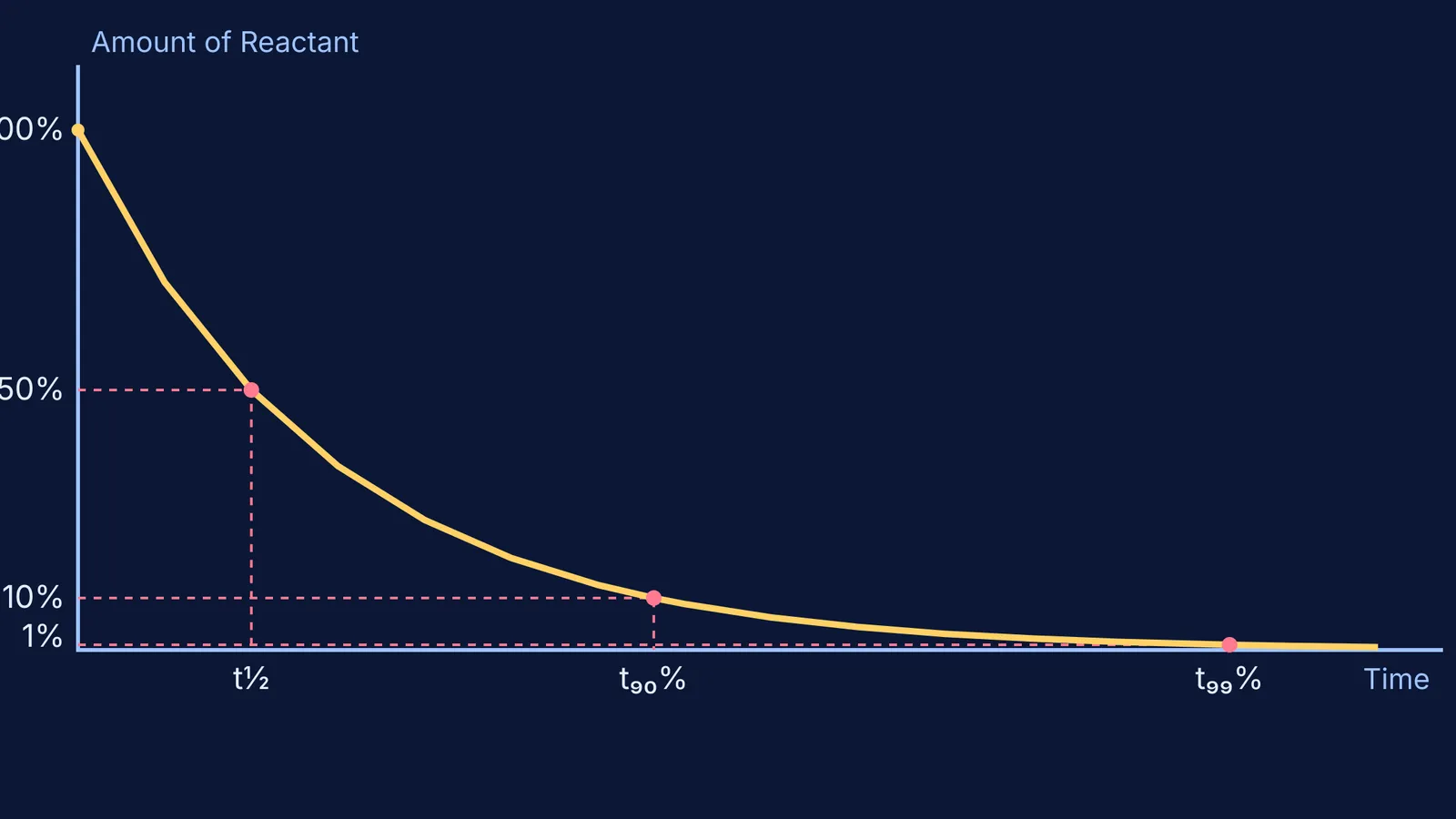
When studying chemical kinetics for exams like JEE or NEET, you will often need to calculate the time required for a reaction to reach a specific percentage of completion. A very common problem asks for the time for 99 percent completion of a first-order reaction. According to the rate equation, whether you are dealing with radioactive decay, drug clearance in the human body, or simple chemical decomposition, the mathematics remains exactly the same.
The time t is given by t = (2.303 / k) log(a / (a - x)), where a is the initial concentration, x is the amount reacted, and k is the rate constant. Let us see how to use this to find the exact completion times and learn the shortcuts that save time in competitive exams.
How to find the time for 99 percent completion?
Based on the rate equation, for a reaction to be 99% complete, the amount reacted is x = 0.99a. The amount of reactant remaining is simply the initial amount minus the reacted amount, which gives a - x = a - 0.99a = 0.01a.
By plugging this remaining fraction into the formula, we get the time for 99% completion: t₉₉% = (2.303 / k) log(a / 0.01a) t₉₉% = (2.303 / k) log(100)
Since log(100) = 2, this simplifies neatly to a clean formula: t₉₉% = 2 × (2.303 / k) = 4.606 / k.
Why is the time for 99% completion twice that for 90%?
This is a classic question based on the rate equation that appears frequently in multiple-choice tests. To prove it mathematically, we first need to find the time required for 90% completion (t₉₀%).
For 90% completion, the amount reacted is x = 0.90a, leaving an unreacted amount of a - x = 0.10a. Substituting this into the equation gives: t₉₀% = (2.303 / k) log(a / 0.10a) t₉₀% = (2.303 / k) log(10)
Since log(10) = 1, we get the expression: t₉₀% = 2.303 / k.
Now, if we compare the two results: t₉₉% = 4.606 / k t₉₀% = 2.303 / k
We can clearly see that t₉₉% = 2 × (2.303 / k) = 2 × t₉₀%.
Therefore, it takes exactly twice as long for the reaction to go from 0 to 99% as it does to go from 0 to 90%. Once you understand this relationship, you can instantly double the 90% time to find the 99% time without touching a calculator. If you ever get stuck on questions like this while practicing, the Fermi Problem Library has worked problems with a step-by-step solver that explains the reasoning rather than printing an answer.
How many half-lives does 99% and 99.9% completion take?
The half-life (t½) is defined from the rate equation as the time needed for 50% of the initial reactant to be consumed. Here, x = 0.5a and the remaining amount is a - x = 0.5a. t½ = (2.303 / k) log(a / 0.5a) = (2.303 / k) log(2). Given the standard value log(2) ≈ 0.301, the half-life formula becomes t½ = 0.693 / k.
To find out exactly how many half-lives make up t₉₉%, we divide the formula for t₉₉% by the formula for t½: (4.606 / k) / (0.693 / k) = 4.606 / 0.693 ≈ 6.64. So, 99% completion takes roughly 6.64 half-lives. This is a very useful fact when tracking radioactive isotopes, which follow first-order kinetics.
What about 99.9% completion? In this case, the reaction is almost entirely finished. We have x = 0.999a, leaving just 0.001a unreacted. t₉₉.₉% = (2.303 / k) log(a / 0.001a) = (2.303 / k) log(1000). Since log(1000) = 3: t₉₉.₉% = 3 × (2.303 / k) = 6.909 / k.
Dividing this new time by the half-life gives: (6.909 / k) / (0.693 / k) = 9.97 ≈ 10. This means 99.9% completion is effectively reached after exactly 10 half-lives. You can also easily see that 99.9% completion takes exactly three times as long as 90% completion, since log(1000) is 3 while log(10) is 1.
Why is the first-order half-life independent of concentration?
A unique feature of the first-order rate equation is that its half-life formula, t½ = 0.693 / k, does not contain the initial concentration term, a. This means that the half-life is entirely independent of how much reactant you start with. Whether you begin with a massive sample of a radioactive isotope or just a tiny speck, it will always take the exact same amount of time to reduce the amount by half.
This constant half-life is the fundamental reason why radioactive dating techniques, such as carbon-14 dating, are so reliable for determining the age of ancient artifacts. It also explains why the time for 99% completion (which is roughly 6.64 half-lives) remains constant regardless of the starting concentration. In contrast, for a zero-order reaction, the half-life decreases as the concentration drops, and for a second-order reaction, the half-life increases as the concentration drops. Remembering this key difference will help you quickly eliminate incorrect options in multiple-choice questions.
A checklist for first-order kinetics problems
When tackling these numerical problems with the rate equation, follow this quick plan to ensure accuracy:
Check the reaction order. These specific log ratios only work for first-order reactions; zero-order and second-order reactions behave differently.
Identify what is asked. Are you looking for the time, the rate constant, or the percentage left?
Convert percentages into fractions of a (the initial concentration). For example, 75% completion means 0.25a is left.
Recall your standard logarithm values: log(2) ≈ 0.301, log(3) ≈ 0.477, log(5) ≈ 0.699, and log(10) = 1.
Use the shortcuts. If you know t₉₉% = 2 × t₉₀%, you can skip the full log calculation if t₉₀% is already known.
Verify the answer logic. Since t₉₉% is about 6.6 half-lives, an answer that is much larger or smaller than 6.6 times the half-life should immediately raise a red flag.
Mastering these mathematical shortcuts is just as important as reading integrated rate law graphs or understanding why rates change using the temperature coefficient of reaction rate. With deliberate practice, chemical kinetics will become second nature.


