

On this page
Statement and match-the-list questions appear in recent NEET papers and are slow: you judge several claims at once. These eight original questions, easy to hard, cover ray optics in Physics Unit 16 of the NMC syllabus for NEET (UG)-2026. Facts follow Chapter 9 of NCERT Class 12 Physics Part II (Reprint 2026-27), with the Cartesian sign convention. New to the chapter? Read how to prepare optics for NEET first.
Key for Q1 and Q3: (1) Both correct (2) Both incorrect (3) I correct, II incorrect (4) I incorrect, II correct.
Statement questions: which ones are true?
Q1 (easy, statements). Statement I: For a spherical mirror of small aperture, the focal length is half the radius of curvature. Statement II: The magnification of a real image formed by a concave mirror is positive.
Answer: (3). I is NCERT's f = R/2. II is false: a real image is inverted, so m = −v/u is negative.
Trap: (1) equates "real" with "positive".
Q2 (easy, statements). Which are correct?
A. n₁₂ = 1/n₂₁. B. A ray entering an optically denser medium bends away from the normal. C. A ray crossing a parallel-sided glass slab emerges parallel to the incident ray, shifted sideways. D. An optical fibre's core has a higher refractive index than its cladding. E. For light going from a denser to a rarer medium, the critical angle is the angle of incidence for which the angle of refraction is 90°.
(1) A, C and D only (2) A, C, D and E only (3) A, B, C and E only (4) B, C, D and E only
Answer: (2). A is NCERT Eq. 9.11. B: n₂₁ > 1 gives r < i, towards the normal. C: the two refractions cancel. D and E are NCERT text.
Trap: (1) rejects E, NCERT's own definition.
Q3 (medium, statements). Statement I: A convex mirror of focal length 20 cm forms the image of an object 30 cm in front of it 60 cm behind the mirror. Statement II: An object 12 cm from a concave mirror of focal length 16 cm gives an erect image four times its size.
Answer: (4). I: 1/v = 1/20 + 1/30 = 1/12, so v = +12 cm. II: 1/v = −1/16 + 1/12 = 1/48, v = +48 cm, m = −v/u = +4.
Trap: (1). 60 cm comes from 1/20 − 1/30, dropping the sign of u.
Q4 (hard, statements). A thin biconvex lens (n = 1.6) has radii 20 cm and 60 cm. Which are correct?
A. Its focal length is 25 cm. B. Turned around, its focal length changes. C. Its power is +4 D. D. A biconcave lens of the same glass and radii has focal length −25 cm. E. The lenses in A and D, in contact, act as a converging lens.
(1) A, C and D only (2) A, B and C only (3) A, C, D and E only (4) B, C and D only
Answer: (1). A: 1/f = 0.6 × (1/20 + 1/60) = 1/25. B: reversing gives R₁ = +60, R₂ = −20, the same sum. C: 1/0.25 m = 4 D. D: both signs flip. E: +4 − 4 = 0 D, a plane sheet.
Trap: (2) thinks the face light meets first sets f.
Match-the-list questions: can you pair them in one pass?
Q5 (easy, match). List-I: (A) Optical fibre (B) Simple microscope (C) Compound microscope objective (D) Reflecting telescope's mirror objective. List-II: (I) Real, inverted, magnified image near the eyepiece (II) Repeated total internal reflection (III) No chromatic aberration; supported over its whole back (IV) Object within one focal length gives an erect, magnified, virtual image.
(1) A-II, B-I, C-IV, D-III (2) A-II, B-IV, C-I, D-III (3) A-III, B-IV, C-I, D-II (4) A-II, B-IV, C-III, D-I
Answer: (2). Each pair is NCERT's description.
Trap: (1) swaps the two microscope lenses.
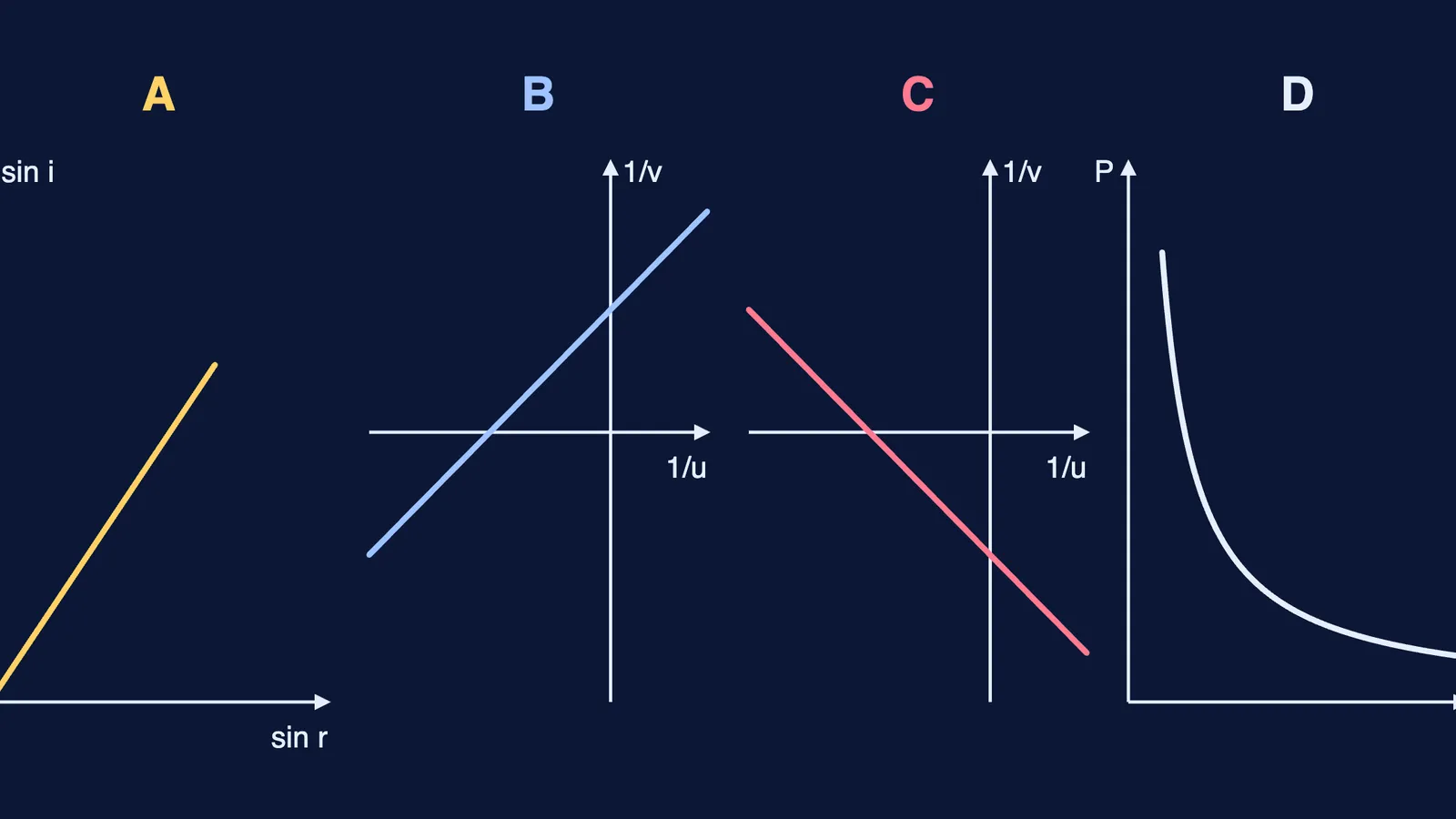
Q6 (medium, match). Match each plot (diagram at the top) to its shape. List-I: (A) sin i against sin r, air into glass (B) 1/v against 1/u, convex lens (C) 1/v against 1/u, concave mirror (D) Lens power against focal length. List-II: (I) Line of slope −1 (II) Rectangular hyperbola (III) Line through the origin, slope above 1 (IV) Line of slope +1, not through the origin.
(1) A-III, B-I, C-IV, D-II (2) A-II, B-IV, C-I, D-III (3) A-III, B-IV, C-II, D-I (4) A-III, B-IV, C-I, D-II
Answer: (4). A: sin i = n₂₁ sin r, n₂₁ > 1. B: 1/v = 1/u + 1/f. C: 1/v = −1/u + 1/f. D: Pf = 1.
Trap: (1) swaps the lens and mirror slopes.
Q7 (medium, match). List-I: (A) Ray through a thin lens's optical centre (B) Ray parallel to the axis, hitting a concave mirror (C) Ray heading towards a convex mirror's centre of curvature (D) Ray in glass hitting the glass-air surface beyond the critical angle. List-II: (I) Passes through the focus (II) Totally reflected (III) Retraces its path (IV) Emerges undeviated.
(1) A-IV, B-I, C-III, D-II (2) A-III, B-I, C-IV, D-II (3) A-IV, B-II, C-III, D-I (4) A-IV, B-I, C-II, D-III
Answer: (1). A and B are NCERT ray rules. C travels along a normal. D cannot refract.
Trap: (2) swaps "undeviated" and "retraces".
Q8 (hard, match). A thin convex lens has f = 12 cm. Match object distance to magnification. List-I: (A) 36 cm (B) 24 cm (C) 18 cm (D) 6 cm. List-II: (I) +2 (II) −2 (III) −1 (IV) −0.5.
(1) A-IV, B-III, C-I, D-II (2) A-III, B-IV, C-II, D-I (3) A-IV, B-III, C-II, D-I (4) A-II, B-III, C-IV, D-I
Answer: (3). With 1/v = 1/f + 1/u and m = v/u: A v = 18, m = −0.5; B v = 24, m = −1; C v = 36, m = −2; D v = −12 cm, m = +2.
Trap: (1) flips C and D; only the virtual image is erect.
How do you work these faster?
Judge definition statements first; strike clashing options.
In a match, fix one sure pair ("retraces its path") and cancel options.
Mirrors: m = −v/u. Lenses: m = v/u. Decide before using numbers.
Next, read how to solve NEET match-the-list questions or try the ray optics NEET practice set.
Lost a sign? The Fermi Problem Library has worked problems with a step-by-step solver that explains the reasoning rather than printing an answer.


