

On this page
Statement and match-the-list questions appear in recent JEE Main papers. These original questions follow Unit 16 of the NTA syllabus for JEE (Main) 2027 and NCERT Class 12 Physics, Chapter 9. Plan: how to prepare ray optics for JEE Main. Take c = 3 × 10⁸ m/s.
Statement questions: how do you judge them?
Options for I/II: (1) Both true (2) Both false (3) I true, II false (4) I false, II true.
Q1 (easy, statements). Statement I: With the incident ray fixed, a plane mirror turned 12° about an axis in its surface, normal to the plane of incidence, turns the reflected ray 24°. Statement II: An object 18 cm in front of a concave mirror of focal length 12 cm forms a real image 36 cm in front of the mirror, half the size of the object.
Answer: (3). I true: the reflected ray turns 2 × 12°. II false: 1/v = −1/12 + 1/18, v = −36 cm, but m = −v/u = −2. Trap: (1) takes m = u/v.
Q2 (easy, statements). Glass n = 1.5, water n = 4/3. Which are correct? A. Light's speed in glass is 2 × 10⁸ m/s. B. Glass relative to water has n = 9/8. C. From glass into water, sin C = 8/9. D. A ray in glass hitting water at 60° incidence is totally reflected. E. 600 nm light (vacuum) has wavelength 900 nm in glass.
(1) A, B, C and D only (2) A, B and C only (3) A, C and E only (4) B, C and D only
Answer: (2). A: c/n. B: 1.5 ÷ 4/3. C: 1/(9/8). D false: C ≈ 62.7° > 60°. E false: λ/n = 400 nm. Trap: (1) assumes 60° exceeds C.
Q3 (medium, statements). An equiconvex lens (n = 1.5) has f = 20 cm in air. Statement I: In a liquid of n = 1.25, f = 40 cm. Statement II: In a liquid of n = 1.6, it diverges with f = −160 cm.
Answer: (4). f scales as 0.5/(n_glass/n_liquid − 1). I false: 50 cm. II true: 0.5/(−0.0625) × 20 = −160 cm. Trap: (3) uses n_glass − n_liquid: 40 and −100 cm.
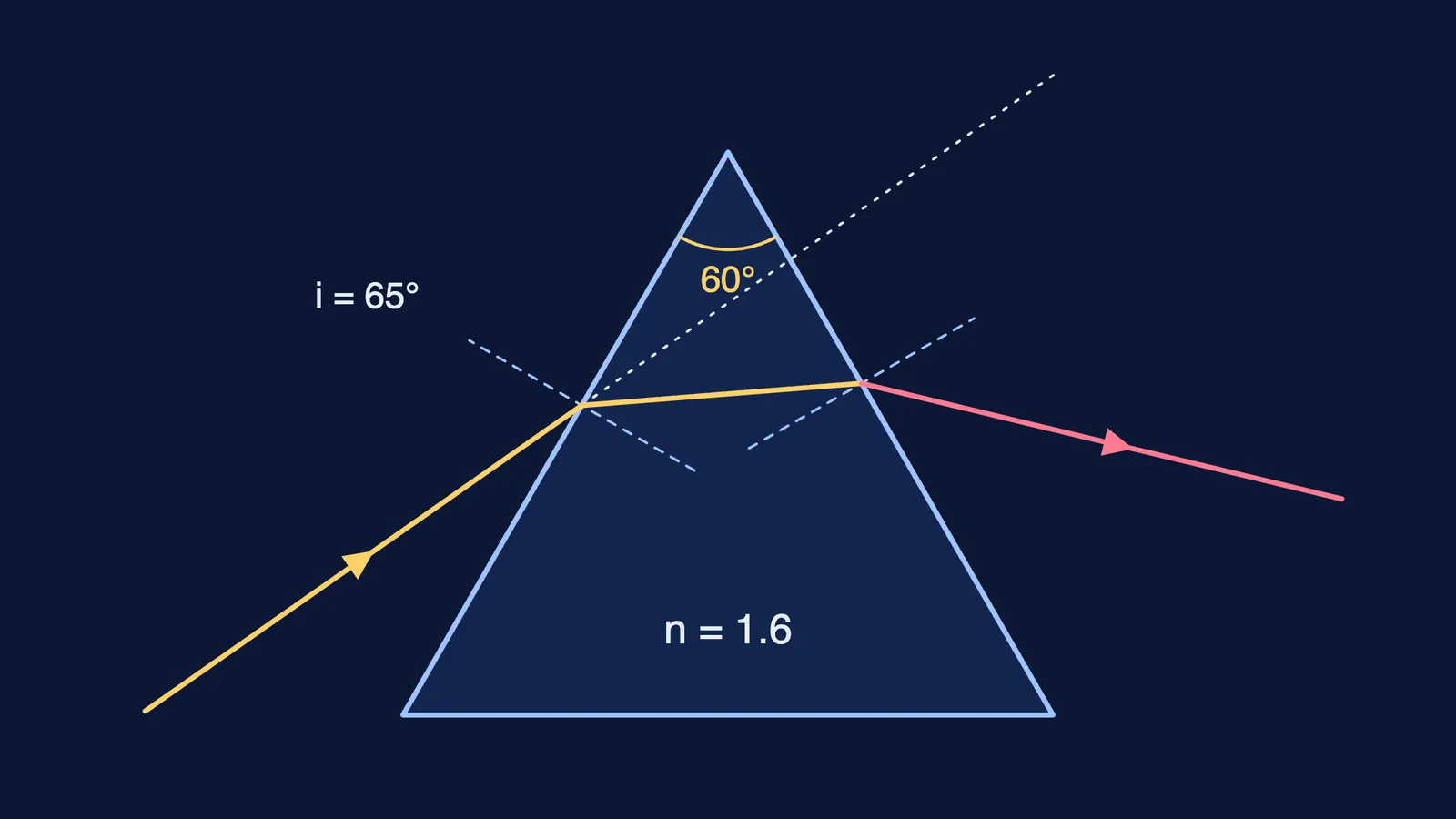
Q4 (hard, statements). A 60° prism has n = 1.6. Which are correct? A. Minimum deviation is about 46.3°. B. Then the angle of incidence is about 53.1°. C. A ray incident at 33° emerges. D. Emergence is grazing at i ≈ 35.6°, deviation ≈ 65.6°. E. No ray emerges from a 75° prism of this glass.
(1) A, B, C and D only (2) A, B, D and E only (3) A, C and E only (4) A, B and D only
Answer: (4). A, B: r = 30°, sin i = 0.8, i ≈ 53.1°, δ = 2i − A. C false: C ≈ 38.7°; at i = 33°, r2 ≈ 40.1° > C, totally reflected. D true: r2 = C needs r1 ≈ 21.3°; δ = i + 90° − A. E false: rays emerge while A < 2C ≈ 77.4°. Trap: (1) skips the r2 check.
Match-the-list questions: how do you pair them?
Q5 (easy, match). Focal lengths in air. List-I: A. Plano-convex, n = 1.5, R = 10 cm B. Equiconcave, n = 1.5, R = 30 cm C. +6 D and −2 D in contact D. Two lenses like A in contact. List-II: I. +10 cm II. +20 cm III. −30 cm IV. +25 cm
(1) A-I, B-III, C-IV, D-II (2) A-II, B-I, C-IV, D-III (3) A-II, B-III, C-IV, D-I (4) A-II, B-III, C-I, D-IV
Answer: (3). A: 1/f = 0.5/10, 20 cm. B: 1/f = 0.5(−2/30), −30 cm. C: +4 D, 25 cm. D: powers add, 10 cm. Trap: (1) takes f = R, valid only for an equiconvex lens with n = 1.5.
Q6 (medium, match). A point object in air lies on the axis of a glass block (n = 1.5) with a convex face of radius 10 cm. List-I (object distance): A. Very far B. 60 cm C. 30 cm D. 10 cm. List-II: I. Real, 30 cm inside II. Real, 45 cm inside III. Real, 90 cm inside IV. Virtual, 30 cm in front
(1) A-I, B-II, C-III, D-IV (2) A-I, B-III, C-II, D-IV (3) A-IV, B-II, C-III, D-I (4) A-I, B-II, C-IV, D-III
Answer: (1). 1.5/v = 0.05 + 1/u: A 30 cm, B 45 cm, C 90 cm, D −30 cm (virtual). Trap: (2) moves the image the wrong way.
Q7 (medium, match). An astronomical telescope has fo = 90 cm, fe = 6 cm. List-I: A. Magnifying power, image at infinity B. Tube length, image at infinity C. Magnifying power, image at 25 cm D. Tube length, image at 25 cm. List-II: I. 15 II. 18.6 III. 96 cm IV. 94.8 cm
(1) A-I, B-IV, C-II, D-III (2) A-II, B-III, C-I, D-IV (3) A-II, B-IV, C-I, D-III (4) A-I, B-III, C-II, D-IV
Answer: (4). A: fo/fe = 15. B: fo + fe = 96 cm. C: 15(1 + 6/25) = 18.6. D: 1/ue = −1/25 − 1/6, |ue| ≈ 4.84 cm, tube ≈ 94.8 cm. Trap: (1) lengthens the tube; the eyepiece moves in.
Q8 (hard, match). Object and screen are 125 cm apart; a convex lens (f = 20 cm) gives a sharp image at two positions. List-I: A. Gap between the two positions B. Image distance for the magnified image C. Least object-screen distance for this lens D. Focal length giving only one position at 125 cm. List-II: I. 31.25 cm II. 75 cm III. 100 cm IV. 80 cm
(1) A-III, B-II, C-IV, D-I (2) A-II, B-III, C-IV, D-I (3) A-II, B-III, C-I, D-IV (4) A-IV, B-III, C-II, D-I
Answer: (2). 1/x + 1/(125 − x) = 1/20: x = 25 or 100 cm. A: 75 cm. B: magnified needs |v| > |u|, so v = 100 cm. C: real roots need D ≥ 4f = 80 cm. D: f = 125/4. Trap: (1) swaps A and B.
How do you work these faster?
Sign u, v, f and R first.
In liquids, use n_glass/n_liquid, not a difference.
For a prism, test r2 against C.
In a match, fix the surest pair, then strike options.
Lost a sign? The Fermi Problem Library has worked problems with a step-by-step solver that explains the reasoning rather than printing an answer. Next: our ray optics JEE Main practice questions with solutions.


