

On this page
Statement and match-the-list questions appear in recent NEET papers. These eight original questions cover Physics Unit 7 of the NMC's NEET (UG)-2026 syllabus, checked against NCERT Class 11 Physics (Reprint 2026-27) Chapters 8, 9 and 10. Take g = 10 m/s². New to the unit? Read how to prepare Properties of Solids and Liquids for NEET.
What do statement questions on solids and liquids look like?
Options for Q1 and Q3: (1) Both correct. (2) Both incorrect. (3) I correct, II incorrect. (4) I incorrect, II correct.
Q1 (easy, statements). Statement I: Surface tension can be given in N m⁻¹ or in J m⁻². Statement II: Compressibility is the reciprocal of Young's modulus.
Answer: (3). I is correct: NCERT calls it force per unit length or surface energy per unit area. II is incorrect: NCERT defines compressibility as 1/B, the reciprocal of the bulk modulus.
Trap: (1) mixes up Young's and bulk moduli.
Q2 (medium, statements). Which are correct? A. Blood is more viscous than water. B. The SI unit of viscosity is the poiseuille, equal to N s m⁻². C. A sphere's terminal velocity in a fluid is proportional to the fluid's viscosity. D. In steady flow through a pipe, the liquid layer touching the wall is at rest. E. Surface tension belongs to a single liquid alone, whatever it touches.
(1) A, B, C and D only (2) B, D and E only (3) A, B and D only (4) A, C and E only
Answer: (3). A and B are true, per NCERT. C is false: v_t = 2a²(ρ − σ)g/(9η) ∝ 1/η. D is true: flow speed is zero at the walls. E is false: NCERT ties surface energy to an interface, not one fluid.
Trap: (1) forgets that η sits in the denominator.
Q3 (medium, statements). Statement I: Blood carrying heat around the body is natural convection. Statement II: Cooking pots have blackened bottoms because black surfaces absorb radiant heat well.
Answer: (4). I is incorrect: NCERT calls it forced convection, with the heart as the pump. II is correct, as NCERT states.
Trap: (1) skims past "natural".
Q4 (hard, statements). Which statements are correct? A. For a fluid at rest, Bernoulli's equation reduces to P₁ + ρgh₁ = P₂ + ρgh₂. B. A spinning ball gets dynamic lift because air speed relative to it differs above and below. C. Air in a closed water tank is 3.75 × 10⁴ Pa above atmospheric; water leaves a small hole 1.25 m below the surface at 10 m/s. D. Bernoulli's equation applies equally well to honey. E. Bernoulli's equation expresses conservation of linear momentum.
(1) A, B and C only (2) A and B only (3) A, B, C and D only (4) B, C and E only
Answer: (1). A is true: put v = 0 everywhere, as NCERT does. B is the Magnus effect. C: v = √(2gh + 2ΔP/ρ) = √100 = 10 m/s. D is false: it ideally applies to non-viscous fluids. E is false: it expresses energy conservation.
Trap: (2) uses the open-tank 5.0 m/s and rejects C.
What do match-the-list questions on this unit look like?
Q5 (easy, match). Match quantity to dimensions.
List-I: A. Young's modulus; B. Coefficient of viscosity; C. Surface tension; D. Thermal conductivity.
List-II: I. [MLT⁻³K⁻¹]; II. [ML⁻¹T⁻²]; III. [MT⁻²]; IV. [ML⁻¹T⁻¹].
(1) A-IV, B-II, C-III, D-I (2) A-II, B-III, C-IV, D-I (3) A-II, B-IV, C-I, D-III (4) A-II, B-IV, C-III, D-I
Answer: (4). A-II: stress over strain. B-IV: as NCERT gives. C-III: force per length. D-I: K is in W m⁻¹ K⁻¹.
Trap: (1) swaps Y and η, one power of T apart.
Q6 (medium, match). Match application to principle.
List-I: A. Hydraulic brakes in a car; B. Lift on an aeroplane wing; C. Oil rising up a cotton wick; D. Copper coating on the bottom of a cooking pot.
List-II: I. Capillary action; II. Pascal's law; III. High thermal conductivity; IV. Bernoulli's principle.
(1) A-II, B-IV, C-I, D-III (2) A-II, B-I, C-IV, D-III (3) A-IV, B-II, C-I, D-III (4) A-II, B-IV, C-III, D-I
Answer: (1). A-II: brake oil transmits pedal pressure. B-IV: faster air over the wing. C-I: surface tension. D-III: copper spreads heat evenly.
Trap: (3) links brakes to flowing oil.
Q7 (medium, match). Match each relation with the shape of its graph.
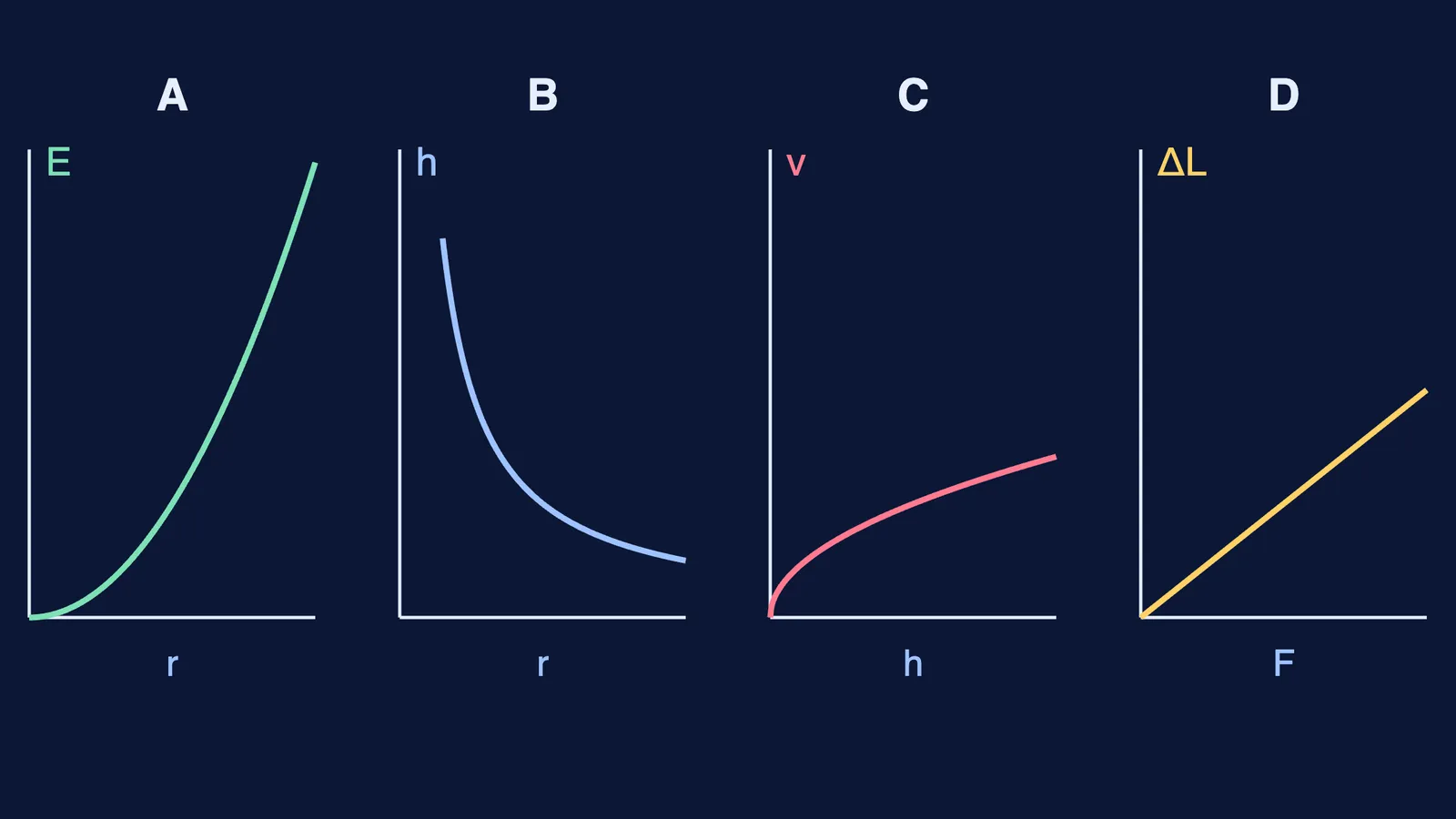
List-I: A. Surface energy of a soap bubble against its radius; B. Capillary rise against tube radius; C. Efflux speed from an open tank against hole depth; D. Extension of a wire against load, within the elastic limit.
List-II: I. Line through the origin; II. y ∝ x²; III. y ∝ 1/x; IV. y ∝ √x.
(1) A-IV, B-III, C-II, D-I (2) A-II, B-III, C-I, D-IV (3) A-II, B-III, C-IV, D-I (4) A-II, B-IV, C-III, D-I
Answer: (3). A-II: two surfaces, so E = 8πr²S ∝ r². B-III: h = 2S cos θ/(ρga). C-IV: v = √(2gh). D-I: Hooke's law, ΔL = FL/(AY).
Trap: (1) puts the square on the wrong graph.
Q8 (hard, match). Match each change with the factor by which the quantity changes.
List-I: A. Capillary rise, tube radius halved and surface tension halved (same density and contact angle); B. Heat current through a rod, radius and length both tripled; C. Power radiated by a black-body sphere, radius quadrupled at fixed temperature; D. Extension of a wire under the same load, length and diameter both doubled.
List-II: I. 16; II. 3; III. 1; IV. 1/2.
(1) A-IV, B-II, C-I, D-III (2) A-III, B-II, C-I, D-IV (3) A-III, B-I, C-II, D-IV (4) A-IV, B-III, C-I, D-II
Answer: (2). A-III: h ∝ S/a = (1/2)/(1/2) = 1. B-II: H ∝ r²/L = 9/3 = 3. C-I: H = AσT⁴ with A ∝ r², so 4² = 16. D-IV: ΔL ∝ L/d² = 2/4 = 1/2.
Trap: (1) ignores squaring the diameter in D.
How do you work these questions faster?
Write the power law first: v_t ∝ a², h ∝ 1/a, v ∝ √h, H ∝ AT⁴.
Convert to kelvin before any T⁴ ratio.
Square every diameter ratio; area goes as d².
In match questions, lock your surest pair and strike codes without it.
Reread adjectives (natural or forced, ideal or viscous); statements turn on one word.
Can't picture why a spinning ball curves? The Fermi Simulation Lab has interactive simulations for ideas easier to see than to read.
For method, see how to solve NEET match-the-list questions, or try Properties of Solids and Liquids NEET practice questions with solutions.


