

On this page
Statement-based and match-the-list questions appear in recent JEE Main papers. Here are eight original ones, easy to hard. Take g = 10 m/s² and P₀ = 1.0 × 10⁵ Pa.
All sit in Physics Unit 7 of NTA's Syllabus for JEE (Main) - 2027 and NCERT Class 11 Physics Chapters 8, 9 and 10 (Reprint 2026-27). Theory first? Read how to prepare Properties of Solids and Liquids for JEE Main.
Statement I/II options: (1) both correct (2) both incorrect (3) I correct, II incorrect (4) I incorrect, II correct.
What do statement questions on this unit look like?
Q1 (easy, Statement I/II). Statement I: Under uniform pressure, a cube's fractional decrease in edge is one-third of that in volume. Statement II: An extra 1.6 × 10⁸ Pa reduces the radius of a steel sphere (B = 1.6 × 10¹¹ Pa) by 0.10%.
Answer: (3). I true: V = a³, so ΔV/V = 3Δa/a. II false: ΔV/V = Δp/B = 0.10%, so the radius falls 0.033%.
Trap: (1), reading volume strain as radius strain.
Q2 (easy, statements). A wire 2.0 m long, cross-section 1.0 mm², stretches 1.0 mm under 100 N. Which are correct? A. Its Young's modulus is 2.0 × 10¹¹ Pa. B. Half of this wire stretches 0.50 mm under 100 N. C. So does a wire of the same material and length but twice the diameter.
(1) A and B only (2) A, B and C (3) B and C only (4) A only
Answer: (1). A true: Y = FL/(AΔL). B true: ΔL ∝ L. C false: four times the area, so 0.25 mm.
Trap: (2), taking ΔL ∝ 1/d instead of 1/d².
Q3 (medium, Statement I/II). Statement I: Steel (Y = 2.0 × 10¹¹ Pa) under a tensile stress of 2.0 × 10⁸ Pa stores 2.0 × 10⁵ J m⁻³ of elastic energy. Statement II: Stretching a soap film (S = 0.050 N m⁻¹) on a frame from 10 cm² to 30 cm² takes 2.0 × 10⁻⁴ J.
Answer: (4). I false: u = σ²/2Y = 1.0 × 10⁵ J m⁻³. II true: two faces, so W = 2SΔA.
Trap: (1), dropping the ½ in the energy density.
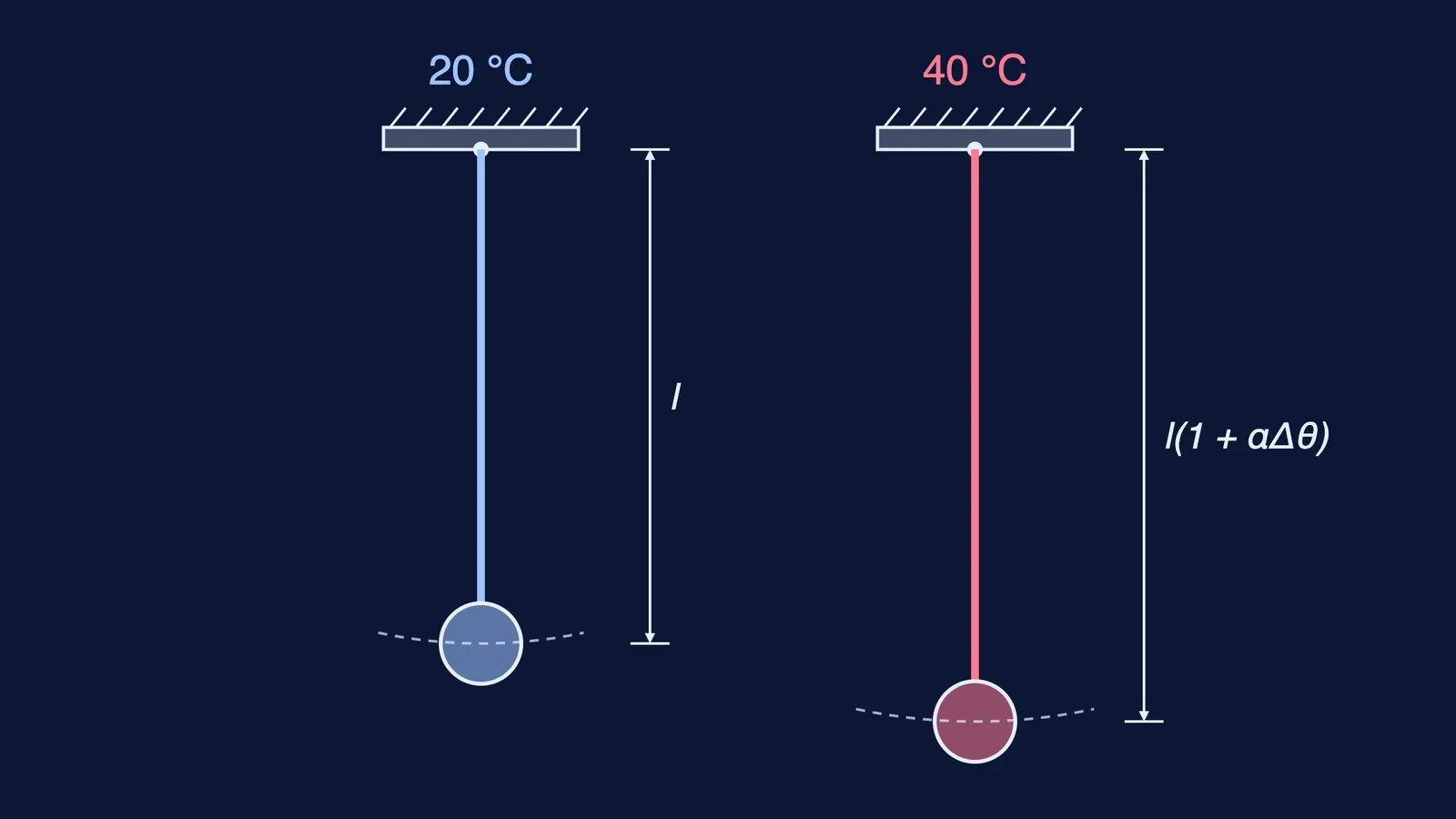
Q4 (hard, statements). Each pendulum clock here keeps correct time at 20 °C. Which are correct? A. A steel one (α = 1.2 × 10⁻⁵ K⁻¹) loses about 10 s a day at 40 °C. B. It gains about 10 s a day at 0 °C. C. A steel one twice as long loses about 20 s a day at 40 °C. D. A brass one (α = 1.9 × 10⁻⁵ K⁻¹) loses about 16 s a day at 40 °C.
(1) A, B and D only (2) A and D only (3) A, B, C and D (4) B, C and D only
Answer: (1). T ∝ √l, so the daily error is ½αΔθ × 86,400 s. A true: about 10.4 s. B true: same size, running fast. C false: independent of l. D true: about 16.4 s.
Trap: (3), thinking longer pendulums lose more.
How do match-the-list questions test it?
Q5 (easy, match). List-I: (A) Gauge pressure 4.0 m under water (B) Absolute pressure there (C) Shear stress on a plate sliding at 0.20 m/s on a 1.0 mm oil film (η = 0.50 Pa s) (D) Pressure drop as water in a level pipe speeds up from 1.0 to 3.0 m/s. List-II: (I) 1.0 × 10² Pa (II) 4.0 × 10³ Pa (III) 4.0 × 10⁴ Pa (IV) 1.4 × 10⁵ Pa
(1) A-IV, B-III, C-I, D-II (2) A-III, B-IV, C-I, D-II (3) A-III, B-IV, C-II, D-I (4) A-II, B-IV, C-I, D-III
Answer: (2). A: ρgh, III. B: add P₀, IV. C: ηv/d, I. D: ½ρ(v₂² − v₁²), II.
Trap: (1), swapping gauge and absolute.
Q6 (medium, match). A metal (linear expansivity α) warms by a small ΔT; match fractional changes. List-I: (A) Area of a plate (B) Density of a block (C) Pressure of a block on the table under it (D) Mass per unit length of a wire. List-II: (I) −αΔT (II) −3αΔT (III) −2αΔT (IV) 2αΔT
(1) A-IV, B-I, C-III, D-II (2) A-III, B-II, C-IV, D-I (3) A-IV, B-II, C-III, D-I (4) A-IV, B-II, C-I, D-III
Answer: (3). A: two lengths grow, IV. B: volume up 3αΔT, II. C: same weight, area up 2αΔT, III. D: length up αΔT, I.
Trap: (2), keeping the area's sign for the pressure.
Q7 (medium, match). A small ball of density 400 kg m⁻³ rises through water (1000 kg m⁻³) under Stokes' law. W is its weight. List-I: (A) Upthrust (B) Drag at terminal speed (C) Drag at a quarter of terminal speed (D) Net upward force at that speed. List-II: (I) 0.375W (II) 1.125W (III) 1.5W (IV) 2.5W
(1) A-III, B-IV, C-I, D-II (2) A-IV, B-III, C-II, D-I (3) A-IV, B-III, C-I, D-II (4) A-II, B-III, C-I, D-IV
Answer: (3). A: (1000/400)W, IV. B: drag and weight both act down, so 2.5W − W, III. C: drag ∝ v, I. D: 2.5W − W − 0.375W, II.
Trap: (1), forgetting the weight, so drag equals upthrust.
Q8 (hard, match). No heat lost; c = 4200 J kg⁻¹ K⁻¹, L = 3.36 × 10⁵ J kg⁻¹; ice at 0 °C. Final temperatures? List-I: (A) 50 g ice + 100 g water at 40 °C (B) 50 g ice + 200 g water at 90 °C (C) 50 g ice + 100 g water at 70 °C (D) 25 g ice + 100 g water at 50 °C. List-II: (I) 0 °C (II) 20 °C (III) 24 °C (IV) 56 °C
(1) A-I, B-IV, C-II, D-III (2) A-II, B-IV, C-I, D-III (3) A-I, B-III, C-II, D-IV (4) A-III, B-IV, C-II, D-I
Answer: (1). A: the water's 16,800 J only just melts the ice, I. B: 840(90 − T) = 16,800 + 210T, IV. C: 420(70 − T) = 16,800 + 210T, II. D: 420(50 − T) = 8400 + 105T, III.
Trap: (2), swapping A and C.
How do you work these faster?
Write area as l² and density as l⁻³; the power times αΔT is the fractional change.
Before any mixing equation, check whether the water can melt all the ice.
On a rising ball, drag and weight both point down.
Phase changes still tripping you up? The Fermi Problem Library has worked problems with a step-by-step solver that explains the reasoning rather than printing an answer.
Then try 8 JEE Main questions on properties of solids and liquids.


