

On this page
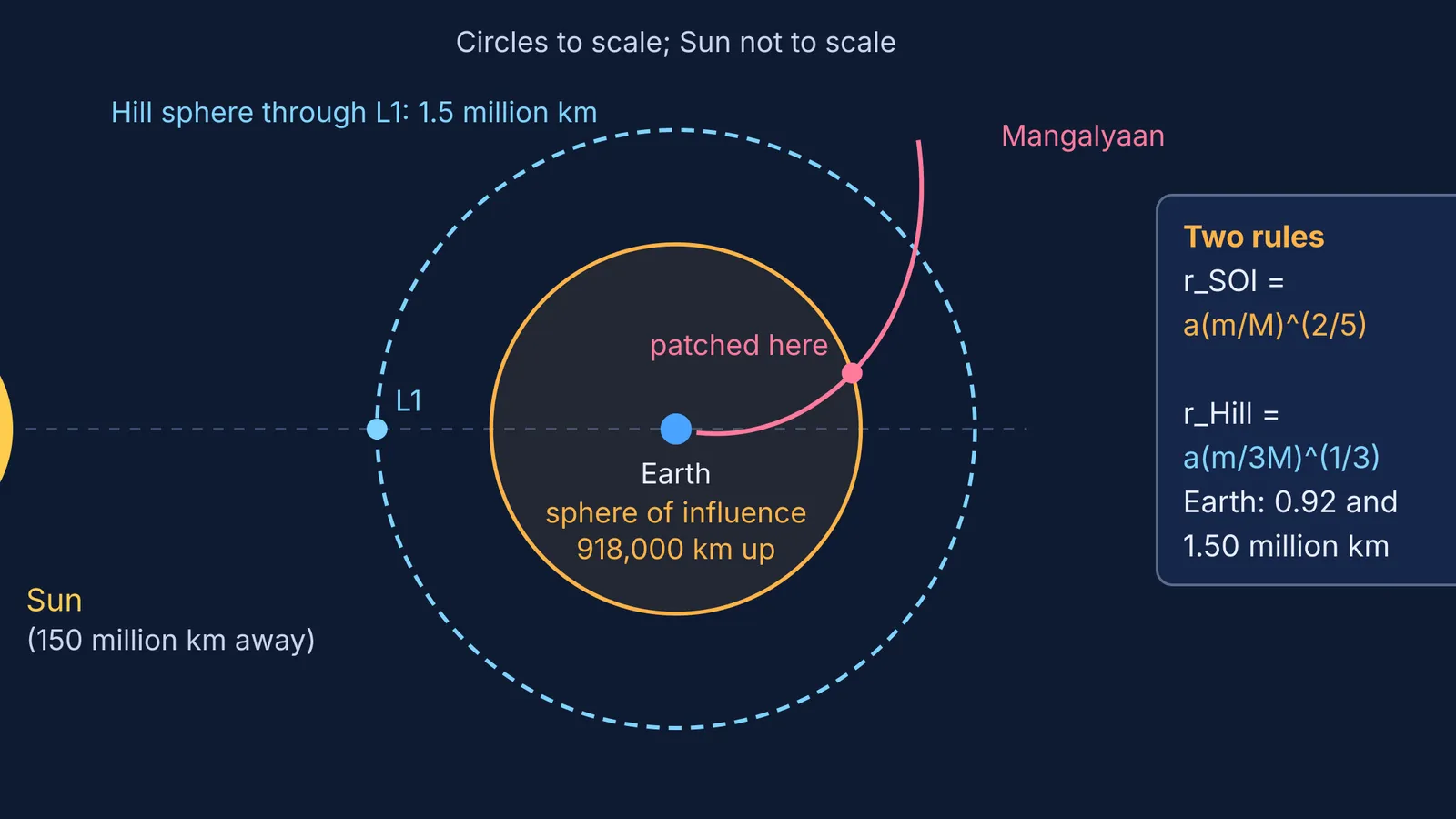
ISRO's Mars Orbiter Mission profile says Earth's sphere of influence "ends at 918347 km from the surface of the earth", beyond which the main disturbing force on the spacecraft comes from the Sun. It gives Mars's sphere of influence as about 573,473 km from the surface of Mars. Where do these numbers come from, and why is the first one smaller than the 1.5 million km to the L1 point where Aditya-L1 sits? One short formula, r = a(m/M)^(2/5), reproduces ISRO's figures to within 0.04%.
What is a planet's sphere of influence?
A spacecraft between Earth and the Sun feels both pulls all the time. Working out its exact path needs a computer. Mission designers start with a simpler picture called the patched conic method: near Earth, treat the craft as moving on a conic (an ellipse or a hyperbola) around Earth alone; far from Earth, treat it as moving on an ellipse around the Sun alone; and switch from one to the other at a boundary. That boundary is the sphere of influence.
So the sphere of influence is a bookkeeping line, not a place where gravity changes. Earth still pulls the craft beyond it, and the Sun still pulls it inside. The question it answers is: which body should you treat as the main attractor, and which as a small disturbance? How Mangalyaan's path was then built from these pieces is covered in the orbit maths that took India to Mars; this post derives the boundary itself.
Why isn't it where Earth's pull equals the Sun's pull?
That is the first guess most students make. Set Gm/r² = GM/a², where m is Earth's mass, M the Sun's mass and a the Earth–Sun distance. Then r = a√(m/M) = 259,000 km, which is inside the Moon's orbit. It cannot be right: the Moon clearly orbits Earth.
The catch is that the Sun pulls Earth too. Near Earth, the Sun accelerates the planet and the spacecraft almost equally, so the two fall towards the Sun together and the craft hardly notices. Only the difference between the Sun's pull on the craft and on Earth disturbs the orbit around Earth. That difference is the tidal pull, about 2GMr/a³ for a craft at distance r from Earth along the Sun–Earth line.
At 924,500 km from Earth's centre the Sun's direct pull on the craft is 5.9 × 10⁻³ m/s², about 13 times Earth's 4.7 × 10⁻⁴ m/s². Yet the tidal part is only 7.3 × 10⁻⁵ m/s², small next to Earth's pull. That is why an Earth-centred orbit still makes sense there.
How do you derive r = a(m/M)^(2/5)?
Laplace's idea was to compare two descriptions and use whichever has the smaller relative disturbance.
Earth-centred description. Main pull: Gm/r². Disturbance: the Sun's tidal pull, 2GMr/a³. Ratio: 2Mr³/(ma³).
Sun-centred description. Main pull: GM/a². Disturbance: Earth's pull, Gm/r². Ratio: ma²/(Mr²).
The boundary is where the two ratios are equal: 2Mr³/(ma³) = ma²/(Mr²).
Rearrange. 2M²r⁵ = m²a⁵, so r⁵ = m²a⁵/(2M²).
Take the fifth root. r = a(m/M)^(2/5) × 2^(−1/5) = 0.87 a(m/M)^(2/5).
The 2/5 power comes from the tidal term, which falls as 1/a³, not from a simple inverse-square balance. The 0.87 depends on how exactly you compare the disturbances; a fuller treatment that compares them in every direction gives a factor close to 1. Mission designers use the standard convention r = a(m/M)^(2/5), and the worked example below shows that this is what ISRO's figures match. It is a rule of thumb with an arbitrary edge, which is fine for a bookkeeping line.
Worked example: Earth's and Mars's spheres of influence
Data: Sun M = 1.989 × 10³⁰ kg; Earth m = 5.972 × 10²⁴ kg at a = 1.496 × 10⁸ km, radius 6,371 km; Mars m = 6.417 × 10²³ kg at a = 2.279 × 10⁸ km, radius 3,390 km.
Mass ratio for Earth. m/M = 5.972 × 10²⁴ / 1.989 × 10³⁰ = 3.00 × 10⁻⁶.
Raise to 2/5. (3.00 × 10⁻⁶)^0.4 = 0.00618.
Multiply by a. r = 1.496 × 10⁸ × 0.00618 = 924,540 km from Earth's centre.
Subtract Earth's radius. 924,540 − 6,371 = 918,170 km from the surface. ISRO's figure is 918,347 km, a difference of 0.02%.
Mars. m/M = 3.23 × 10⁻⁷, so r = 2.279 × 10⁸ × (3.23 × 10⁻⁷)^0.4 = 577,060 km from the centre, or 573,670 km from the surface. ISRO gives 573,473 km, a difference of 0.03%.
The small gaps come from the exact masses and distances ISRO used. The units check is easy: (m/M) has no units, so r has the units of a.
Why is the sphere of influence smaller than the Hill sphere where Aditya-L1 sits?
The L1 point lies at the edge of Earth's Hill sphere, r = a(m/3M)^(1/3). For Earth that is 1.496 × 10⁸ × (1.00 × 10⁻⁶)^(1/3) = 1,496,000 km, the derivation worked in Lagrange and the point where Aditya-L1 watches the Sun. ISRO describes Aditya-L1's halo orbit as roughly 1.5 million km from Earth.
The Hill sphere asks a different question: roughly how far out can Earth hold on to a satellite against the Sun's tidal pull at all? The sphere of influence asks where the simpler sum changes. The Hill radius is 1.6 times larger, because (m/3M)^(1/3) = 0.0100 while (m/M)^(2/5) = 0.0062.
So on its way to L1, Aditya-L1 crossed Earth's sphere of influence first. ISRO announced on 30 September 2023 that the craft had escaped the sphere of Earth's influence, about 9.2 lakh km out, and it went on to L1. Why that point suits a solar observatory is covered in why India studies the Sun from L1.
The same formula works inside the Earth–Moon system. With the Moon's 7.342 × 10²² kg at 384,400 km from Earth, the Moon's sphere of influence is 384,400 × (7.342 × 10²² / 5.972 × 10²⁴)^0.4 = 66,200 km from its centre.
If the difference between a direct pull and a tidal pull still feels slippery, the Concept Library covers every concept in physics, including tidal forces and orbits.
Quick checklist
Sphere of influence: where you switch from a planet-centred orbit to a Sun-centred one.
r = a(m/M)^(2/5), from the planet's centre.
Earth: 924,540 km from the centre, 918,170 km from the surface; ISRO says 918,347 km.
Mars: 577,060 km from the centre, 573,670 km from the surface; ISRO says 573,473 km.
Not where the pulls are equal (259,000 km): only the Sun's tidal pull disturbs an Earth orbit.
Hill sphere (L1, 1.5 million km) is larger and answers a different question.


