

On this page
Statement-based and match-the-list questions appear in recent NEET papers. Here are eight original ones on Physics and Measurement, easy to hard, from Unit 1 of the NMC syllabus for NEET (UG)-2026 and NCERT Class 11 Physics Chapter 1, Units and Measurement (Reprint 2026-27). New to the chapter? Read how to prepare Physics and Measurement for NEET.
Can you judge statements on units and dimensions?
For Statement I/II items: (1) both correct, (2) both incorrect, (3) I correct, II incorrect, (4) I incorrect, II correct.
Q1 (easy, statements). Which are correct? A. 1 W = 1 kg m² s⁻³. B. 1 Pa = 1 kg m⁻² s⁻². C. The kelvin, the SI unit of thermodynamic temperature, is a base unit. D. The coulomb is an SI base unit. E. 1 N s = 1 kg m s⁻¹.
(1) A, B and E only (2) A, C and E only (3) B, C and D only (4) A, D and E only
Answer: (2). A true: J s⁻¹. B false: N m⁻² = kg m s⁻²/m² = kg m⁻¹ s⁻². C true, per NCERT Table 1.1. D false: the ampere is the base unit; 1 C = 1 A s. E true.
Trap: (1), dividing by metres once instead of twice for the pascal.
Q2 (easy, Statement I/II). Statement I: A length of 6.4 × 10⁶ m has order of magnitude 7. Statement II: A length of 0.00052 m has order of magnitude −4.
Answer: (3). NCERT rounds a in a × 10ᵇ to 1 if a ≤ 5, to 10 if 5 < a ≤ 10. I true: 6.4 > 5, so 10⁷ m. II false: 0.00052 m = 5.2 × 10⁻⁴ m, and 5.2 > 5, so 10⁻³ m, order −3.
Trap: (4), reading each exponent straight off as the order.
Q3 (medium, statements). Which are correct? A. An equation that fails the dimensional consistency test is wrong. B. In P = P₀ e^(−αt²), with t a time, α has dimensions [T⁻¹]. C. Dimensional analysis can tell a frequency from an angular velocity. D. In y = a sin(ωt − kx), with x a length, k has dimensions [L⁻¹]. E. A length can be added to a speed multiplied by a time.
(1) A, B and D only (2) B, C and E only (3) A, D and E only (4) A, C and D only
Answer: (3). A true: NCERT says such an equation "is proved wrong". B false: an exponent must be dimensionless, so αt² is [1] and α is [T⁻²]. C false: both are [T⁻¹]. D true: a sine's argument is dimensionless, so kx is too. E true: [L T⁻¹][T] = [L].
Trap: (1), matching α to t instead of t².
Q4 (hard, Statement I/II). With h Planck's constant, G the gravitational constant, c the speed of light and m a mass: Statement I: h/(mc) has the dimensions of length. Statement II: √(hG/c³) has the dimensions of time.
Answer: (3). h = [M L² T⁻¹], G = [M⁻¹ L³ T⁻²], c = [L T⁻¹]. I true: [M L² T⁻¹]/([M][L T⁻¹]) = [L]. II false: hG/c³ = [L⁵ T⁻³]/[L³ T⁻³] = [L²], so the root is a length.
Trap: (1), stopping once M cancels.
How do you match List-I with List-II quickly?
Q5 (easy, match). List-I: (A) Angular momentum (B) Spring constant (C) Moment of inertia (D) Angular acceleration. List-II: (I) [M T⁻²] (II) [T⁻²] (III) [M L²] (IV) [M L² T⁻¹]
(1) A-III, B-I, C-IV, D-II (2) A-IV, B-II, C-III, D-I (3) A-IV, B-I, C-II, D-III (4) A-IV, B-I, C-III, D-II
Answer: (4). A: Iω = [M L² T⁻¹], IV. B: force per extension, [M T⁻²], I. C: mass × distance², III. D: rad s⁻², II.
Trap: (1), swapping angular momentum and moment of inertia.
Q6 (medium, match). Match each calculation with the significant figures in its reported result. List-I: (A) 3.81 m + 0.0425 m (B) 0.42 cm × 125.6 cm (C) 9.47 g − 9.41 g (D) 7.500 g ÷ 2.500 cm³. List-II: (I) 1 (II) 2 (III) 3 (IV) 4
(1) A-III, B-II, C-I, D-IV (2) A-IV, B-II, C-III, D-I (3) A-III, B-I, C-II, D-IV (4) A-II, B-III, C-I, D-IV
Answer: (1). A: 3.8525 keeps two decimal places, 3.85, III. B: 52.752 keeps two figures, 53, II. C: 0.06 g, one figure, I. D: 3.000 g cm⁻³, four, IV.
Trap: (2), giving C its inputs' three figures.
Q7 (medium, match). Match quantities with the same dimensions. List-I: (A) Surface tension × area (B) Gravitational potential (C) Strain (D) Velocity gradient, dv/dx. List-II: (I) Angular frequency (II) Torque (III) Square of speed (IV) Refractive index
(1) A-II, B-I, C-IV, D-III (2) A-III, B-II, C-IV, D-I (3) A-II, B-III, C-IV, D-I (4) A-II, B-III, C-I, D-IV
Answer: (3). A: [M T⁻²][L²] = [M L² T⁻²], II. B: energy per mass, [L² T⁻²], III. C: dimensionless, like refractive index, IV. D: [L T⁻¹]/[L] = [T⁻¹], I.
Trap: (2), giving potential the mass of potential energy.
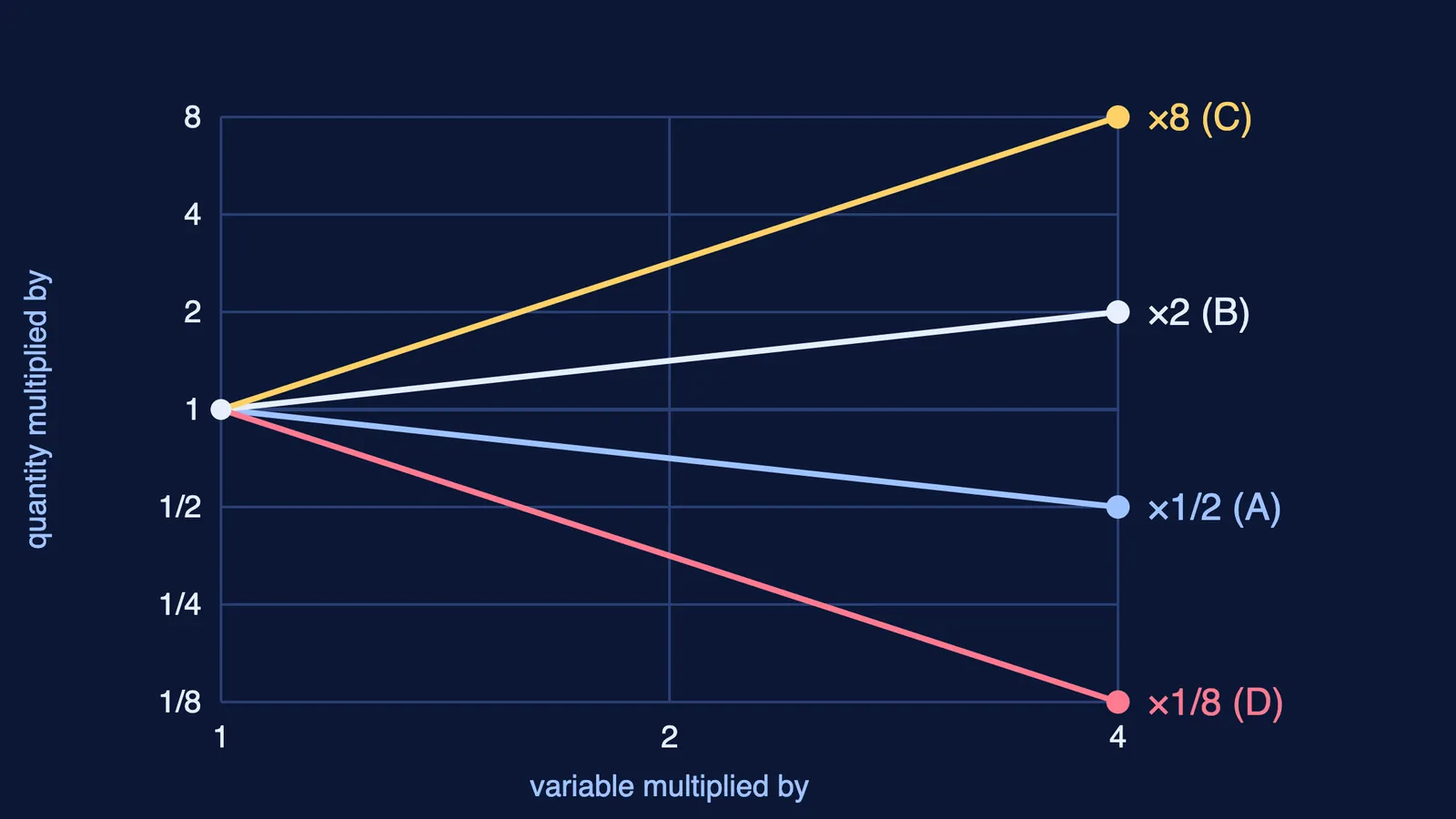
Q8 (hard, match). Each depends only on the variables named. List-I: (A) Wave speed on a string (tension F, mass per length μ), μ ×4 (B) Deep-water wave speed (g, wavelength λ), λ ×4 (C) Satellite's orbital period (orbit radius R, G, planet mass M), R ×4 (D) Frequency of surface-tension ripples (surface tension S, density ρ, wavelength λ), λ ×4. List-II, factor of change: (I) 1/8 (II) 1/2 (III) 2 (IV) 8
(1) A-III, B-II, C-IV, D-I (2) A-II, B-III, C-IV, D-I (3) A-II, B-III, C-I, D-IV (4) A-II, B-IV, C-III, D-I
Answer: (2). A: v ∝ √(F/μ), so 1/2, II. B: v ∝ √(gλ), so 2, III. C: T ∝ √(R³/GM), so 4³ᐟ² = 8, IV. D: f ∝ √(S/ρλ³), so 4⁻³ᐟ² = 1/8, I.
Trap: (3), mixing up a period with a frequency.
How do you work these faster?
Fix your surest pair, strike out options without it, repeat.
Name the operation first: products count figures, sums and differences count decimal places.
For scaling, find the power, then raise 4 to it.
For combinations of constants, add the powers of M, L and T (Q4).
Did one of these trip you twice? The Fermi Problem Library has worked problems with a step-by-step solver that explains the reasoning rather than printing an answer. For the method, see how to solve NEET match-the-list questions, then try the timed Physics and Measurement NEET practice questions with solutions.


