

On this page
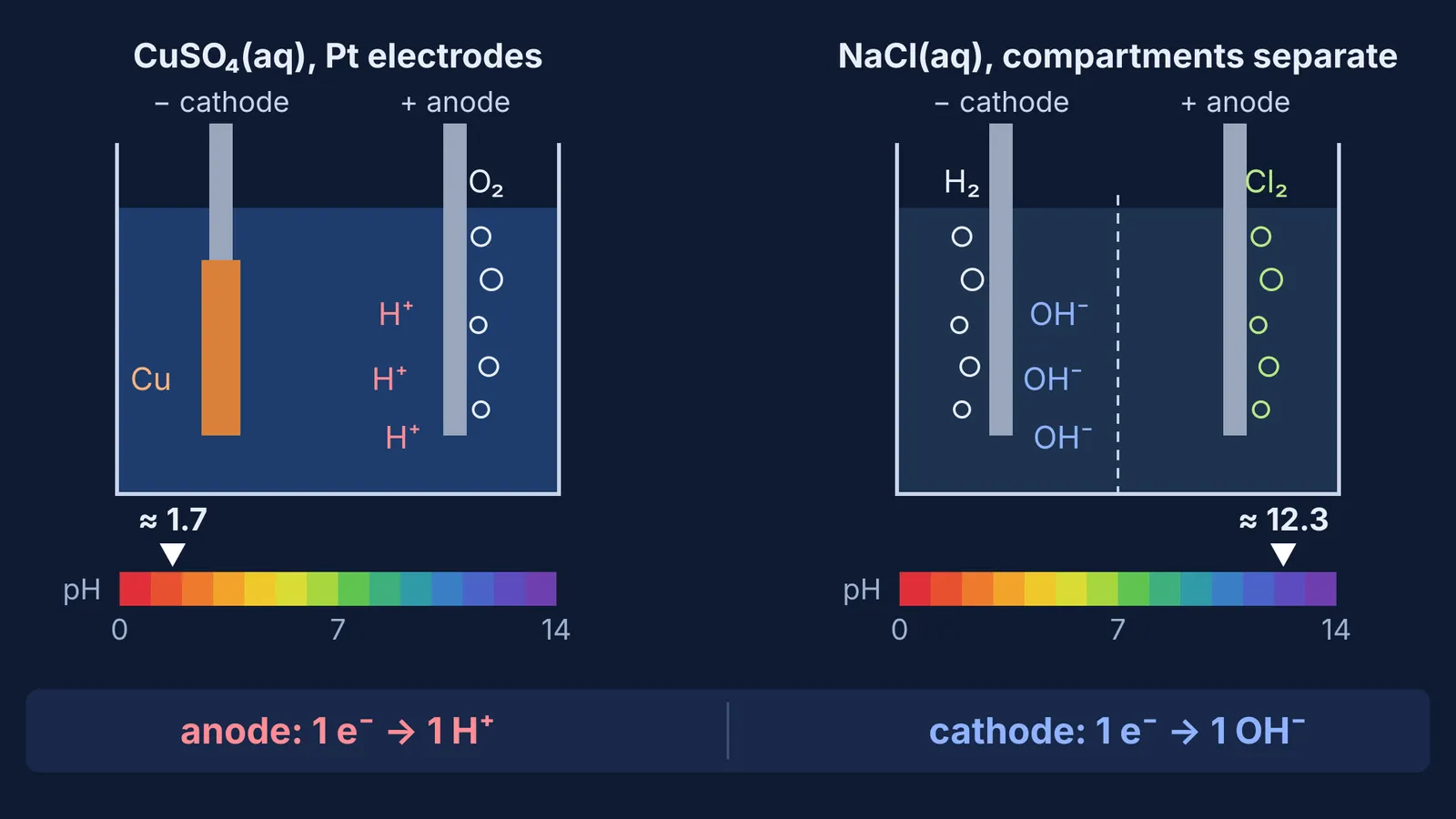
When you electrolyse copper sulphate between platinum electrodes, the blue colour fades and the solution turns acidic. A common exam question then asks for the pH after a given current has flowed for a given time. You do not need any equilibrium constants for this. At the anode, every electron pulled out of water leaves one H⁺ behind, so Faraday's law gives you the moles of acid directly. This post shows that bookkeeping for CuSO₄, AgNO₃ and brine, and the cases where the pH does not change at all.
Why does electrolysis of CuSO₄ with platinum electrodes make acid?
With inert platinum electrodes, the two electrode reactions are:
Cathode: Cu²⁺ + 2e⁻ → Cu
Anode: 2H₂O → O₂ + 4H⁺ + 4e⁻
Sulphate is not oxidised at the anode; water is. Why each ion wins or loses is covered in electrolysis of copper sulphate with copper and platinum electrodes, so we will not repeat it here.
Double the cathode equation so the electrons match, then add:
2Cu²⁺ + 2H₂O → 2Cu + O₂ + 4H⁺
Check it: 2 Cu on each side, 4 H, 2 O, and charge +4 on each side. In effect, copper sulphate slowly turns into sulphuric acid. Every Cu²⁺ that leaves the solution is replaced by two H⁺, so the solution stays electrically neutral. The sulphate ions take no part. They just change partner.
How many H⁺ ions form for each electron passed?
Exactly one. Read it off the anode half-equation: 4 electrons leave, 4 H⁺ appear. Silver nitrate works the same way:
4Ag⁺ + 2H₂O → 4Ag + O₂ + 4H⁺
Again 4 electrons give 4 H⁺, and the charge is +4 on both sides. So, as long as the anode makes O₂ from water and the cathode deposits a metal:
moles of H⁺ formed = moles of electrons = It/F
Here I is the current in amperes, t the time in seconds and F ≈ 96500 C mol⁻¹. This is the same Q = It step you use for mass deposited in Faraday's laws of electrolysis, pointed at a different product.
How do you calculate the pH after electrolysis?
Problem. 250 mL of 0.100 M CuSO₄ is electrolysed between platinum electrodes with a current of 0.500 A for 965 s. Find the pH of the solution afterwards.
Assumptions. The volume stays 250 mL. The initial pH is ignored (Cu²⁺ hydrolysis makes the starting solution slightly acidic). The sulphuric acid formed is treated as fully ionised, so HSO₄⁻ is neglected.
Charge passed. Q = It = 0.500 × 965 = 482.5 C.
Moles of electrons. 482.5 ÷ 96500 = 5.00 × 10⁻³ mol, or 5.00 mmol.
Check that Cu²⁺ is still left. Copper deposited = 5.00 ÷ 2 = 2.50 mmol (about 0.159 g). Copper present at the start = 0.250 L × 0.100 M = 25.0 mmol. Only a tenth has gone, so the cathode is still depositing copper and the one-H⁺-per-electron rule holds.
H⁺ formed. 5.00 mmol, one per electron.
Concentration. [H⁺] = 5.00 mmol ÷ 250 mL = 0.0200 M.
pH. pH = −log(0.0200) = 2 − log 2 = 2 − 0.30 = 1.70.
Is the constant-volume assumption fair? The reaction uses one H₂O for every two electrons, so 2.50 mmol of water, which is 45 mg. Against 250 mL, that is nothing.
The same idea in reverse. How long must 100 mL of AgNO₃ be electrolysed at 0.200 A, with platinum electrodes, to bring the pH to 2.00? You need [H⁺] = 0.0100 M, so 1.00 mmol of H⁺ in 100 mL. That needs 1.00 mmol of electrons, so Q = 1.00 × 10⁻³ × 96500 = 96.5 C, and t = 96.5 ÷ 0.200 = 482.5 s, about 8 minutes.
What happens to the pH when brine is electrolysed?
Brine runs the other way round. The acid-making step disappears and a base-making step takes its place.
Cathode: 2H₂O + 2e⁻ → H₂ + 2OH⁻
Anode: 2Cl⁻ → Cl₂ + 2e⁻
Overall: 2Cl⁻ + 2H₂O → Cl₂ + H₂ + 2OH⁻ (charge −2 on both sides)
Now it is one OH⁻ for every electron. Pass the same 482.5 C through 250 mL of brine and you make 5.00 mmol of OH⁻. So [OH⁻] = 0.0200 M, pOH = 1.70 and pH = 14.00 − 1.70 = 12.30 at 25 °C.
This assumes the anode and cathode compartments are kept separate, as they are in the industrial cell described in products of the chlor-alkali process. If the chlorine mixes with the alkali, it reacts: Cl₂ + 2OH⁻ → Cl⁻ + OCl⁻ + H₂O. That uses up the hydroxide, and the pH you calculated no longer applies.
When does electrolysis leave the pH unchanged?
These cases are tested as often as the acid-making ones.
CuSO₄ with copper electrodes. The anode reaction becomes Cu → Cu²⁺ + 2e⁻. No water is oxidised, so no H⁺ forms. Copper simply moves from anode to cathode and the pH barely changes.
Na₂SO₄ or KNO₃ with platinum electrodes. The anode makes 4H⁺ and the cathode makes 4OH⁻ for every 4 electrons. Universal indicator turns red near the anode and violet near the cathode. Stir the cell and the two cancel, leaving a neutral solution.
Dilute H₂SO₄ with platinum electrodes. The anode makes H⁺ and the cathode uses it up: 2H⁺ + 2e⁻ → H₂. The moles of acid stay fixed. Only water is lost, so the concentration creeps up slowly.
CuSO₄ after all the copper is gone. Once Cu²⁺ runs out, the cathode switches to making H₂ and the cell behaves like dilute H₂SO₄. In the example above, the most acid you can ever make is 2 × 25.0 = 50.0 mmol of H⁺, which is 0.200 M and pH about 0.70 (again neglecting HSO₄⁻). After that point, [H⁺] stops rising, apart from the slow loss of water.
How accurate is the pH 1.70 answer?
It is the textbook answer, but two simplifications sit behind it.
HSO₄⁻. The second ionisation of sulphuric acid is not complete. Its Ka₂ is about 1.0 × 10⁻². With 0.100 M sulphate in the solution, a large share of the 0.0200 M H⁺ is held as HSO₄⁻, so the real pH is noticeably higher than 1.70. Exam questions treat H₂SO₄ as fully ionised, and so did we. With AgNO₃ this problem does not arise, because HNO₃ is a strong acid.
Starting pH. The CuSO₄ solution is slightly acidic before you begin, because hydrated Cu²⁺ ions release a little H⁺. Questions ignore this.
If you want more problems that mix electrolysis with pH, the Fermi Problem Library has a step-by-step solver that explains the reasoning at each step, including which electrode reaction to write.
Quick checklist
Write both half-equations before you calculate anything.
O₂ at a platinum anode means one H⁺ per electron. H₂ at the cathode means one OH⁻ per electron.
Moles of H⁺ (or OH⁻) = It/F. Divide by the volume, then take the log.
Check that enough metal ion remains to last the whole time.
A dissolving anode (Cu in CuSO₄) makes no acid.
Na₂SO₄ and dilute H₂SO₄ leave the overall pH unchanged.
For brine, the answer assumes the compartments are kept separate.
State what you neglected: HSO₄⁻, initial pH, volume change.


