

On this page
Statement and match-the-list formats appear in recent JEE Main papers. Here are eight original ones, easy to hard, apart from our solved JEE Main Oscillations practice set.
Which Oscillations topics do these questions cover?
Unit 10 of the NTA's Syllabus for JEE (Main) - 2027 covers SHM, phase, springs, energy and the simple pendulum; formulas follow NCERT Class 11 Physics, Chapter 13. New to it? Read our guide to preparing Oscillations for JEE Main.
Statement questions
Options for Q1 and Q3: (1) Both correct (2) Both incorrect (3) I correct, II incorrect (4) I incorrect, II correct.
Q1 (easy, statements). Statement I: A pendulum clock correct at rest loses about 8 minutes per hour in a lift accelerating down at g/4. Statement II: In a freely falling lift, its period becomes zero.
Answer: (3). I: effective g = 3g/4, so it runs at √0.75 = 0.866 of the right rate: 52 minutes per hour. II is false: zero effective g means no restoring force and no oscillation (T → ∞).
Trap: (1), letting T → 0 as g → 0.
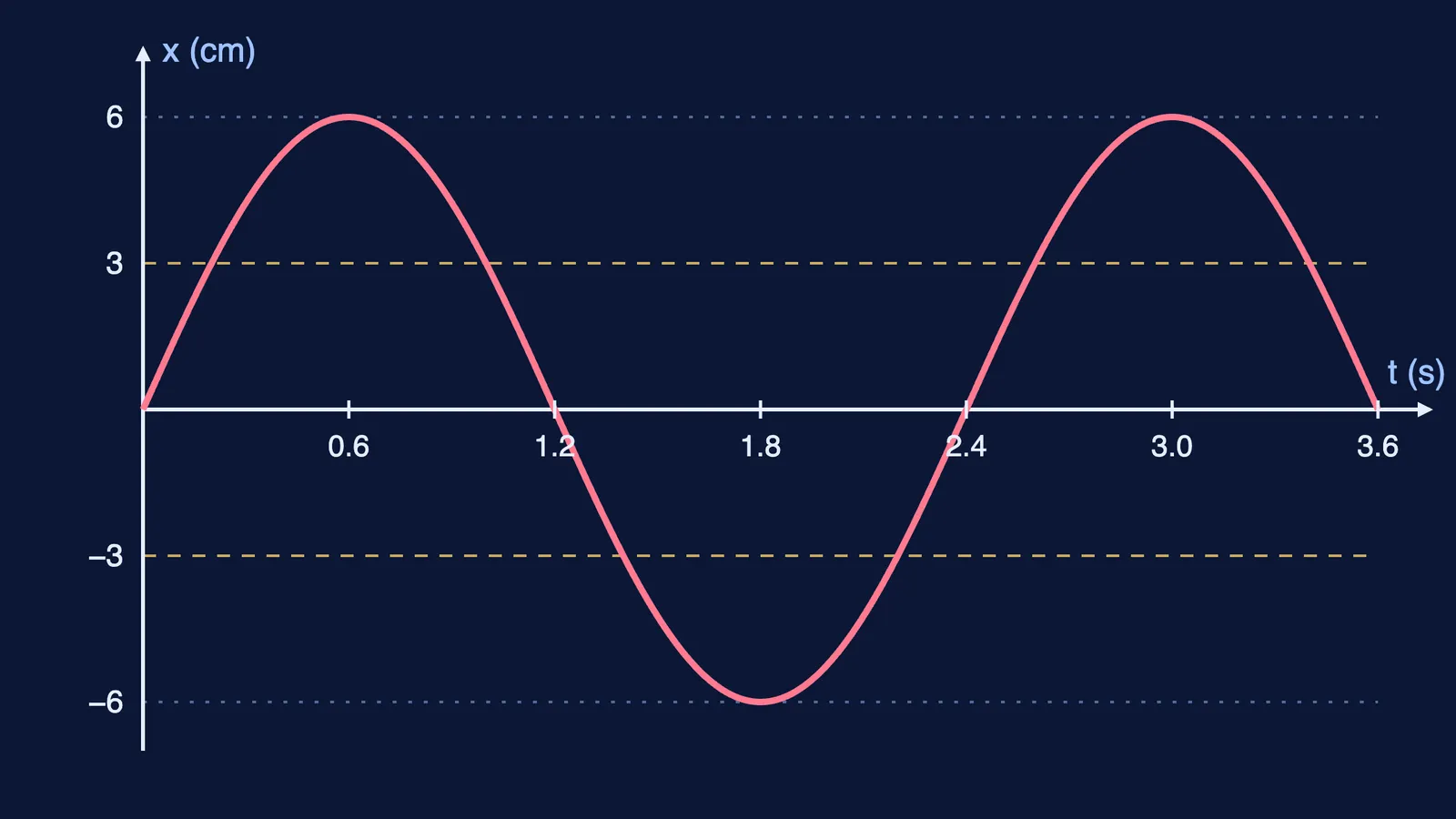
Q2 (medium, statements). A particle moves as x = 6 sin(2πt/2.4), x in cm, t in s. Which are correct?
A. It first reaches x = 3 cm at t = 0.2 s.
B. It then reaches 6 cm 0.2 s later.
C. Its average speed over one period is 10 cm/s.
D. At x = 3 cm its speed is half the maximum.
E. At x = 3 cm its kinetic energy is three times its potential energy.
(1) A, B and C only (2) A, C and E only (3) A, C, D and E only (4) C, D and E only
Answer: (2). A: phase π/6 means T/12 = 0.2 s. B is false: T/4 − T/12 = 0.4 s. C: 4A/T = 10 cm/s. D is false: ω√(A² − x²) is √3/2 of the maximum. E: K/U = (A² − x²)/x² = 27/9 = 3.
Trap: (1), equal distances, equal times.
Q3 (medium, statements). Two particles in SHM on one line, with equal mean position, amplitude A and period, cross at x = (√3/2)A moving oppositely. Statement I: Their phase difference is π/3. Statement II: Their greatest separation is A.
Answer: (1). I: x = (√3/2)A at phases π/3 and 2π/3. II: x₁ − x₂ is an SHM of amplitude 2A sin(Δφ/2) = 2A sin 30° = A.
Trap: (3), using 2A cos(Δφ/2) = √3A, the amplitude of the sum.
Q4 (hard, statements). A 1 kg block hangs from a light spring (k = 100 N/m) held at natural length, then released from rest (g = 10 m/s²). Which are correct?
A. The amplitude is 10 cm.
B. The greatest extension is 20 cm.
C. On the Moon, the period would be longer.
D. At the lowest point the spring pulls with 20 N.
E. At the mean position, spring energy equals kinetic energy.
(1) A, B, C and D only (2) A, B and D only (3) B, D and E only (4) A, B, D and E only
Answer: (4). A: the mean position (kx = mg) is 0.1 m below the release point, an extreme. B: the other extreme is 0.2 m. C is false: T = 2π√(m/k) has no g. D: 100 × 0.2 = 20 N. E: ½(100)(0.1)² = 0.5 J = ½m(Aω)²; gravity supplied 1.0 J.
Trap: (2), assuming the mean position holds only kinetic energy.
Match-the-list questions
Q5 (easy, match). Identical springs (k = 200 N/m) hold a 2 kg block on smooth ground. Match ω (rad/s).
List-I: (A) One spring (B) Two in series (C) Two in parallel (D) Three in series
List-II: (I) 14.1 (II) 5.77 (III) 10.0 (IV) 7.07
(1) A-III, B-I, C-IV, D-II (2) A-III, B-IV, C-I, D-II (3) A-I, B-IV, C-III, D-II (4) A-III, B-II, C-I, D-IV
Answer: (2). ω = √(k/m). A: √100 = 10. B: k/2, √50 = 7.07. C: 2k, √200 = 14.1. D: k/3, √33.3 = 5.77.
Trap: (1), treating series like parallel.
Q6 (medium, match). Match each function with its nature.
List-I: (A) sin ωt cos ωt (B) sin ωt + √3 cos ωt (C) |sin ωt| (D) ωt sin ωt
List-II: (I) Not periodic (II) Periodic but not SHM (III) SHM, period π/ω (IV) SHM, period 2π/ω
(1) A-IV, B-III, C-II, D-I (2) A-III, B-IV, C-I, D-II (3) A-III, B-II, C-IV, D-I (4) A-III, B-IV, C-II, D-I
Answer: (4). A: ½ sin 2ωt, SHM at 2ω. B: 2 sin(ωt + π/3). C: repeats every π/ω, but its velocity flips sign abruptly at x = 0, so it is not sinusoidal. D: the factor ωt keeps growing.
Trap: (1), missing A's 2ωt.
Q7 (medium, match). For a block on a spring, match each change (all else fixed) with the new/old ratio.
List-I: (A) Period, mass ×4 (B) Energy, amplitude ×2 (C) Maximum speed, mass ×4 (D) Energy, mass ×4
List-II: (I) 2 (II) 4 (III) 1/2 (IV) 1
(1) A-I, B-II, C-III, D-IV (2) A-I, B-II, C-IV, D-III (3) A-III, B-II, C-I, D-IV (4) A-II, B-I, C-III, D-IV
Answer: (1). A: T ∝ √m. B: E = ½kA² ∝ A². C: v_max = Aω ∝ 1/√m. D: E = ½kA² has no m.
Trap: (3), inverting ω = √(k/m).
Q8 (hard, match). A 0.2 kg bob on a 1.0 m string hangs in a truck accelerating horizontally at 7.5 m/s² (g = 10 m/s²).
List-I: (A) Equilibrium angle from vertical (degrees) (B) Effective g (m/s²) (C) Small-oscillation period (s) (D) Equilibrium tension (N)
List-II: (I) 2.5 (II) 37 (III) 1.78 (IV) 12.5
(1) A-II, B-IV, C-I, D-III (2) A-IV, B-II, C-III, D-I (3) A-II, B-IV, C-III, D-I (4) A-II, B-I, C-III, D-IV
Answer: (3). A: tan θ = a/g = 0.75, θ ≈ 37°. B: √(10² + 7.5²) = 12.5. C: 2π√(1.0/12.5) = 1.78 s. D: 0.2 × 12.5 = 2.5 N.
Trap: (4), swapping B and D.
How do you work these faster?
Find the mean position first; release from rest marks an extreme (Q4).
For times, use phase: A/2 is π/6 from the mean, (√3/2)A is π/3 (Q2, Q3).
In accelerating frames, use effective g (Q1, Q8).
Unsure why Q4's spring holds only half the energy? The Fermi Problem Library has worked problems with a step-by-step solver that explains the reasoning rather than printing an answer.


