

On this page
Statement and match-the-list questions appear in recent NEET papers and are slow. These eight original questions run easy to hard within Physics Unit 10 of the NMC's NEET (UG)-2026 syllabus and NCERT Class 11 Physics Chapter 13, Oscillations and Chapter 14, Waves (Reprint 2026-27). New to the chapter? Read our Oscillations and Waves for NEET guide.
Can you solve these Oscillations and Waves statement questions?
Options for Q1 and Q3: (1) Both correct. (2) Both incorrect. (3) I correct, II incorrect. (4) I incorrect, II correct.
Q1 (easy, statements). Statement I: At equal tension, waves travel faster on a string of smaller linear mass density. Statement II: Doubling a string's tension doubles the wave speed.
Answer: (3). I is correct: v = √(T/μ). II is incorrect: v ∝ √T, so v rises by √2 ≈ 1.41.
Trap: (1) treats v as proportional to T.
Q2 (medium, statements). Which statements are correct? A. A simple pendulum's small-oscillation period is independent of the bob's mass. B. A spring-block system's period is independent of amplitude. C. In SHM, acceleration and displacement differ in phase by π. D. In one period T of SHM, kinetic energy reaches its maximum only once. E. A simple pendulum performs SHM at any angular amplitude.
(1) A, B and C only (2) A, C and D only (3) A, B, C and E only (4) B, C and D only
Answer: (1). A: T = 2π√(L/g) has no mass. B: T = 2π√(m/k) has no amplitude. C: a = −ω²x. D is false: K peaks at every pass through x = 0, twice per period. E is false: it is approximately SHM only for small angles.
Trap: (4) forgets that the particle passes the mean position twice per cycle.
Q3 (medium, statements). Statement I: Transverse mechanical waves can travel through both steel and air. Statement II: Longitudinal mechanical waves can travel through solids, liquids and gases.
Answer: (4). I is incorrect: transverse waves need a medium that sustains shear, which fluids cannot (NCERT 14.2). II is correct: solids and fluids both resist compression.
Trap: (1) assumes any wave goes wherever sound goes.
Q4 (hard, statements). A 0.20 kg particle moves as x = 0.05 cos(20t + π/3), in SI units. Which statements are correct? A. Its maximum speed is 1.0 m/s. B. Its maximum acceleration is 20 m/s². C. Its period is about 0.31 s. D. Its total mechanical energy is 0.20 J. E. At t = 0 it is at x = 2.5 cm, moving towards +x.
(1) A, B and D only (2) A, B and C only (3) A, C and E only (4) A, B, C and D only
Answer: (2). A: Aω = 0.05 × 20 = 1.0 m/s. B: Aω² = 0.05 × 400 = 20 m/s². C: 2π/20 ≈ 0.314 s. D is false: ½mω²A² = 0.10 J. E is false: x(0) = 2.5 cm, but v(0) = −Aω sin 60° ≈ −0.87 m/s.
Trap: (4) drops the ½ in the energy formula.
Can you solve these Oscillations and Waves match-the-list questions?
Q5 (easy, match). Match each quantity with its dimensions.
List-I: A. Force constant of a spring, k; B. Angular frequency, ω; C. Angular wave number, k; D. Linear mass density of a string, μ.
List-II: I. [ML⁻¹]; II. [T⁻¹]; III. [MT⁻²]; IV. [L⁻¹].
(1) A-III, B-II, C-I, D-IV (2) A-II, B-III, C-IV, D-I (3) A-I, B-II, C-IV, D-III (4) A-III, B-II, C-IV, D-I
Answer: (4). A-III: N/m = kg s⁻². B-II: ω = 2π/T. C-IV: k = 2π/λ. D-I: kg/m.
Trap: (1) swaps the two "per metre" quantities.
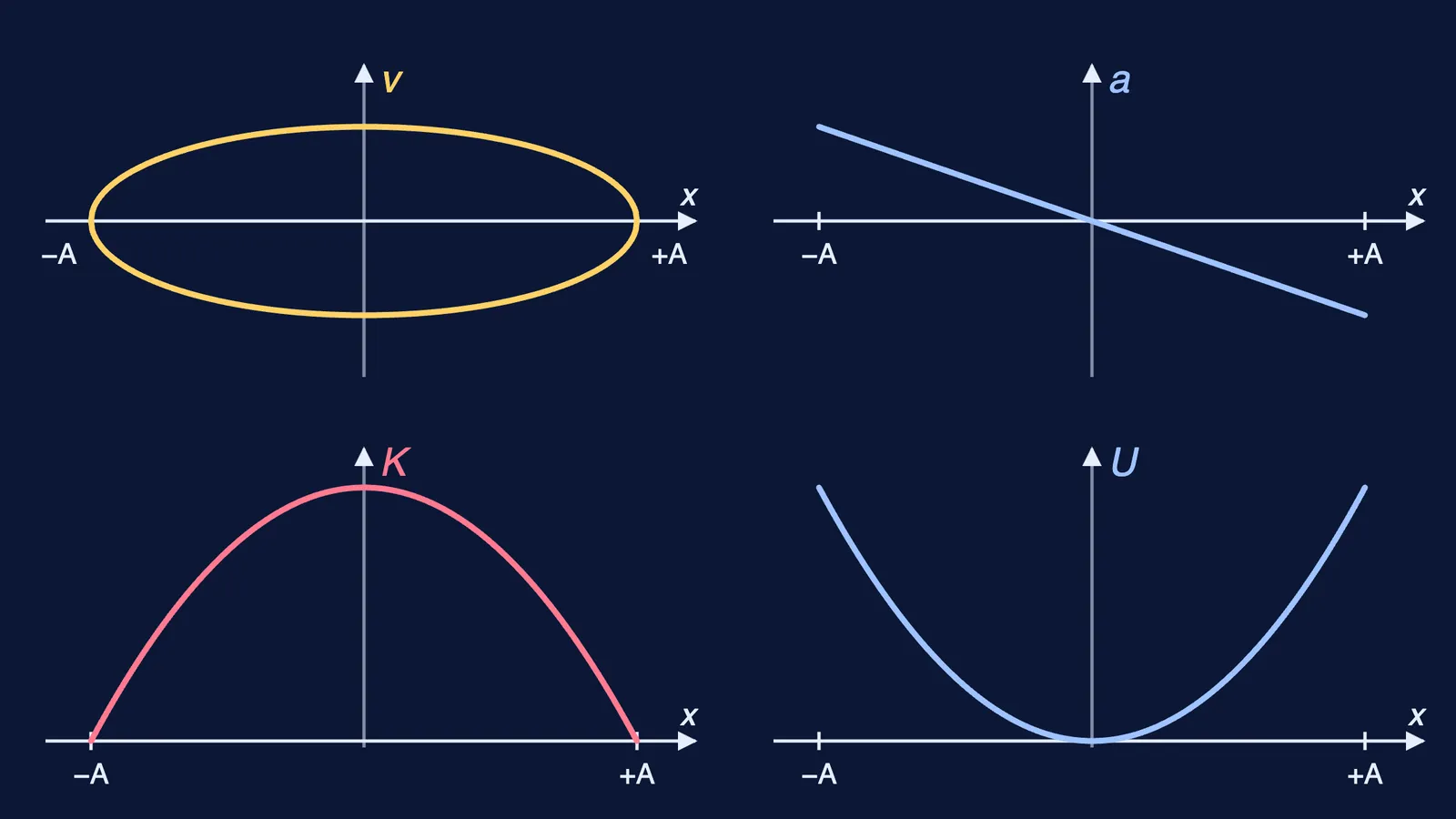
Q6 (medium, match). Match each SHM quantity with its graph against displacement x.
List-I: A. Velocity v; B. Acceleration a; C. Kinetic energy K; D. Potential energy U.
List-II: I. Straight line through the origin with negative slope; II. Ellipse; III. Parabola opening downward, zero at x = ±A; IV. Parabola opening upward, zero at x = 0.
(1) A-III, B-I, C-II, D-IV (2) A-II, B-I, C-III, D-IV (3) A-II, B-I, C-IV, D-III (4) A-I, B-II, C-III, D-IV
Answer: (2). A-II: v² = ω²(A² − x²). B-I: a = −ω²x. C-III: K = ½k(A² − x²). D-IV: U = ½kx². The graphs at the top plot these relations.
Trap: (3) swaps K and U.
Q7 (medium, match). Match each situation with what happens.
List-I: A. Identical waves travel oppositely on a string; B. Two sounds of slightly different frequencies; C. A string pulse reflects from a rigid support; D. A string pulse reflects from an end tied to a light ring sliding freely on a smooth rod.
List-II: I. Reflected with no phase change; II. Loudness waxes and wanes; III. Reflected with a phase change of π; IV. Standing wave with fixed nodes.
(1) A-IV, B-II, C-III, D-I (2) A-IV, B-II, C-I, D-III (3) A-II, B-IV, C-III, D-I (4) A-IV, B-III, C-II, D-I
Answer: (1). A-IV: a standing wave. B-II: beats, at ν₁ − ν₂. C-III: the rigid end cannot move, so the pulse inverts. D-I: the free ring is an open boundary, so the pulse returns upright.
Trap: (2) swaps the rigid and free ends.
Q8 (hard, match). An open pipe and a closed pipe are each 55 cm long; sound travels at 330 m/s; ignore end corrections. Match each mode with its frequency.
List-I: A. Open pipe, fundamental; B. Closed pipe, first overtone; C. Closed pipe, fifth harmonic; D. Open pipe, first overtone.
List-II: I. 300 Hz; II. 450 Hz; III. 600 Hz; IV. 750 Hz.
(1) A-I, B-III, C-IV, D-II (2) A-III, B-I, C-IV, D-II (3) A-I, B-II, C-IV, D-III (4) A-II, B-I, C-III, D-IV
Answer: (3). A-I: v/2L = 330/1.10 = 300 Hz. B-II: closed pipes have only odd harmonics: 3 × 150 = 450 Hz. C-IV: 5 × 150 = 750 Hz. D-III: 2 × 300 = 600 Hz.
Trap: (2) uses v/L for the open pipe and an even closed-pipe overtone.
How do you work these Oscillations and Waves questions faster?
Write x, v and a with their phases first.
K and U repeat every T/2; each peaks at ½kA².
For pipes, sketch the ends: closed end a node, open end an antinode.
Lock your surest pair and strike options without it.
Can't picture the v–x ellipse? The Fermi Simulation Lab has interactive simulations for ideas that are easier to see than to read.
See our method for NEET match-the-list questions, or try Oscillations and Waves NEET practice questions with solutions.


