

On this page
These eight Oscillations and Waves questions follow our first NEET practice set on Oscillations and Waves and test the parts of the unit that set did not. We wrote every question ourselves, not copied from NCERT or past papers. Each answer ends with the trap behind the most tempting wrong option.
Which topics does set 2 cover?
Oscillations and Waves is Physics Unit 10 in the National Medical Commission's syllabus for NEET (UG)-2026. It covers periodic functions, SHM, springs, energy, the simple pendulum, wave speed, standing waves and beats. The matching NCERT text (Reprint 2026-27) is Class 11 Physics Chapter 13, Oscillations, and Chapter 14, Waves.
Set 1 tested added mass on a spring, pendulum length, wave direction, the KE-to-PE ratio, string and closed-pipe harmonics, SHM phase and beats. Set 2 covers the condition a = −ω²x, a pendulum matched to a spring, energy in joules, two springs on one block, the Laplace correction, node spacing, a squared sine and a pendulum in water.
How should you use this practice set?
Cover the answers and allow 15 minutes for all eight.
Write the relation first, then check units (cm or m).
Read every trap line, even where you were right.
New to the chapter? Read our guide on how to prepare Oscillations and Waves for NEET first.
Easy: the SHM condition, a matched pendulum and energy
Q1 (easy). A particle's acceleration is a = −36π²x, in SI units. What is the frequency of its oscillation?
(A) 6 Hz (B) 3 Hz (C) 36 Hz (D) 0.33 Hz
Answer: (B). SHM means a = −ω²x, so ω² = 36π² and ω = 6π rad/s. Then f = ω/2π = 3 Hz.
Trap: (A) divides ω by π instead of 2π. (D) is the period, 1/3 s, read as a frequency.
Q2 (easy). A 0.50 kg block on a 20 N/m spring and a simple pendulum, set going side by side, stay exactly in step. Take g = 9.8 m/s². How long is the pendulum?
(A) 2.5 cm (B) 4.1 m (C) 24.5 cm (D) 49 cm
Answer: (C). Equal periods need 2π√(m/k) = 2π√(L/g), so L/g = m/k and L = gm/k = 9.8 × 0.50/20 = 0.245 m.
Trap: (A) sets L equal to m/k and drops g. (B) inverts the ratio.
Q3 (easy). A 0.50 kg block oscillates in SHM at 5.0 Hz with an amplitude of 4.0 cm. What is its total mechanical energy?
(A) 0.79 J (B) 0.010 J (C) 3.9 × 10³ J (D) 0.39 J
Answer: (D). ω = 2π × 5.0 = 10π rad/s. E = ½mω²A² = 0.5 × 0.50 × (10π)² × (0.040)² ≈ 0.39 J.
Trap: (B) puts f = 5.0 in place of ω. (C) leaves the amplitude in centimetres.
Medium: two springs, sound in a gas and a standing wave
Q4 (medium). A 0.60 kg block on a smooth floor is joined to the left wall by a 100 N/m spring and to the right wall by a 140 N/m spring. What is the period of small oscillations?
(A) 0.31 s (B) 0.64 s (C) 0.44 s (D) 0.050 s
Answer: (A). Displaced by x, one spring pushes and the other pulls the block back, so the force is (100 + 140)x. With k = 240 N/m, T = 2π√(0.60/240) = 2π × 0.05 ≈ 0.31 s.
Trap: (B) treats the springs as being in series. Both springs share the block's displacement, so their constants add.
Q5 (medium). A gas has pressure 1.2 × 10⁵ Pa, density 1.5 kg/m³ and γ = 1.40. What is the speed of sound in it?
(A) 283 m/s (B) 396 m/s (C) 335 m/s (D) 239 m/s
Answer: (C). Sound compressions are adiabatic, so the bulk modulus is γP and v = √(γP/ρ) = √(1.40 × 1.2 × 10⁵/1.5) ≈ 335 m/s.
Trap: (A) is Newton's formula, v = √(P/ρ), which assumes isothermal compressions; NCERT calls the fix the Laplace correction.
Q6 (medium). A standing wave on a string is y = 0.5 sin(πx/12) cos(80πt), with x and y in cm and t in s. What is the distance between a node and the nearest antinode?
(A) 12 cm (B) 6 cm (C) 3 cm (D) 24 cm
Answer: (B). k = π/12 per cm, so λ = 2π/k = 24 cm. Nodes sit at x = 0, 12, 24 cm and antinodes at 6, 18 cm: λ/4 = 6 cm apart.
Trap: (A) is node to node, λ/2.
Hard: a hidden SHM and a pendulum in water
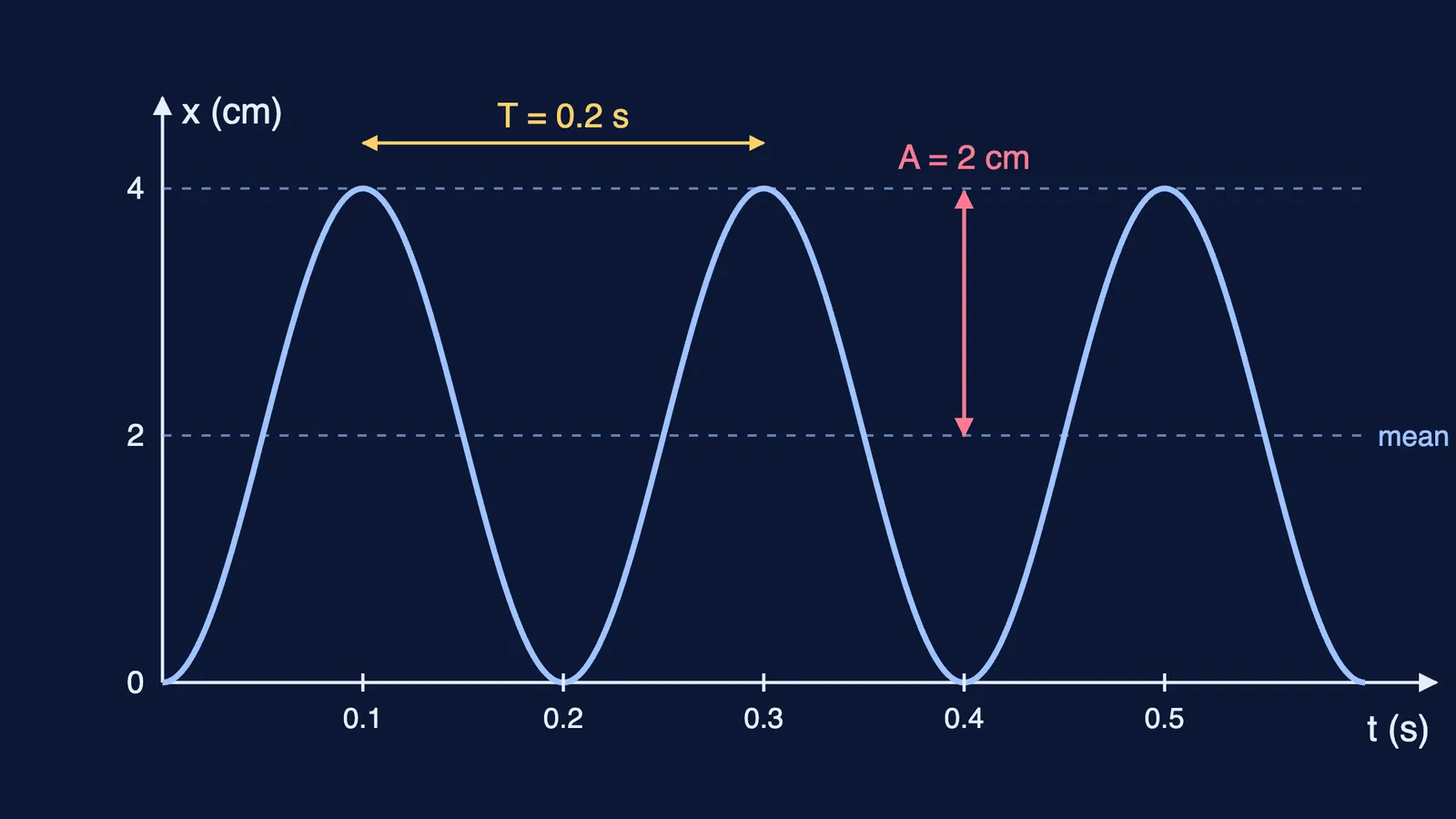
Q7 (hard). A particle moves along a line as x = 4 sin²(5πt), with x in cm and t in s. What are the amplitude and period of its motion?
(A) 4 cm, 0.4 s (B) 4 cm, 0.2 s (C) 2 cm, 0.4 s (D) 2 cm, 0.2 s
Answer: (D). Use sin²θ = (1 − cos 2θ)/2: x = 2 − 2 cos(10πt). This is SHM about x = 2 cm, with amplitude 2 cm and ω = 10π rad/s, so T = 2π/10π = 0.2 s. The graph at the top plots it.
Trap: (C) gets the amplitude right but takes the period from sin(5πt), 0.4 s. Squaring doubles the frequency.
Q8 (hard). A simple pendulum with a solid bob of density 6.0 × 10³ kg/m³ has a period of 1.20 s in air. It then swings with the bob fully under water (density 1.0 × 10³ kg/m³). Ignore drag. What is its new period?
(A) 1.10 s (B) 1.20 s (C) 1.44 s (D) 1.31 s
Answer: (D). Buoyancy cancels 1/6 of the bob's weight, so the restoring force acts as if g were 5g/6. The bob's mass is unchanged, so T′ = T√(6/5) = 1.20 × 1.095 ≈ 1.31 s.
Trap: (B) says mass cancels in a pendulum, so water changes nothing. Buoyancy cuts the restoring force, not the mass, so the period grows.
What should you do after checking your answers?
Sort each miss: ω mixed with f (Q1, Q3), wrong model (Q2, Q4, Q5, Q8) or misread equation (Q6, Q7). Redo misses the next day without solutions. If you cannot see where your method went wrong, the Fermi Problem Library has worked problems with a step-by-step solver that explains the reasoning rather than printing an answer.
For standing waves in more depth, read how standing waves form on strings and in pipes.


