

On this page
A sulphur sol, a starch sol and soapy water are all colloids. Their particles all fall in the same size window, roughly 1 to 1000 nm. But the particle is a different kind of thing in each one. In the sulphur sol it is a cluster of thousands of small molecules. In the starch sol it is one huge molecule. In soapy water it is a temporary crowd of ions that only forms above a certain concentration. NCERT sorts colloids this way, by what the dispersed particle actually is, and the three classes behave differently when you dilute or heat them.
This topic sits in Surface Chemistry. That chapter is still on the JEE Advanced syllabus but has been dropped from the JEE Main and NEET syllabi, so check which exam you are preparing for before you spend time on it.
What are the three types of colloids based on the type of particles?
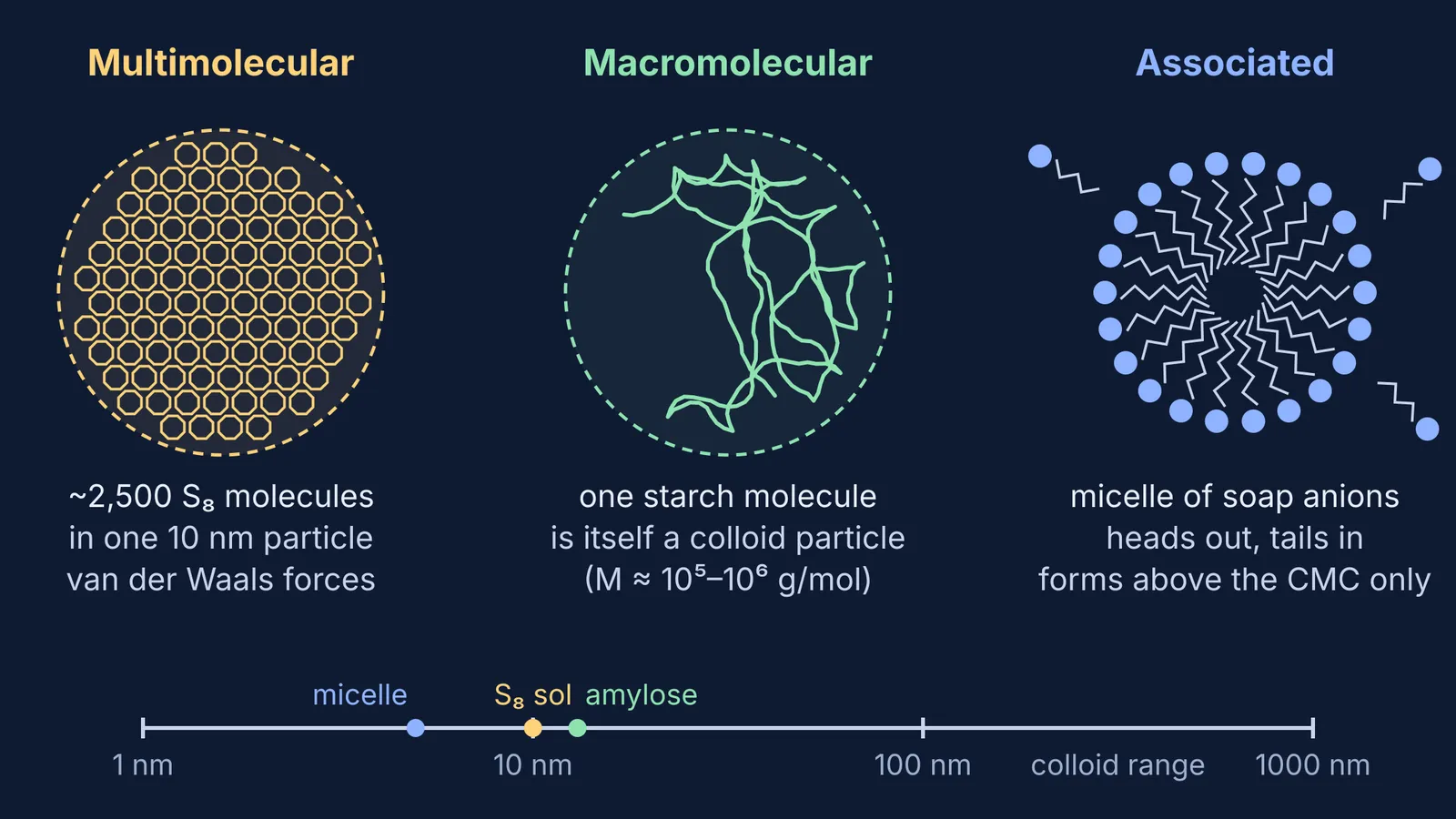
Multimolecular colloids. Many atoms or small molecules (each smaller than 1 nm) come together into one particle of colloidal size. They are held by weak van der Waals forces, not by covalent bonds. NCERT's examples are a gold sol, whose particles contain many gold atoms, and a sulphur sol, whose particles contain a thousand or more S₈ molecules.
Macromolecular colloids. A single molecule is so large that it is already in the colloidal size range. No clustering is needed. Examples are starch, cellulose and proteins, and synthetic polymers such as polythene, nylon and rubber when dispersed in a suitable solvent.
Associated colloids. Small ions or molecules that behave as a normal strong electrolyte at low concentration, but aggregate into particles called micelles once their concentration passes the critical micelle concentration (CMC). Soaps and synthetic detergents are the standard examples. NCERT calls these aggregated particles associated colloids.
You already know a different way to classify colloids: by size alone, as in telling a true solution from a colloid or a suspension. The three classes here all pass that size test. They differ in what is inside the particle.
How many S₈ molecules are in one sulphur sol particle?
Here is a worked estimate. Colloidal sulphur particles vary a lot in size, so assume a spherical particle of diameter 10 nm.
Radius in cm. r = 5 nm = 5 × 10⁻⁷ cm.
Volume. V = 4/3 π r³ = 4/3 × 3.1416 × (5 × 10⁻⁷)³ = 5.24 × 10⁻¹⁹ cm³.
Mass. Use the density of rhombic sulphur, 2.07 g cm⁻³. m = 5.24 × 10⁻¹⁹ × 2.07 = 1.08 × 10⁻¹⁸ g.
Moles of S₈. M(S₈) = 8 × 32.06 = 256.5 g mol⁻¹. n = 1.08 × 10⁻¹⁸ / 256.5 = 4.23 × 10⁻²¹ mol.
Number of molecules. N = 4.23 × 10⁻²¹ × 6.022 × 10²³ ≈ 2,500 S₈ molecules, which is about 20,000 sulphur atoms.
That matches NCERT's "a thousand or more" S₈ molecules. Notice how fast the count grows with size: because N scales with r³, a 20 nm particle holds eight times as many, about 20,000 S₈ molecules.
Now compare a starch molecule. Amylose has a molar mass of roughly 10⁵ to 10⁶ g mol⁻¹. One molecule of M = 10⁶ g mol⁻¹ has a mass of 10⁶ / 6.022 × 10²³ = 1.66 × 10⁻¹⁸ g. That is about the same mass as the whole 10 nm sulphur particle. If you squeeze it into a compact sphere of density about 1.5 g cm⁻³, its diameter comes out near 13 nm. So one starch molecule is a colloidal particle on its own. Real starch chains are coiled and swollen with water, not compact spheres, so treat 13 nm only as an order-of-magnitude check.
Why does an associated colloid need the CMC?
A soap such as sodium stearate, C₁₇H₃₅COO⁻Na⁺, dissolves as separate ions in dilute solution. Each stearate ion has a long hydrocarbon tail that water does not want, and a charged COO⁻ head that it does. Once the concentration passes the CMC, the anions gather into a micelle: tails point inward, away from water, and heads face outward into the water. NCERT gives the CMC of soaps as about 10⁻⁴ to 10⁻³ mol L⁻¹, and says a micelle can contain 100 or more ions.
Two conditions must both hold. The concentration must be above the CMC, and the temperature must be above the Kraft temperature. The CMC and Kraft temperature post covers that pair in detail, so this post only uses the result.
What happens to each type when you dilute or heat it?
This is where the classification earns its place in exam questions.
Dilution. A multimolecular sol is still a sol after dilution: you have fewer particles per litre, but each particle is still a cluster. A macromolecular sol behaves the same way, because each particle is one molecule and dilution cannot split a molecule. An associated colloid is different. Dilute it below the CMC and the micelles break up into free ions, so it stops being a colloid and becomes an ordinary electrolyte solution.
Heating. Heating an associated colloid above the Kraft temperature helps micelles form. Boiling a lyophobic sol, such as a sulphur or gold sol, increases collisions between particles and can make them coagulate. Heating a protein sol can denature the protein, which is why egg white sets when you cook it.
Conductivity. Below the CMC, a soap solution conducts like a strong electrolyte. Above it, molar conductivity drops more sharply, because many ions are now locked in large micelles that move slowly and carry part of their counter-ions with them.
How is this different from lyophilic and lyophobic classification?
The lyophilic and lyophobic scheme sorts colloids by how strongly the dispersed phase interacts with the medium. That decides stability and reversibility: a starch sol re-forms if you dry it and add water, while a dried sulphur sol does not. The lyophilic vs lyophobic sols post covers that axis.
The scheme in this post asks a separate question: how many molecules make one particle, and what holds them together? You can place the same colloid on both axes. A starch sol is macromolecular and lyophilic. A sulphur sol is multimolecular and lyophobic. A soap solution above its CMC is associated, and its micelles carry a charged surface that keeps them dispersed.
If any of these ideas is still hazy, the Concept Library covers colloids, micelles and the rest of chemistry one concept at a time, so you can read it alongside your NCERT.
Quick checklist
Multimolecular: many small molecules or atoms per particle, held by van der Waals forces (S₈ in sulphur sol, Au atoms in gold sol).
Macromolecular: one giant molecule per particle (starch, cellulose, proteins, polymers in solution).
Associated: ions that form micelles only above the CMC and Kraft temperature (soaps, detergents).
Count molecules per particle with V = 4/3 π r³, then mass, then moles, then Avogadro's number. Doubling the diameter multiplies the count by 8.
Only associated colloids fall apart on dilution.
Keep this classification separate from lyophilic and lyophobic.


