On this page
Most questions on sols come down to one thing: does the dispersed phase like the liquid or not? Starch and gum do. Arsenious sulphide (As2S3) and ferric hydroxide (Fe(OH)3) do not. Everything else follows from that.
What is the difference between lyophilic and lyophobic sols?
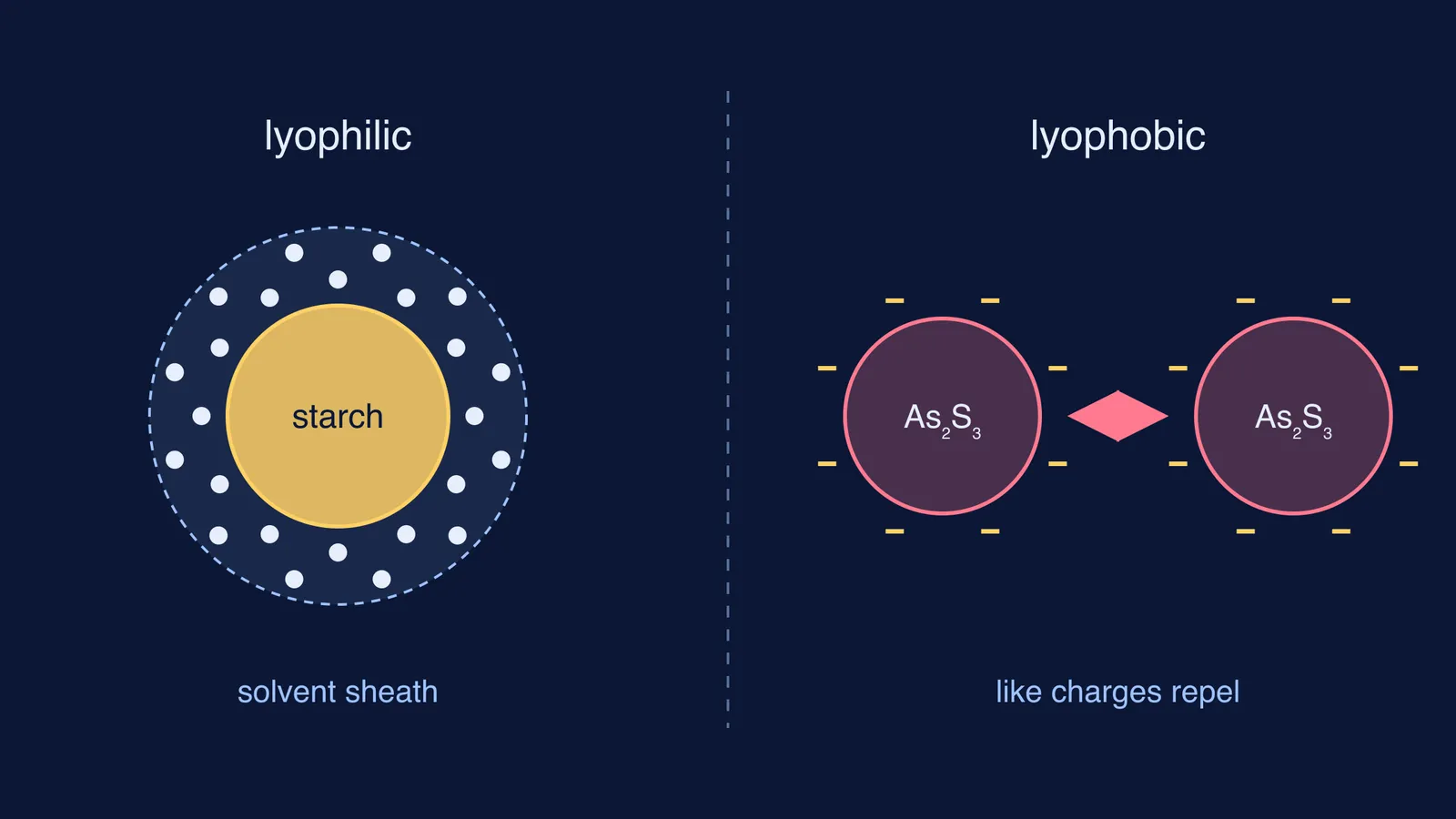
A lyophilic sol is one in which the particles of the dispersed phase have a great affinity for the dispersion medium; the word means "solvent lover" (NIOS Senior Secondary Chemistry, Lesson 8: Colloids). A lyophobic sol is one in which the dispersed phase has no affinity for the medium; the word means "solvent hating". With water as the medium, they are called hydrophilic and hydrophobic.
NIOS gives gum, gelatine and starch as lyophilic examples, and metals such as gold and silver, and their hydroxides or sulphides, as lyophobic ones. Surface chemistry notes by A K Ghosh of Patna University, on the NISCPR National Science Digital Library, name Fe(OH)3 and As2S3 sols as lyophobic and note that such sols need stabilising agents.
Why are lyophilic sols more stable than lyophobic sols?
Lyophilic sols are more stable because their particles are extensively solvated, each wrapped in a sheath of the liquid around it (NIOS). Two things keep them stable, charge and that sheath, so to coagulate one you remove both: add alcohol or acetone to strip the water, then a little electrolyte.
A lyophobic sol relies on charge: NIOS says its stability is due to the charge on the particles. As2S3 sol particles are negatively charged and ferric hydroxide particles positively charged, so like particles repel. Remove the charge, by electrophoresis, boiling, adding an electrolyte or mixing two oppositely charged sols, and they settle. The Ghosh notes put the contrast plainly: lyophobic sols coagulate with small amounts of electrolyte, lyophilic sols need large amounts.
Why is a starch sol reversible but an As2S3 sol is not?
Separate a lyophilic sol into its two phases and you can form it again just by remixing them (NIOS). A lyophobic sol, once precipitated, has little tendency to return to the colloidal state, so it is called irreversible.
Peptisation is not simple remixing: it needs an added electrolyte. NIOS describes adding ferric chloride to freshly precipitated Fe(OH)3: the particles adsorb Fe3+ ions, become positive, repel one another and form a reddish-brown sol.
How are starch, gum, As2S3 and Fe(OH)3 sols prepared?
Starch, gelatin and gum: dissolve directly in hot water, a method that works only for lyophilic sols (NIOS).
As2S3: double decomposition, 2H3AsO3 + 3H2S → As2S3 + 6H2O (Ghosh notes).
Fe(OH)3: hydrolysis, adding concentrated ferric chloride slowly to boiling water. The Ghosh notes write the product as hydrated ferric oxide, Fe2O3·xH2O, which school books label Fe(OH)3. Peptisation with FeCl3 also works.
Gold, silver and platinum: Bredig's arc, struck between metal electrodes in water; the metal vapour condenses in the cold water as a sol (NIOS).
Worked example: which salt coagulates which sol?
The Hardy-Schulze rule, as NIOS states it: generally, the greater the valence of the flocculating ion, the greater its power to cause precipitation. For a negative sol the order is Al3+ > Ba2+ > Na+; for a positive sol, [Fe(CN)6]4- > PO4 3- > SO4 2- > Cl-. The coagulating value is the minimum electrolyte concentration, in millimoles per litre, that precipitates a sol in two hours, so a smaller value means a stronger ion.
Question: which of NaCl, BaCl2 and AlCl3 coagulates As2S3 sol best? Which of NaCl, Na2SO4 and Na3PO4 coagulates Fe(OH)3 sol best?
Find the charge. As2S3 sol is negative; Fe(OH)3 sol is positive.
Pick the ion that matters. Cations coagulate a negative sol; anions coagulate a positive one.
For As2S3, compare Na+, Ba2+ and Al3+. Al3+ carries the most charge, so the rule predicts AlCl3 is strongest, with the lowest coagulating value.
For Fe(OH)3, compare Cl-, SO4 2- and PO4 3-. Phosphate carries the most charge, so Na3PO4 is predicted strongest.
Bonus: mix the two sols in almost equal proportions and they precipitate partly or completely. NIOS calls this mutual coagulation.
The usual slip is step 2, picking the ion with the same charge as the sol. If that keeps happening, work through a few problems in the Fermi Problem Library, where a step-by-step solver explains the reasoning rather than printing the answer.
How should you revise this comparison?
For any sol in a question, ask four things in order:
Does the dispersed phase like the solvent?
Was the sol made by direct mixing, or by a special method such as double decomposition, hydrolysis, Bredig's arc or peptisation?
What is the particle charge, and which oppositely charged ion neutralises it?
What keeps it stable: charge alone, or charge plus a solvent sheath?
If the idea underneath is shaky, such as why adsorbed ions give a particle its charge, the Fermi Concept Library has a lesson for each chemistry concept.