

On this page
Every heartbeat sends an electric current through the heart muscle. An ECG picks this up as voltages on the skin. But any current also makes a magnetic field, so the heart is a weak magnet that switches on and off about once a second. Measuring that field is called magnetocardiography, or MCG. The hard part is not the sensor alone. It is that the heart's field is about a million times weaker than the Earth's, and a passing car is far louder. This post uses the Biot–Savart law and the 1/r³ fall-off of a magnetic dipole to show how a simple trick, two coils 5 cm apart, picks the heart out of the noise.
How strong is the heart's magnetic field?
A 2024 review in the journal Sensors reports that the heart produces peak fields of about 10 to 100 pT measured roughly 3 cm above the chest (Elfouly and Alouani, Sensors 24, 6017 (2024)). One picotesla is 10⁻¹² T.
The Earth's field at the surface is about 50 µT, with values between roughly 25 and 65 µT depending on where you are. So:
50 µT ÷ 100 pT = 5 × 10⁵
50 µT ÷ 10 pT = 5 × 10⁶
The heart's field is between half a million and five million times weaker than the Earth's: about a million, in round numbers. The same review notes that SQUID sensors, which need liquid helium cooling, can detect fields of a few femtotesla, and that newer optically pumped magnetometers work at room temperature.
How can you estimate the heart's field with Biot–Savart?
At each beat, a wave of electrical activity sweeps through the heart muscle. Close up, you can model it as one short current element: a current I flowing along a short length dl. Physicists call the product Q = I dl a current dipole, measured in A m. The Biot–Savart law, covered in the Biot–Savart law for a current element, gives the field at distance r, at right angles to the element:
B = μ₀Q/(4πr²)
Take an illustrative Q = 1 µA m (a round number chosen to sit in the measured range, not a measured value):
At r = 6 cm: B = 10⁻⁷ × 10⁻⁶ / 0.06² = 2.8 × 10⁻¹¹ T = 28 pT.
At r = 8 cm: B = 10⁻⁷ × 10⁻⁶ / 0.08² = 16 pT.
At r = 3 cm: B = 111 pT.
These sit in or near the measured 10 to 100 pT, which is the check this model needs. It is a simple model. The real body is a conductor, and the currents flowing back through the chest also shape the field outside, so treat the numbers as order-of-magnitude estimates.
Why does magnetic noise from a car swamp the heart's signal?
A car, a lift or a steel door is a lump of magnetised iron. Seen from far away it acts like a magnetic dipole, with a field that falls as 1/r³, the result explained in why a dipole field falls as 1/r³.
Model a car as a dipole of moment m = 100 A m² (an illustrative round value). On its axis at 10 m:
B = 2μ₀m/(4πr³) = 2 × 10⁻⁷ × 100 / 10³ = 2 × 10⁻⁸ T = 20 nT.
That is about 720 times the heart's 28 pT at 6 cm. Cars, lifts and trains move, so this noise also changes from moment to moment, which is what a heart signal does too.
How do two coils 5 cm apart cancel distant noise?
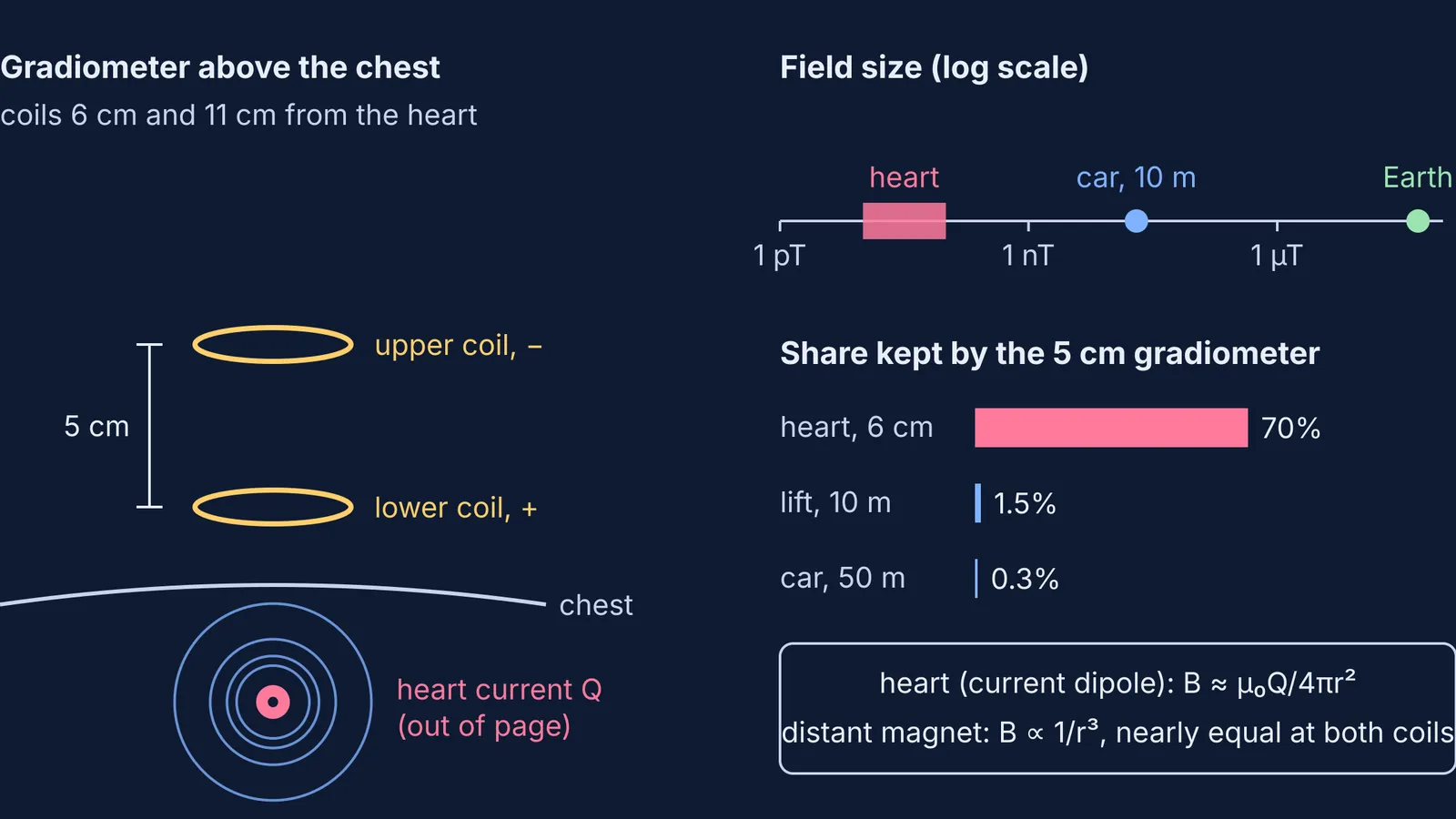
The trick is a gradiometer: two identical pickup coils on the same axis, one above the other, wired so that their signals subtract. A field that is the same at both coils gives zero. Only a field that changes between the coils survives.
Now compare a near source with a far one. Put the lower coil 6 cm from the heart and the upper coil 5 cm above it, at 11 cm. The fraction of the signal that survives the subtraction is 1 − (field at far coil)/(field at near coil).
Heart, field ∝ 1/r². Kept = 1 − (6/11)² = 1 − 0.298 = 0.70, so 70% survives.
Lift 10 m away, field ∝ 1/r³. Kept = 1 − (10/10.05)³ = 0.015, so 1.5% survives.
Car 50 m away. Kept = 1 − (50/50.05)³ = 0.003, so 0.3% survives.
The heart is close, so its field changes a lot over 5 cm. A distant source's field is almost the same at both coils, so it almost cancels.
Is one gradiometer enough?
Not on its own. Take the car at 10 m. After the first-order gradiometer, its 20 nT becomes 20 nT × 0.0149 = 0.30 nT, or 300 pT. The heart's 28 pT becomes 28 × 0.70 = 19.5 pT. The car is still about 15 times larger.
So real systems stack several tricks:
A second-order gradiometer. Three coils, 5 cm apart, combined as B₁ − 2B₂ + B₃. This cancels both a uniform field and a steady gradient. Working it through, the heart keeps 55% (15 pT) and the car at 10 m keeps 0.029% (5.9 pT). The heart is now the larger signal.
Magnetically shielded rooms, often used with SQUID systems, which cut outside fields before they reach the sensors.
Averaging many beats. The heart repeats; traffic does not.
If the jump from Biot–Savart to dipole fields still feels shaky, the Concept Library covers every concept in physics, from the field of a current element to magnetic dipoles.
How is MCG different from an ECG?
Both come from the same currents in the heart. An ECG measures voltages between electrodes on the skin, an idea that goes back to Willem Einthoven's string galvanometer. MCG measures the magnetic field outside the body, so it needs no contact with the skin. The two carry overlapping but not identical information. This post is a physics explainer only, and says nothing about what either test should be used for.
Quick checklist
The heart's field is about 10 to 100 pT near the chest; the Earth's is about 50 µT, roughly a million times larger.
Near the heart, model it as a current dipole: B ≈ μ₀Q/4πr².
Distant magnets such as cars and lifts are dipoles: B ∝ 1/r³.
A gradiometer subtracts two coils, keeping 70% of the heart but 1.5% of a lift 10 m away.
A car at 10 m still wins after one gradiometer; second-order gradiometers, shielding and averaging finish the job.


