

On this page
Eight original questions in two slow NEET-UG formats. New to the unit? Start with how to prepare magnetic effects of current and magnetism for NEET.
What do these questions cover?
The NMC syllabus for NEET (UG)-2026 lists this chapter as Physics Unit 13. Facts follow NCERT Class 12 Physics Chapter 4, Moving Charges and Magnetism and Chapter 5, Magnetism and Matter (Reprint 2026-27). Take μ₀/2π = 2 × 10⁻⁷ T m A⁻¹; proton: 1.67 × 10⁻²⁷ kg, 1.6 × 10⁻¹⁹ C.
Key for Q1 and Q3: (1) Both correct (2) Both incorrect (3) I correct, II incorrect (4) I incorrect, II correct.
Statement questions: which ones are true?
Q1 (easy, statements). Statement I: A diamagnetic substance moves from the weaker to the stronger part of a non-uniform field. Statement II: A superconductor is a perfect diamagnet, with χ = −1 and μr = 0.
Answer: (4). I is false: NCERT says diamagnets move from stronger to weaker field. II is true (the Meissner effect).
Trap: (1) gives diamagnets the paramagnet's direction.
Q2 (easy, statements). Which are correct?
A. 1 gauss = 10⁻⁴ tesla. B. The cyclotron frequency qB/2πm is independent of speed and radius. C. A helix's pitch depends on the velocity component perpendicular to B. D. Parallel currents attract; anti-parallel ones repel. E. A charge at rest in a magnetic field feels a force qB.
(1) B, D and E only (2) A, B and D only (3) A, B, C and D only (4) A, C and D only
Answer: (2). A and B are NCERT facts. C: pitch p = v∥T; v⊥ sets the radius. D is NCERT's summary. E: F = q(v × B) is zero when v = 0.
Trap: (3) swaps the two velocity components.
Q3 (medium, statements). Two long parallel wires 5.0 cm apart carry 3.0 A and 4.0 A in opposite directions. Statement I: They repel with 4.8 × 10⁻⁵ N per metre. Statement II: The field midway between them is 8.0 μT.
Answer: (3). I: F/L = 2 × 10⁻⁷ × 3.0 × 4.0/0.050 = 4.8 × 10⁻⁵ N/m, repulsive. II: for opposite currents the fields add at the midpoint: 2 × 10⁻⁷ × (3.0 + 4.0)/0.025 = 56 μT.
Trap: (1). 8.0 μT subtracts the fields, as for same-direction currents.
Q4 (hard, statements). A circular coil of 50 turns, radius 4.0 cm, carries 1.5 A. Which are correct?
A. Its magnetic moment is about 0.38 A m². B. The field at its centre is about 1.18 mT. C. On its axis, 4.0 cm from the centre, the field is half its centre value. D. Its moment points along the axis, by the right-hand thumb rule. E. In a uniform 0.20 T field, the largest torque on it is about 0.15 N m.
(1) A, B and D only (2) A, B, C and D only (3) A, D and E only (4) B, C and E only
Answer: (1). A: m = NIA = 50 × 1.5 × π × 0.040² ≈ 0.377 A m². B: μ₀NI/2R ≈ 1.18 mT. C: at x = R the factor R³/(R² + x²)^(3/2) ≈ 0.35, not 0.5. D is NCERT's rule. E: τmax = mB ≈ 0.075 N m, half that.
Trap: (2) guesses "half" without computing.
Match-the-list questions: can you pair them in one pass?
Q5 (easy, match). List-I: (A) Magnetic field B (B) Magnetic moment m (C) Magnetisation M (D) Permeability μ₀. List-II: (I) [L² A] (II) [M L T⁻² A⁻²] (III) [M T⁻² A⁻¹] (IV) [L⁻¹ A].
(1) A-III, B-IV, C-I, D-II (2) A-II, B-I, C-IV, D-III (3) A-III, B-I, C-IV, D-II (4) A-I, B-III, C-IV, D-II
Answer: (3). A: tesla = N A⁻¹ m⁻¹. B: m = NIA, A m². C: moment per volume, A m⁻¹. D: T m A⁻¹.
Trap: (1) swaps moment m and magnetisation M.
Q6 (medium, match). List-I: (A) Copper (B) Aluminium (C) Alnico (D) Soft iron. List-II: (I) Paramagnetic (II) Hard ferromagnet, for permanent magnets (III) Diamagnetic (IV) Soft ferromagnet, loses magnetisation without a field.
(1) A-I, B-III, C-II, D-IV (2) A-III, B-I, C-IV, D-II (3) A-III, B-IV, C-II, D-I (4) A-III, B-I, C-II, D-IV
Answer: (4). NCERT lists copper as diamagnetic and aluminium as paramagnetic. Alnico keeps its magnetisation (permanent magnets); soft iron loses it.
Trap: (1) forgets that copper is diamagnetic.
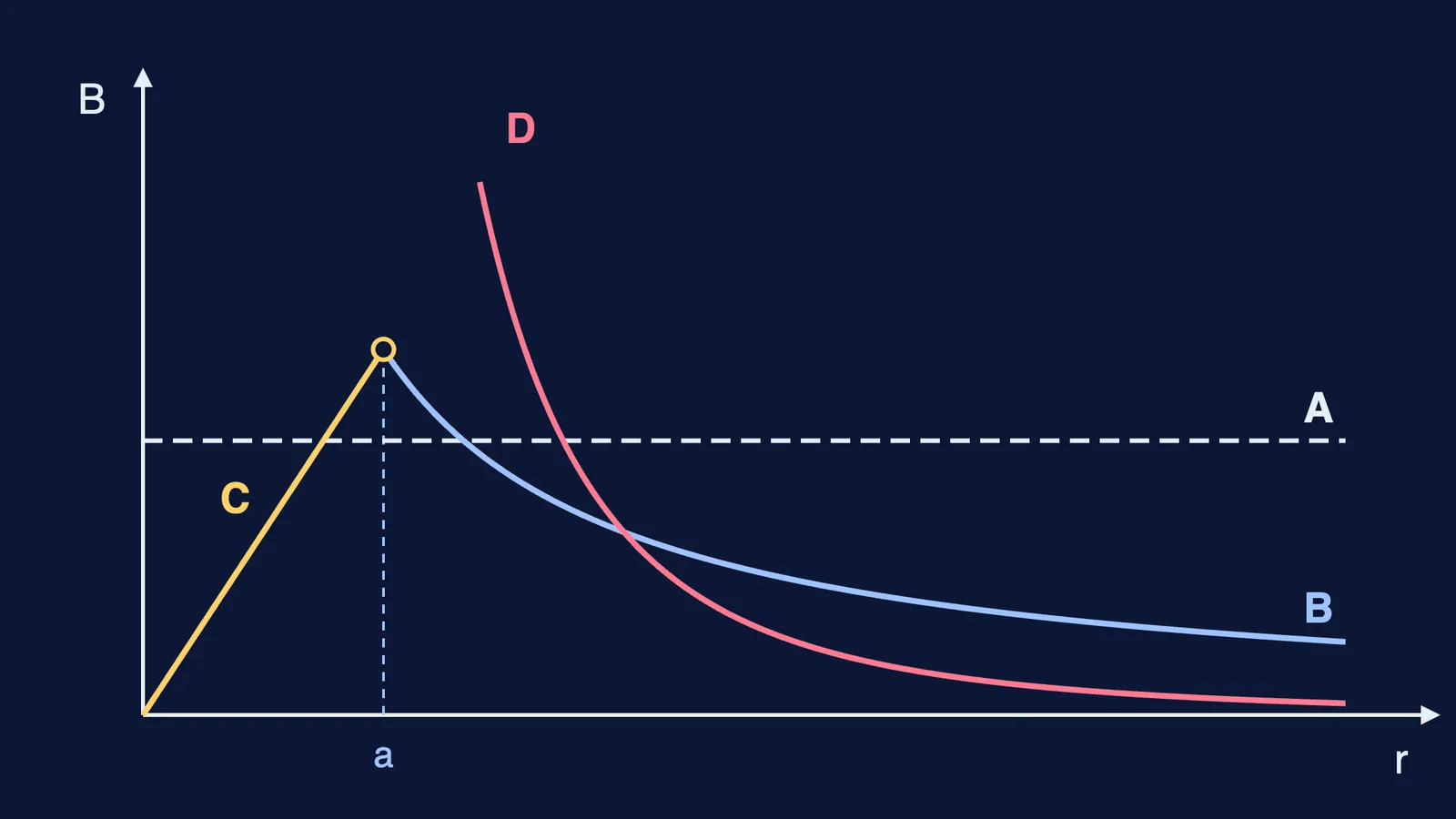
Q7 (medium, match). Match each field to how it varies with distance r (see the diagram). List-I: (A) Inside a long solenoid (B) Outside a long straight wire (C) Inside a long straight wire of radius a, uniform current, r < a (D) Far along a short bar magnet's axis. List-II: (I) B ∝ 1/r³ (II) B ∝ 1/r (III) B does not depend on r (IV) B ∝ r.
(1) A-III, B-II, C-IV, D-I (2) A-II, B-III, C-IV, D-I (3) A-III, B-IV, C-II, D-I (4) A-III, B-II, C-I, D-IV
Answer: (1). A: B = μ₀nI has no r. B: B = μ₀I/2πr. C: the loop encloses Ir²/a², so B ∝ r (NCERT Example 4.7). D: B = μ₀2m/4πr³.
Trap: (3) swaps inside and outside the wire.
Q8 (hard, match). A proton enters a uniform 0.25 T field at 5.0 × 10⁵ m/s, at 30° to the field. List-I: (A) Radius of the helix (B) Pitch of the helix (C) Time for one turn (D) Cyclotron frequency. List-II: (I) about 2.6 × 10⁻⁷ s (II) about 1.0 cm (III) about 3.8 MHz (IV) about 11 cm.
(1) A-IV, B-II, C-I, D-III (2) A-II, B-IV, C-I, D-III (3) A-II, B-IV, C-III, D-I (4) A-II, B-I, C-IV, D-III
Answer: (2). v⊥ = v sin 30° = 2.5 × 10⁵ m/s; v∥ ≈ 4.33 × 10⁵ m/s. A: r = mv⊥/qB ≈ 1.04 cm. C: T = 2πm/qB ≈ 2.62 × 10⁻⁷ s. B: p = v∥T ≈ 11.4 cm. D: ν = 1/T ≈ 3.81 MHz.
Trap: (1) swaps radius and pitch.
How do you work these faster?
In a match, lock the surest pair first and cancel options.
For two wires, draw both field arrows before adding.
For a helix, split v into v⊥ (radius) and v∥ (pitch) first.
For the method, read how to solve NEET match-the-list questions, then try the magnetism NEET practice set.
Is a helical path hard to picture? The Fermi Simulation Lab has interactive simulations for the ideas that are easier to see than to read.


