

On this page
Statement and match-the-list questions appear in recent JEE Main papers. Here are eight original magnetism ones.
What do these magnetism questions cover?
All fit Unit 13 of the NTA's Syllabus for JEE (Main) 2027. The JEE (Main) 2027 information bulletin marks MCQs +4 or −1. Answers follow NCERT Chapter 4 and Chapter 5. New to the chapter? Read how to prepare magnetism for JEE Main.
Take μ₀ = 4π × 10⁻⁷ T m A⁻¹.
Statement questions
Q1 (easy, Statement I/II). A 100 Ω galvanometer reads full scale at 5.0 mA. Statement I: A shunt of about 0.50 Ω makes it a 0–1 A ammeter. Statement II: For 0–2 A, the shunt must be about twice as large.
(1) Both correct (2) Both incorrect (3) I correct, II incorrect (4) I incorrect, II correct
Answer: (3). I is correct: S = IgG/(I − Ig) = 0.5/0.995 ≈ 0.50 Ω. II is incorrect: 0.5/1.995 ≈ 0.25 Ω, half.
Trap: (1) grows the shunt with range.
Q2 (medium, statements). A charge circles in a uniform field. Which are correct? A. Doubling its speed doubles its radius. B. That also halves its period. C. At equal kinetic energy, a deuteron's radius is twice a proton's. D. At equal momentum, an alpha particle's radius is half a proton's. E. Doubling the field halves the period.
(1) A, B and D only (2) A, D and E only (3) C, D and E only (4) A, C and E only
Answer: (2). A true: r = mv/qB. B false: T = 2πm/qB has no v. C false: r = √(2mK)/qB gives √2. D true: r = p/qB, charge 2e. E true: T ∝ 1/B.
Trap: (4) takes r ∝ m at equal kinetic energy.
Q3 (medium, Statement I/II). A loop of radius R carrying I has field B₀ at its centre. Statement I: On its axis, √3 R from the centre, the field is B₀/8. Statement II: A coplanar, concentric loop of radius 2R carrying I the opposite way makes the centre field B₀/2.
(1) Both correct (2) Both incorrect (3) I correct, II incorrect (4) I incorrect, II correct
Answer: (1). I is correct: R³/(R² + 3R²)^(3/2) = 1/8. II is correct: μ₀I/2R − μ₀I/4R = B₀/2.
Trap: (4) uses the far-field (R/x)³.
Q4 (hard, statements). A short magnet has moment 2.0 A m². Which are correct? A. At 10 cm on its axis, B = 0.40 mT. B. At 10 cm on its equatorial line, B = 0.20 mT along its moment. C. At 60° to a uniform 0.30 T field, the torque is about 0.52 N m. D. Turning it from 60° to 180° there takes 0.90 J. E. Its potential energy there is lowest at 90°.
(1) A, B and C only (2) A, C and D only (3) A, D and E only (4) B, C and D only
Answer: (2). A true: 10⁻⁷ × 2m/r³ = 4.0 × 10⁻⁴ T. B false: it opposes the moment. C true: mB sin 60° = 0.52 N m. D true: mB(cos 60° − cos 180°) = 0.90 J. E false: U = −mB cos θ is lowest at 0°.
Trap: (1) ignores direction.
Match-the-list questions
Q5 (easy, match). Each carries 5.0 A. Match the field. List-I: (A) a long straight wire, 10 cm away (B) centre of a circular loop of radius 10 cm (C) centre of a 10 cm semicircular arc with radial straight leads (D) inside a long solenoid, 1000 turns/m. List-II: (I) 10 μT (II) 15.7 μT (III) 31.4 μT (IV) 6.28 mT.
(1) A-II, B-III, C-I, D-IV (2) A-I, B-II, C-III, D-IV (3) A-III, B-I, C-II, D-IV (4) A-I, B-III, C-II, D-IV
Answer: (4). A-I: μ₀I/2πd. B-III: μ₀I/2R. C-II: half a loop; radial leads add nothing. D-IV: μ₀nI.
Trap: (2) swaps the full loop and the half loop.
Q6 (medium, match). Match each galvanometer change to its effect. List-I: (A) turns and coil resistance tripled: voltage sensitivity (B) turns tripled: current sensitivity (C) torsion constant doubled: voltage sensitivity (D) field halved and torsion constant tripled: current sensitivity. List-II: (I) unchanged (II) three times (III) halved (IV) one-sixth.
(1) A-I, B-II, C-III, D-IV (2) A-II, B-I, C-III, D-IV (3) A-I, B-II, C-IV, D-III (4) A-II, B-I, C-IV, D-III
Answer: (1). Current sensitivity NAB/k; voltage sensitivity NAB/kG. A-I: N and G both triple. B-II: ∝ N. C-III: ∝ 1/k. D-IV: (1/2) × (1/3).
Trap: (2) ignores the tripled resistance.
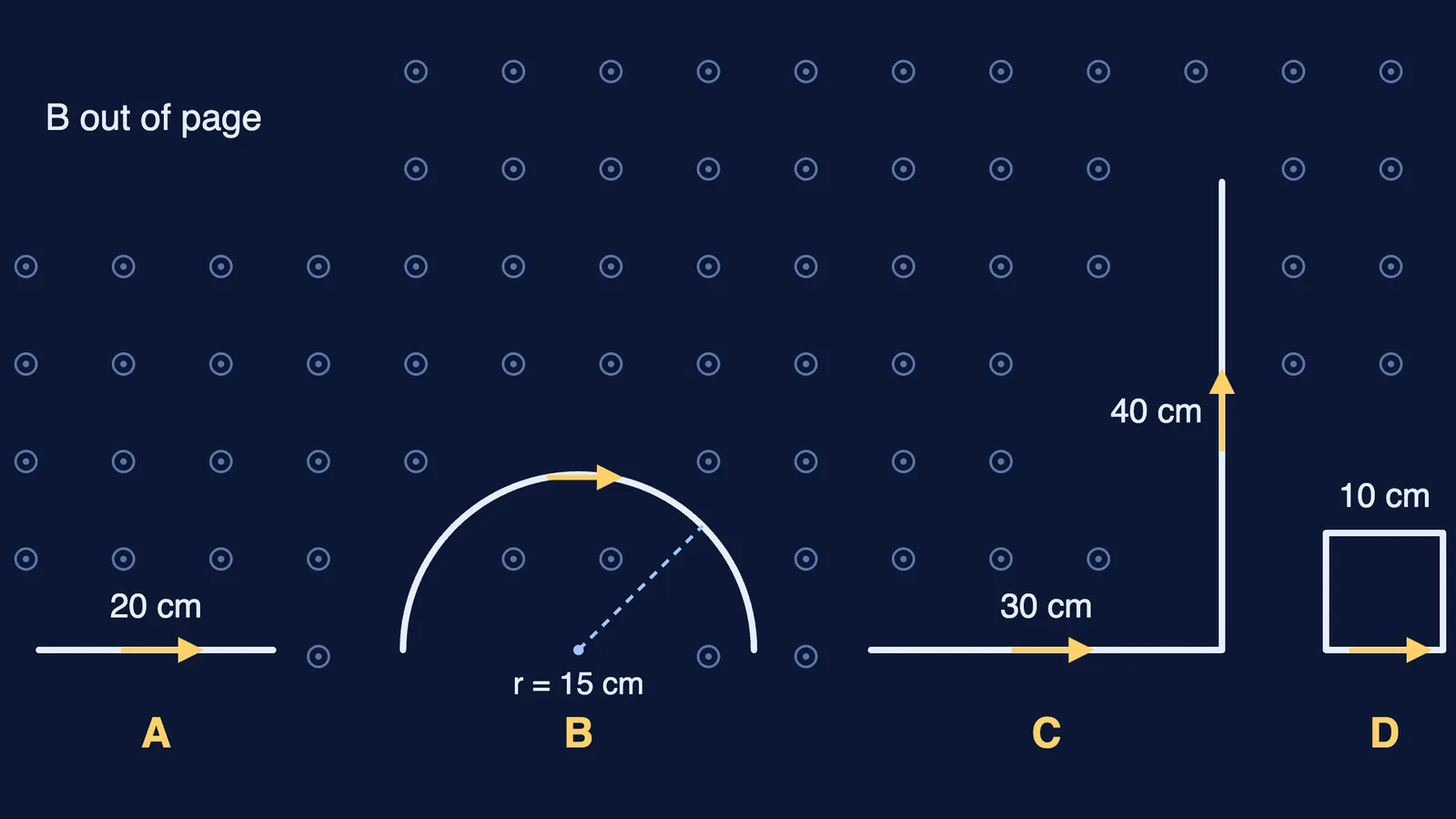
Q7 (medium, match). Wires in the page carry 2.0 A in a uniform 0.50 T field out of the page. Match the net force. List-I: (A) a straight wire 20 cm long (B) a semicircle of radius 15 cm (C) an L with arms 30 cm and 40 cm (D) a closed 10 cm square. List-II: (I) zero (II) 0.20 N (III) 0.30 N (IV) 0.50 N.
(1) A-II, B-IV, C-III, D-I (2) A-I, B-III, C-IV, D-II (3) A-II, B-III, C-IV, D-I (4) A-IV, B-III, C-II, D-I
Answer: (3). Each wire acts like the line joining its ends: F = IdB. A-II: 20 cm. B-III: the 30 cm diameter. C-IV: √(30² + 40²) = 50 cm. D-I: a closed loop.
Trap: (1) uses the semicircle's 47 cm arc.
Q8 (hard, match). Each loop carries 2.0 A. Match the magnetic moment, in 10⁻² A m². List-I: (A) a flat 20 cm square (B) that square folded 90° along a diagonal (C) a flat circle of radius 10 cm (D) that circle folded 90° along a diameter. List-II: (I) 4.44 (II) 5.66 (III) 6.28 (IV) 8.0.
(1) A-IV, B-III, C-II, D-I (2) A-IV, B-I, C-III, D-II (3) A-III, B-II, C-IV, D-I (4) A-IV, B-II, C-III, D-I
Answer: (4). m = IA, a vector; a folded loop is two loops sharing the fold. A-IV: 2.0 × 0.040. B-II: two 0.020 m² halves at 90°: 2.0 × 0.020 × √2. C-III: 2.0 × π × 0.010. D-I: 6.28/√2.
Trap: (3) assumes a circle always beats a square.
How do you work these faster?
Charges in a field: use r = p/qB or √(2mK)/qB, matching what is held equal.
Any wire in a uniform field: replace it by the line joining its ends.
A dipole's axial field points along m; its equatorial field points against m.
Stuck on a step? The Fermi Problem Library has worked problems with a step-by-step solver that explains the reasoning rather than printing an answer.
For numericals, try set 1 of our magnetism JEE Main practice questions.


