

On this page
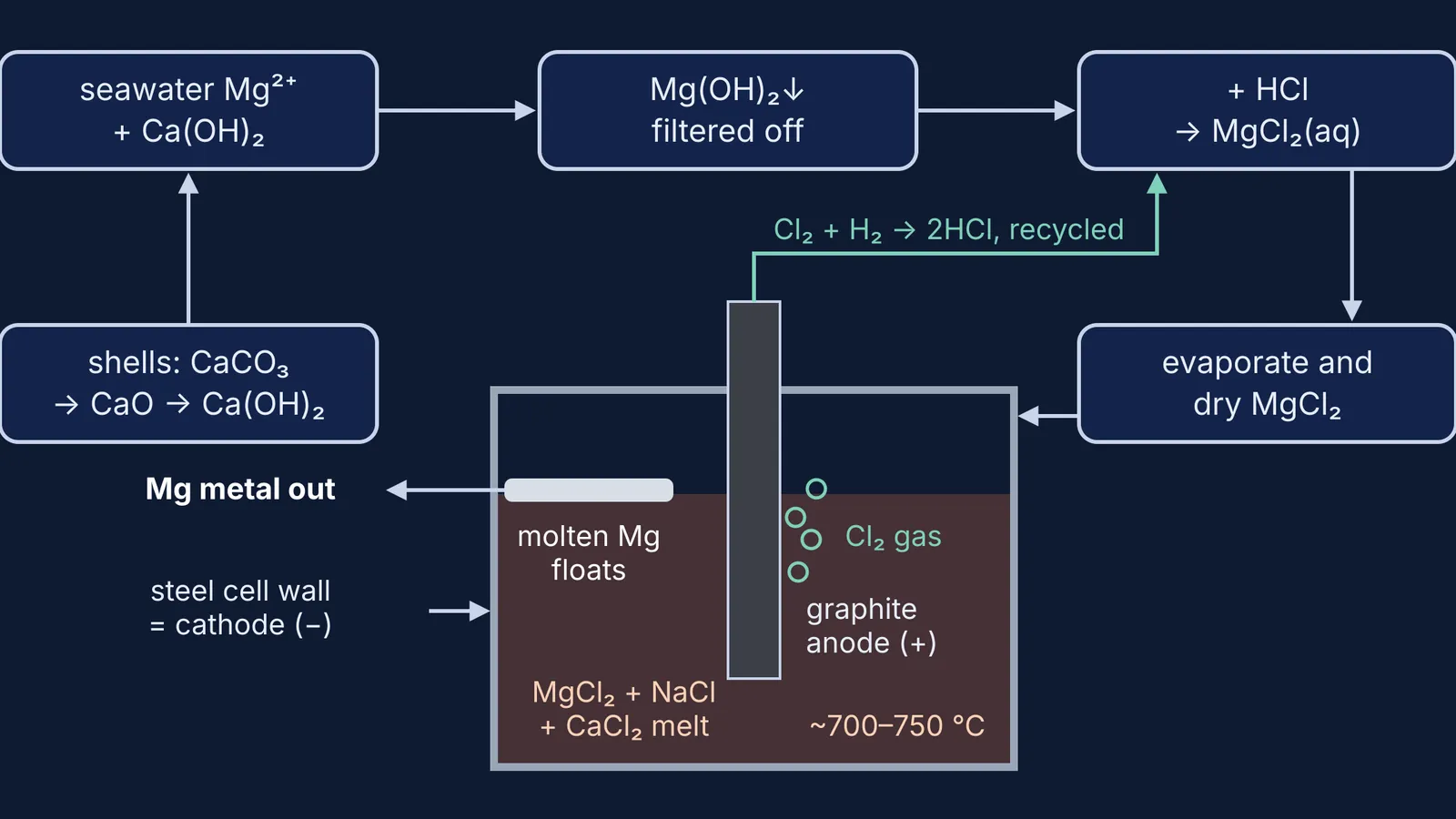
Seawater holds a lot of magnesium, and the Dow process gets it out. Lime made from seashells turns the dissolved magnesium into solid Mg(OH)₂. Hydrochloric acid turns that into magnesium chloride. A big electric current through the molten chloride then gives magnesium metal and chlorine, and the chlorine goes back to make more acid. JEE Advanced lists electrolytic reduction, with magnesium and aluminium as examples, but this chapter is no longer in the rationalised NCERT Class 12 book. This post walks through the route with two calculations: the pH needed to precipitate Mg(OH)₂, and the charge and energy for a kilogram of metal.
How much magnesium is in seawater?
Typical seawater contains about 1.29 g of magnesium per kilogram, as dissolved Mg²⁺ (seawater composition). After Na⁺, it is the most common cation in the sea. In moles, 1.29 ÷ 24.31 = 0.053 mol per kg, so [Mg²⁺] is about 0.053 M.
That sounds dilute, but the sea is large. Even if every bit were recovered, 1 kg of magnesium needs only about 1000 ÷ 1.29 ≈ 775 kg of seawater, less than a cubic metre.
Why is lime added to seawater?
To pull Mg²⁺ out as a solid, you precipitate magnesium hydroxide, which is only very slightly soluble:
Mg(OH)₂(s) ⇌ Mg²⁺(aq) + 2OH⁻(aq), Ksp = [Mg²⁺][OH⁻]²
The cheapest base is slaked lime. In the original Dow plant on the Texas coast, it came from oyster shells, which are mostly calcium carbonate:
CaCO₃ → CaO + CO₂ (strong heating, calcination)
CaO + H₂O → Ca(OH)₂ (slaking)
Mg²⁺ + Ca(OH)₂ → Mg(OH)₂↓ + Ca²⁺ (in the seawater)
Check the last one: Mg 1, Ca 1, O 2, H 2 on each side, and charge +2 on each side. Ca(OH)₂ is far more soluble than Mg(OH)₂, so it raises the OH⁻ level until the magnesium hydroxide comes out.
Worked example 1: what pH precipitates Mg(OH)₂?
Data tables disagree on Ksp for Mg(OH)₂: values from 5.6 × 10⁻¹² to 1.8 × 10⁻¹¹ at 25 °C are both common. We use 5.6 × 10⁻¹², the value listed in the magnesium hydroxide data.
Precipitation starts when the ionic product reaches Ksp: [Mg²⁺][OH⁻]² = 5.6 × 10⁻¹².
Put in [Mg²⁺] = 0.053 M: [OH⁻]² = 5.6 × 10⁻¹² ÷ 0.053 = 1.06 × 10⁻¹⁰.
[OH⁻] = 1.0 × 10⁻⁵ M, so pOH = 5.0.
pH = 14.0 − 5.0 = 9.0. Above pH 9, Mg(OH)₂ starts to form.
Compare seawater, pH about 8.1. Then [OH⁻] = 10⁻⁵·⁹ = 1.26 × 10⁻⁶ M, and the ionic product is 0.053 × (1.26 × 10⁻⁶)² = 8.4 × 10⁻¹⁴. That is about 70 times smaller than Ksp, so nothing precipitates by itself.
With Ksp = 1.8 × 10⁻¹¹ the threshold comes out at pH 9.3. Either way, seawater is about one pH unit short, and the lime supplies the extra OH⁻. To remove most of the magnesium, not just start precipitation, the pH has to go well above this threshold. For more Ksp problems worked in steps, the Fermi Problem Library has a solver that explains the reasoning at each line.
How is Mg(OH)₂ turned into MgCl₂?
The Mg(OH)₂ slurry settles, is filtered and is then dissolved in hydrochloric acid:
Mg(OH)₂ + 2HCl → MgCl₂ + 2H₂O
The solution is evaporated and the magnesium chloride is dried. Drying is the awkward part. Heated in air, hydrated MgCl₂ hydrolyses and loses HCl, leaving MgO that the cell cannot use. The reasons, and the dry-HCl fix, are in why heating MgCl₂·6H₂O gives MgO. The original Dow cells did not wait for fully anhydrous salt; they were fed partly dried MgCl₂ that still carried some water, and the water's oxygen slowly ate into the graphite anodes as a result.
What happens in the electrolytic cell?
The dried chloride is melted with NaCl and CaCl₂ and electrolysed at about 700–750 °C. Pure MgCl₂ melts at about 714 °C; the added salts lower the melting point of the bath and make it conduct better. Na⁺ and Ca²⁺ are not discharged, because Mg²⁺ (E° = −2.37 V) is easier to reduce than Na⁺ (−2.71 V) or Ca²⁺ (−2.87 V).
Cathode (steel, negative): Mg²⁺ + 2e⁻ → Mg
Anode (graphite, positive): 2Cl⁻ → Cl₂ + 2e⁻
Overall: MgCl₂ → Mg + Cl₂
Magnesium melts at about 650 °C, so it forms as a liquid. Liquid magnesium is less dense than the salt melt, so it rises and floats as a pool on the surface, where it is collected. The cell is built to keep that pool away from the chlorine, which would otherwise turn it back into MgCl₂.
Water cannot be the solvent. In aqueous MgCl₂, water is reduced to H₂ at the cathode long before Mg²⁺, which is why the salt must be molten.
Where does the chlorine go?
The chlorine from the anode is turned back into hydrochloric acid, for example by burning it with hydrogen: H₂ + Cl₂ → 2HCl. That acid dissolves the next batch of Mg(OH)₂. The loop closes in the numbers too. Each Mg needs 2HCl to make MgCl₂, and each MgCl₂ gives one Cl₂, which can make 2HCl again. Per kilogram of magnesium that is about 2.92 kg of Cl₂ and 3.00 kg of HCl going round the loop, with only losses to top up.
Worked example 2: how much charge and energy for 1 kg of Mg?
Moles of Mg: 1000 ÷ 24.31 = 41.1 mol.
Each Mg²⁺ needs 2 electrons: 2 × 41.1 = 82.3 mol of electrons.
Charge: 82.3 × 96 485 C = 7.94 × 10⁶ C.
Energy = charge × cell voltage. Assume, for illustration, a cell running at 6 V: 7.94 × 10⁶ × 6 = 4.8 × 10⁷ J.
Convert: 4.8 × 10⁷ ÷ 3.6 × 10⁶ = 13 kWh per kg.
Treat 13 kWh as an estimate, not a plant figure. The 6 V is an assumption. Real cell voltage is not E°: it adds the resistance of the bath and the overpotentials at the electrodes, and differs from plant to plant. Current efficiency is also below 100%. At an assumed 80%, the same cell would use about 16.5 kWh per kg. For comparison, the competing thermal route reduces MgO with silicon instead of electricity, as told in Lloyd Pidgeon and the Pidgeon process.
Quick checklist
Seawater: about 1.29 g Mg per kg, so [Mg²⁺] ≈ 0.053 M.
Lime from shells: CaCO₃ → CaO → Ca(OH)₂.
Mg²⁺ + Ca(OH)₂ → Mg(OH)₂↓ + Ca²⁺; needs pH above about 9 (Ksp 5.6 × 10⁻¹²).
Mg(OH)₂ + 2HCl → MgCl₂ + 2H₂O, then dry the chloride.
Electrolyse molten MgCl₂ + NaCl + CaCl₂ at about 700–750 °C.
Cathode: Mg²⁺ + 2e⁻ → Mg (floats). Anode: 2Cl⁻ → Cl₂ + 2e⁻ (recycled to HCl).
1 kg Mg needs 7.94 × 10⁶ C; at an assumed 6 V, about 13 kWh.


