

On this page
Eight original questions on Unit 3 of the NMC syllabus for NEET (UG)-2026. Facts follow the NCERT Class 11 chapter on laws of motion. Take g = 10 m/s², sin 37° = 0.6, cos 37° = 0.8. See our guide on how to prepare laws of motion for NEET.
Statement questions: which statements are correct?
Statement options: (1) Both true (2) Both false (3) I true, II false (4) I false, II true.
Q1 (easy, statements). Statement I: The SI unit of impulse, N s, is equivalent to kg m/s, the unit of momentum. Statement II: A cricket ball thrown vertically upward is in equilibrium at the instant it stops at the top.
Answer: (3). I true: 1 N s = 1 kg m s⁻² × s. II false: at the top v = 0, but the net force is still mg, so the acceleration is g. Trap: (1) confuses zero velocity with zero force.
Q2 (medium, statements). Which statements are correct? A. Static friction on a body at rest can be smaller than μsN. B. Kinetic friction is nearly independent of the sliding speed. C. Kinetic friction grows with contact area at fixed normal force. D. For the same weight, rolling friction is much smaller than sliding friction. E. μk is generally greater than μs.
(1) A, C and D only (2) B, D and E only (3) A and D only (4) A, B and D only
Answer: (4). A true: static friction self-adjusts. B true: NCERT says nearly independent of velocity. C false: friction is independent of contact area. D true: NCERT puts it 2 or 3 orders of magnitude lower. E false: μk < μs. Trap: (3) drops B.
Q3 (medium, statements). A 3 kg shell at rest in space explodes into a 1 kg piece moving at 12 m/s and a 2 kg piece. Statement I: The 2 kg piece moves at 6 m/s, opposite to the 1 kg piece. Statement II: Both pieces receive impulses of magnitude 12 N s.
Answer: (1). I: momentum stays zero, so 2v = 12 and v = 6 m/s. II: 1 × 12 = 2 × 6 = 12 N s. Trap: (3) assumes the heavier piece gets the bigger impulse.
Q4 (hard, statements). A 10 kg block rests on a floor with μs = 0.5 and μk = 0.4. Which statements are correct? A. Pulled by a rope at 37° above the horizontal, it feels a normal force below 100 N. B. The least 37° pull that starts it moving is about 45 N. C. A push at 37° below the horizontal needs less force than that pull. D. A horizontal pull needs less force than the 37° pull. E. Once sliding, a 40 N horizontal pull keeps its velocity constant.
(1) A, B and D only (2) A, B and E only (3) B, C and E only (4) A, C and D only
Answer: (2). A true: N = 100 − 0.6F. B true: 0.8F = 0.5(100 − 0.6F) gives F ≈ 45.5 N. C false: a push raises N, giving 50/0.5 = 100 N. D false: horizontally 50 N is needed. E true: kinetic friction is 40 N. Trap: (1) assumes horizontal is easiest.
Match-the-list questions: how do you pair them?
Q5 (easy, match). Match List-I with List-II. List-I: A. Impulse B. Rate of change of momentum C. Coefficient of static friction D. v²/R List-II: I. [LT⁻²] II. [M⁰L⁰T⁰] III. [MLT⁻¹] IV. [MLT⁻²]
(1) A-IV, B-III, C-II, D-I (2) A-III, B-IV, C-II, D-I (3) A-III, B-IV, C-I, D-II (4) A-IV, B-III, C-I, D-II
Answer: (2). Impulse is momentum change (III), its rate is force (IV), μs is a ratio (II), v²/R an acceleration (I). Trap: (1) gives B momentum's dimensions.
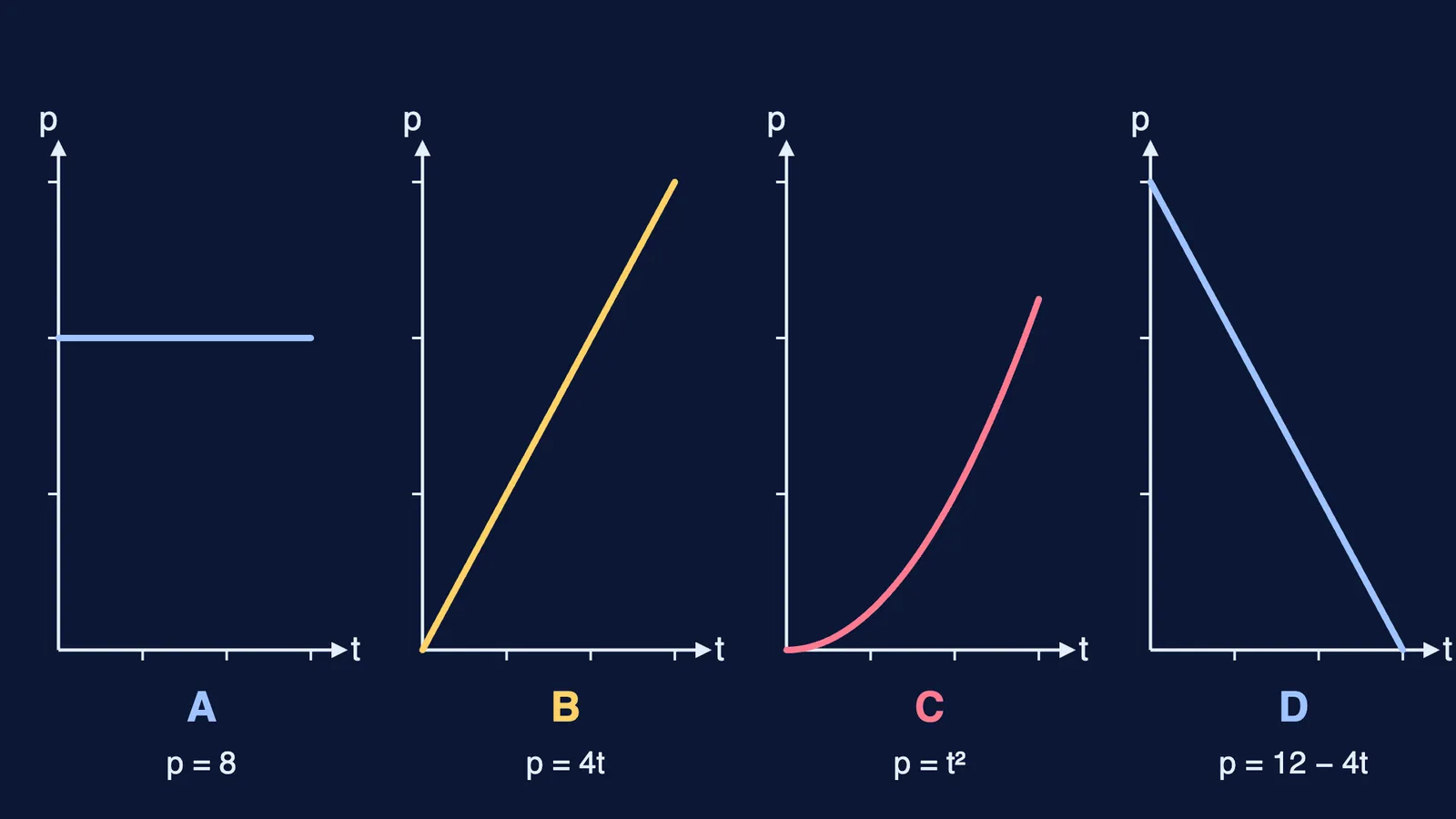
Q6 (medium, match). Match each momentum–time graph (above) with the net force on a body moving along a line. List-I: A. p = 8 kg m/s, constant B. p = 4t C. p = t² D. p falls steadily from 12 kg m/s to zero in 3 s List-II: I. Zero II. Constant 4 N along the motion III. Constant 4 N against the motion IV. Increasing linearly with time
(1) A-I, B-II, C-III, D-IV (2) A-I, B-IV, C-II, D-III (3) A-III, B-II, C-IV, D-I (4) A-I, B-II, C-IV, D-III
Answer: (4). Force is the slope dp/dt: zero (A), 4 N (B), 2t (C) and −12/3 = −4 N (D). Trap: (2) reads rising momentum as rising force.
Q7 (medium, match). Match each motion with its centripetal force. List-I: A. Car turning on a level road B. Car on a banked road at v = √(Rg tan θ) C. Planet in a near-circular orbit round the Sun D. Electron in Bohr's model of hydrogen List-II: I. Gravitational force II. Friction between tyres and road III. Electrostatic attraction IV. Horizontal component of the normal force
(1) A-IV, B-II, C-I, D-III (2) A-II, B-IV, C-III, D-I (3) A-II, B-IV, C-I, D-III (4) A-IV, B-II, C-III, D-I
Answer: (3). A-II: friction. B-IV: NCERT shows no friction is needed at this optimum speed. C-I: gravity. D-III: the nucleus's electric pull. Trap: (1) gives the banked car friction.
Q8 (hard, match). A 3 kg block on a table (μs = 0.6, μk = 0.5) is joined by a string over a smooth pulley to a hanging 2 kg block, then released. List-I: A. Tension B. Friction on the 3 kg block C. Net force on the 2 kg block D. Net force on the 3 kg block List-II: I. 2 N II. 3 N III. 15 N IV. 18 N
(1) A-IV, B-III, C-I, D-II (2) A-III, B-IV, C-I, D-II (3) A-IV, B-III, C-II, D-I (4) A-III, B-IV, C-II, D-I
Answer: (1). Limiting friction 18 N < 20 N, so it slides: B-III, 0.5 × 30 = 15 N. Then a = 5/5 = 1 m/s², so T = 2(10 − 1) = 18 N (A-IV), and the net forces are 2 N (C-I) and 3 N (D-II). Trap: (2) keeps friction at μsN = 18 N after sliding starts.
How do you work these faster?
On a p–t graph read the slope; its sign says whether force is along or against the motion.
Before using μ, ask whether it has slipped; see Q4 and Q8.
For any curve, name the real force pointing to the centre before writing mv²/R.
Same wrong method again? The Fermi Problem Library has a step-by-step solver that explains the reasoning. See our guide to NEET match-the-list questions and our laws of motion NEET practice questions with solutions.


