

On this page
Statement and match-the-list questions appear in recent JEE Main papers. These eight original questions follow Unit 3 of the NTA syllabus for JEE (Main) 2027 and NCERT Class 11 Physics, Chapter 4. For a plan: how to prepare laws of motion for JEE Main. Take g = 10 m/s², sin 37° = 0.6, cos 37° = 0.8.
Statement questions: how do you judge them?
Options for I/II: (1) Both true (2) Both false (3) I true, II false (4) I false, II true.
Q1 (easy, statements). Blocks P (4 kg) and Q (6 kg) touch on a smooth floor; 30 N pushes P toward Q. Statement I: The contact force is 18 N. Statement II: Pushing Q toward P instead, it stays 18 N.
Answer: (3). I true: a = 3 m/s²; the contact force accelerates Q: 18 N. II false: it accelerates P: 12 N. Trap: (1) ignores which block is pushed.
Q2 (easy, statements). A 60 kg skater on a 40 kg trolley, on a smooth floor, jumps off horizontally at 4 m/s (ground frame). Which are correct? A. The trolley recoils at 6 m/s. B. The trolley's impulse is 240 N s. C. They push each other equally. D. At 4 m/s relative to the trolley, it recoils at 1.6 m/s. E. Kinetic energy is conserved.
(1) A and B only (2) A, B and C only (3) A, B and D only (4) A, B, C and E only
Answer: (2). A, B: 60 × 4 = 40 × 6 = 240 N s. C: third law. D false: u + V = 4 and 60u = 40V give 2.4 m/s. E false: KE rises from zero. Trap: (3) takes the skater's 1.6 m/s for the trolley's.
Q3 (medium, statements). A 50 kg worker stands on a 30 kg cradle and pulls down on a rope that runs from the cradle over a ceiling pulley back to his hands. Statement I: Rising steadily, he pulls 800 N. Statement II: Rising at 2 m/s², he pulls 480 N and the cradle pushes him up with 120 N.
Answer: (4). I false: two rope segments hold the system, 2T = 800, so T = 400 N. II true: 2T − 800 = 80 × 2 gives T = 480 N; for him, T + N − 500 = 50 × 2, so N = 120 N. Trap: (3) forgets the rope also pulls him.
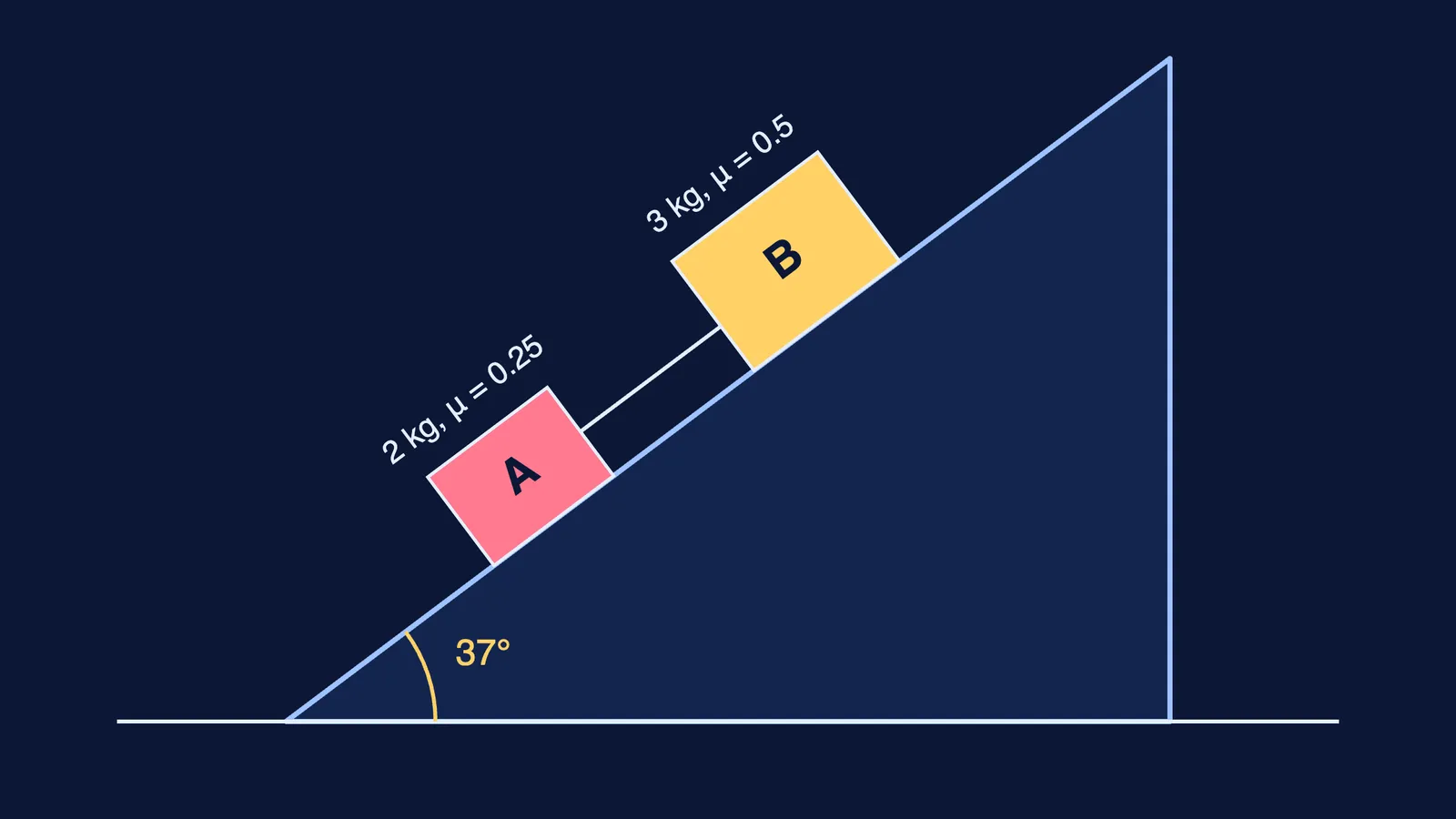
Q4 (hard, statements). On a 37° incline, A (2 kg, μ = 0.25) sits below B (3 kg, μ = 0.5), tied by a string, released from rest. Which are correct? A. Both slide at 2.8 m/s². B. Tension is 2.4 N. C. Friction on A is 5 N. D. Swapped, tension just after release is zero. E. String cut, A slides at 2.8 m/s².
(1) A, B and D only (2) A, C and D only (3) A, B and E only (4) B, D and E only
Answer: (1). Alone, A slides at 4 m/s², B at 2: taut string. A true: a = (30 − 4 − 12)/5 = 2.8 m/s². B true: for block A, 12 − 4 − T = 2 × 2.8, so T = 2.4 N. C false: 0.25 × mg cos 37° = 4 N. D true: the faster block trails. E false: 4 m/s². Trap: (2) uses μmg.
Match-the-list questions: how do you pair them?
Q5 (easy, match). Net force on a 2 kg ball. List-I: A. Free fall B. Steady 5 m/s in a line C. 2 m/s on a 0.5 m radius circle on a smooth table D. Speed rising steadily along a line, 1 to 4 m/s in 1 s. List-II: I. 0 II. 6 N III. 16 N IV. 20 N
(1) A-IV, B-III, C-I, D-II (2) A-II, B-I, C-III, D-IV (3) A-IV, B-I, C-III, D-II (4) A-IV, B-I, C-II, D-III
Answer: (3). A: 20 N. B: zero. C: mv²/r = 16 N. D: 2 × 3/1 = 6 N. Trap: (1) calls uniform circular motion force-free.
Q6 (medium, match). Match two of three balancing forces with the third. List-I: A. 6 N, 8 N at 90° B. 8 N, 8 N at 120° C. 5 N, 12 N at 90° D. 3 N, 5 N at 60°. List-II: I. 7 N II. 8 N III. 10 N IV. 13 N
(1) A-III, B-IV, C-II, D-I (2) A-III, B-I, C-IV, D-II (3) A-IV, B-II, C-III, D-I (4) A-III, B-II, C-IV, D-I
Answer: (4). Third = √(a² + b² + 2ab cos θ). A: 10 N. B: √(128 − 64) = 8 N. C: 13 N. D: √49 = 7 N. Trap: cos 120° is −0.5; taking +0.5 gives about 13.9 N for B, not 8 N.
Q7 (medium, match). A 0.2 kg coin (μs = 0.5, μk = 0.4) sits on a turntable slowly brought up to ω. Match its friction. List-I: A. r = 0.1 m, ω = 5 rad/s B. r = 0.2 m, ω = 3 rad/s C. r = 0.5 m, ω = 3 rad/s D. r = 0.4 m, ω raised towards 5 rad/s (just after it starts to slide, if it does). List-II: I. 0.36 N II. 0.5 N III. 0.8 N IV. 0.9 N
(1) A-II, B-I, C-III, D-IV (2) A-II, B-I, C-IV, D-III (3) A-I, B-II, C-IV, D-III (4) A-II, B-IV, C-I, D-III
Answer: (2). Static friction gives mω²r, up to 1 N. A: 0.5 N. B: 0.36 N. C: 0.9 N. D would need 2 N at 5 rad/s (it slips near 3.5 rad/s), so it slides: μkmg = 0.8 N. Trap: (1) slips the outermost coin, C; ω²r decides.
Q8 (hard, match). A car rounds a curve of radius 30 m, banked at 37°, μs = 0.4. List-I: A. 15 m/s B. 20 m/s C. 12 m/s D. 25 m/s. List-II: I. No friction needed II. Friction down the slope, holds III. Friction up the slope, holds IV. Slides up the bank
(1) A-I, B-II, C-III, D-IV (2) A-I, B-III, C-II, D-IV (3) A-I, B-II, C-IV, D-III (4) A-III, B-II, C-I, D-IV
Answer: (1). No friction at v² = Rg tan θ = 225: A-I. Faster, friction points down; vmax² = Rg(tan θ + μ)/(1 − μ tan θ) ≈ 493, 22.2 m/s: B-II, D-IV. Slower, it points up; vmin² = Rg(tan θ − μ)/(1 + μ tan θ) ≈ 81, 9 m/s: C-III. Trap: (2) puts friction up the slope at 20 m/s; above the no-friction speed it points down.
How do you work these faster?
Ask which bodies a contact force or rope accelerates.
On slopes, compare each block's solo acceleration.
Before using μN, confirm slipping.
On curves, find the no-friction speed first.
Same slip twice? The Fermi Problem Library has worked problems with a step-by-step solver that explains the reasoning rather than printing an answer. More: our laws of motion JEE Main practice questions with solutions.


