

On this page
Eight original laws of motion questions that ask for a number, as in Section B of JEE Main physics, easy to hard, each with its most likely wrong number. Take g = 10 m/s², sin 37° = 0.6 and cos 37° = 0.8.
How are numerical-value questions marked in JEE Main?
The JEE (Main) 2027 information bulletin from NTA gives each subject 20 multiple-choice questions in Section A and 5 numerical-value questions in Section B. In Section B, a correct answer earns +4 and an incorrect answer −1, and the answer should be rounded off to the nearest integer.
All eight questions sit inside Unit 3, Laws of Motion, of the NTA syllabus for JEE (Main) 2027: momentum, friction and circular motion on a level road, also in Chapter 4 of NCERT Class 11 Physics Part I. For theory and a plan, see how to prepare laws of motion for JEE Main.
Easy: can you apply one law cleanly?
Q1 (easy). Sand falls vertically onto a horizontal conveyor belt at 4 kg/s. The belt runs at a steady 1.5 m/s. Find the extra horizontal force the motor must apply to keep that speed, in newtons.
Answer: 6. Each second, 4 kg of sand goes from zero to 1.5 m/s along the belt, so F = (dm/dt)v = 4 × 1.5 = 6 N.
Trap: 0, from "constant speed means no force"; the moving mass keeps growing.
Q2 (easy). A 3 kg block hangs above a 2 kg block, joined by a light string. A rope pulls the top block upward with 75 N. Find the tension in the string between the blocks, in newtons.
Answer: 30. For both blocks, 75 − 50 = 5a, so a = 5 m/s² upward. For the 2 kg block, T − 20 = 2 × 5, so T = 30 N.
Trap: 20, the lower block's weight, true only at rest.
Q3 (easy). A car moving at 72 km/h on a level road brakes hard and skids with locked wheels. The coefficient of kinetic friction is 0.5. Find the skid distance, in metres.
Answer: 40. Friction gives a deceleration μg = 5 m/s². At 20 m/s, d = v²/(2a) = 400 / 10 = 40 m.
Trap: 518, from squaring 72 without converting km/h to m/s.
Medium: can you combine two steps?
Q4 (medium). A 0.2 kg ball is dropped from 5 m onto a hard floor and rebounds to 1.25 m. It is in contact with the floor for 0.01 s. Find the average force the floor exerts on the ball during contact, in newtons.
Answer: 302. It lands at √(2 × 10 × 5) = 10 m/s and leaves at 5 m/s upward. Δp = 0.2 × 15 = 3 kg m/s, so the net force is 3 / 0.01 = 300 N. Add the 2 N weight the floor also supports: 302 N.
Trap: 300, the net force; 100, from subtracting the speeds.
Q5 (medium). A 10 kg box rests on the floor of a lift that accelerates upward at 2 m/s². Between box and floor, μs = 0.4 and μk = 0.3. A horizontal 60 N pull acts on the box. Find its acceleration relative to the lift, in units of 0.1 m/s².
Answer: 24. The floor pushes up with N = m(g + a) = 120 N, so friction can reach 0.4 × 120 = 48 N. The 60 N pull exceeds that, so the box slides, against kinetic friction 0.3 × 120 = 36 N: a = (60 − 36) / 10 = 2.4 m/s².
Trap: 30, from taking N = mg in an accelerating lift.
Q6 (medium). A uniform 1 m chain lies on a rough horizontal table, part of it hanging over the edge. The coefficient of static friction between chain and table is 0.25. Find the greatest length that can hang without the chain sliding, in cm.
Answer: 20. At the limit, the hanging weight equals friction on the part lying on the table: x = 0.25(1 − x), so x = 0.25 / 1.25 = 0.2 m = 20 cm.
Trap: 25, taking friction on the whole chain.
Hard: where does friction run out?
Q7 (hard). A car starts from rest on a flat circular track of radius 100 m and speeds up at a steady 3 m/s² along the track. The coefficient of static friction between tyres and road is 0.5. Find the distance it covers along the track before it starts to skid, in metres, rounded to the nearest integer.
Answer: 67. Friction supplies the tangential 3 m/s² and the centripetal v²/r, together at most μg = 5 m/s². Skidding starts when √(3² + (v²/100)²) = 5, so v²/100 = 4 and v² = 400. Then s = v²/(2 × 3) = 400 / 6 ≈ 66.7 m, so 67.
Trap: 83, from v² = μgr = 500, ignoring the friction used for speeding up.
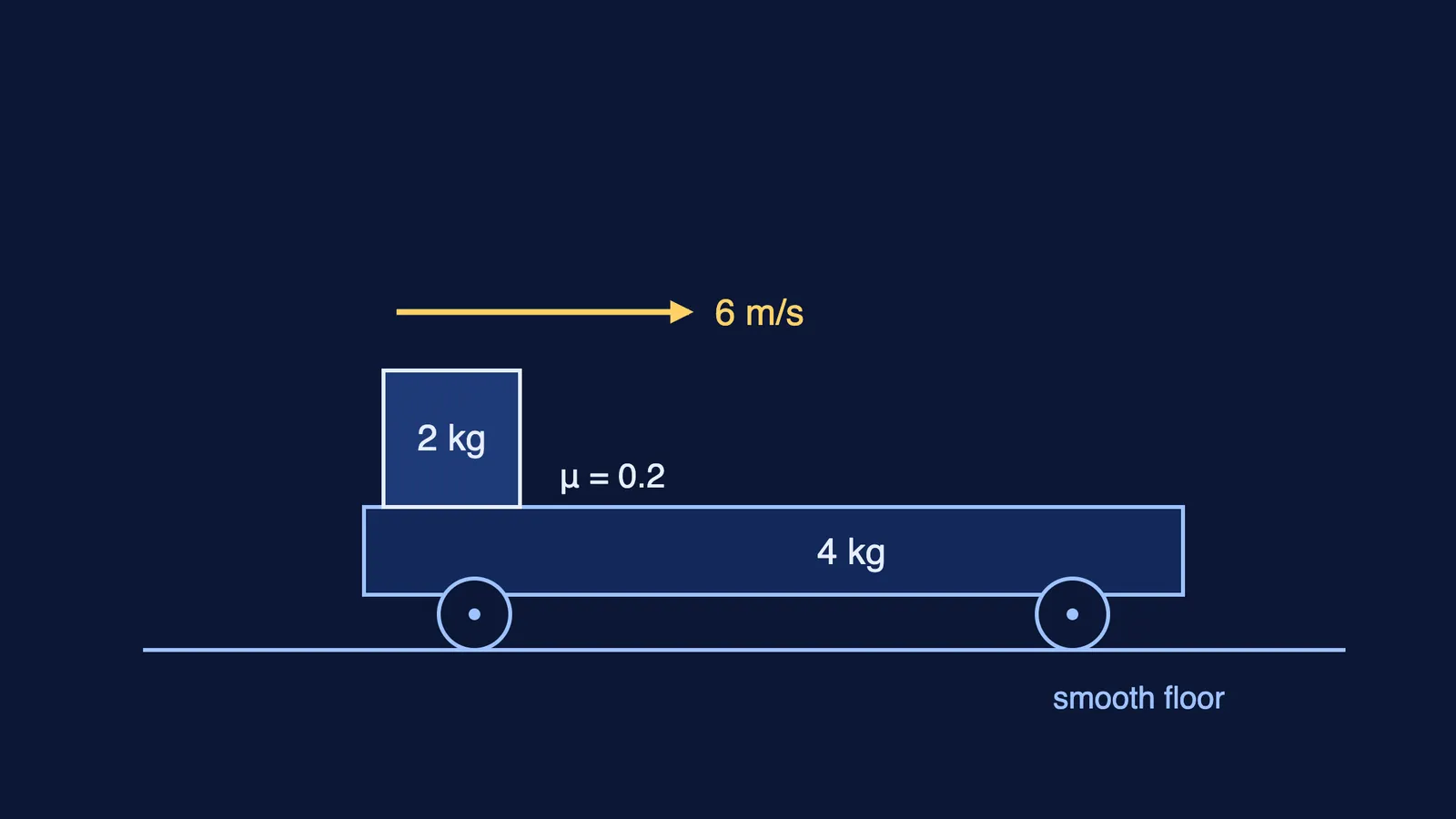
Q8 (hard). A 2 kg block slides at 6 m/s onto a 4 kg cart at rest on a smooth floor. The coefficient of kinetic friction between block and cart is 0.2, and the cart is long. Find how far the block slides along the cart before it stops slipping, in metres.
Answer: 6. Momentum conservation gives a common speed of 12 / 6 = 2 m/s. Friction is 0.2 × 20 = 4 N, so the block slows at 2 m/s² and the cart speeds up at 1 m/s²; they match after 2 s. The block covers 6 × 2 − ½ × 2 × 4 = 8 m and the cart ½ × 1 × 4 = 2 m, so the block slides 8 − 2 = 6 m along the cart.
Trap: 8, the block's distance over the ground.
How do you get the number right?
Convert km/h to m/s before squaring (Q3).
On a rebound, add the speeds (Q4).
Ask which force the stem wants: net, contact or tension.
Keep full precision, then round once to the nearest integer (Q7).
In a lift, find N from the lift's acceleration before using μN (Q5).
For options-style practice, try our laws of motion JEE Main practice questions with solutions.
Typing the same wrong number twice? The Fermi Problem Library has worked problems with a step-by-step solver that explains the reasoning rather than printing an answer.


