

On this page
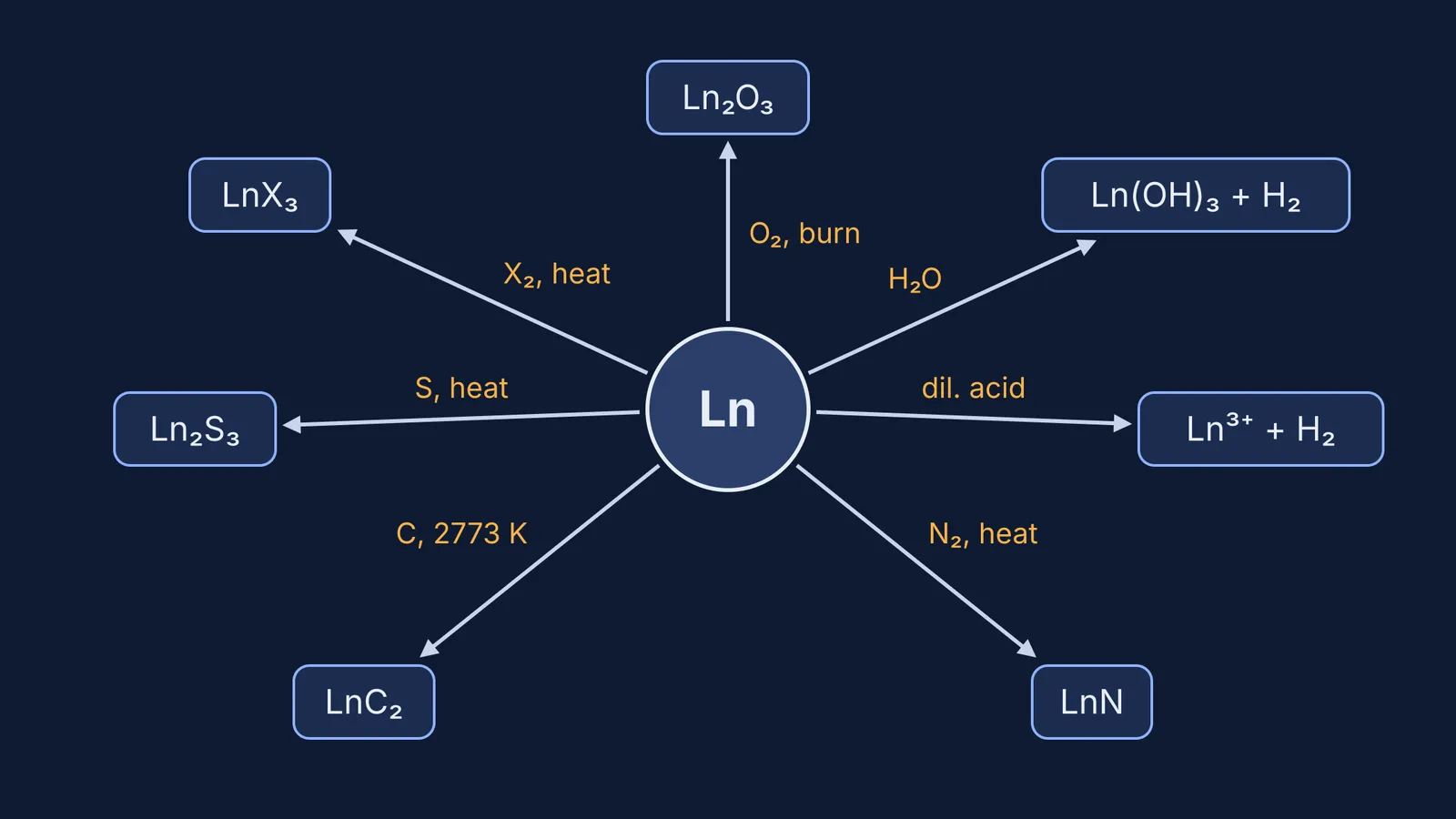
Most of what you learn about lanthanoids is about their ions: the +3 state, the shrinking radii, the colours. NCERT also has a short section on the metals themselves, summed up in one figure with Ln in the middle and arrows to oxygen, water, acids, nitrogen, carbon, sulphur and the halogens. Questions on it test whether you can write the products, balance the equations and do the mole arithmetic. Here is each reaction, why the metals are so reactive, and a worked hydrogen-volume problem.
How reactive are the lanthanoid metals?
They are silvery-white, soft metals that tarnish quickly in air. NCERT puts their reactivity in one line: the earlier members are quite reactive, similar to calcium, and with increasing atomic number they behave more like aluminium.
The electrode potentials explain this. For Ln³⁺(aq) + 3e⁻ → Ln(s), NCERT gives E° values of about −2.2 to −2.4 V across the series, with europium at about −2.0 V. That is close to magnesium (about −2.37 V) and well below aluminium (about −1.66 V). A metal with such a negative E° gives up electrons easily, so it reduces water, acids and many non-metals.
Two cautions keep your answers accurate:
E° tells you what is thermodynamically possible, not how fast it happens. With cold water most lanthanoids react slowly, and the reaction speeds up on warming, partly because a hydroxide or oxide layer forms on the surface.
Reactivity is not constant along the series. The heavier members react more sluggishly, which is what NCERT means by "more like aluminium".
What do lanthanoids form with oxygen, water and acids?
In each reaction below, Ln stands for a typical lanthanoid in its usual +3 state.
Oxygen. The metals tarnish in air and burn when heated in oxygen to give the oxide Ln₂O₃: 4Ln + 3O₂ → 2Ln₂O₃.
Water. Hydrogen is released and the hydroxide forms: 2Ln + 6H₂O → 2Ln(OH)₃ + 3H₂.
Dilute acids. Hydrogen again, this time with a soluble salt: 2Ln + 6HCl → 2LnCl₃ + 3H₂, or in ionic form 2Ln + 6H⁺ → 2Ln³⁺ + 3H₂.
The oxide rule has a well-known exception. Cerium burns to CeO₂, with Ce in the +4 state, because Ce⁴⁺ has the empty 4f⁰ configuration. Praseodymium and terbium also give oxides with some metal in the +4 state (Pr₆O₁₁ and Tb₄O₇) when heated in air. If an exam question just says "Ln", write Ln₂O₃. If it names cerium, think of CeO₂. Why Ce⁴⁺ exists at all is explained in why Ce⁴⁺ is oxidising and Eu²⁺ is reducing.
NCERT also notes that the metals combine with hydrogen when gently heated in the gas.
What do lanthanoids form with nitrogen, carbon, sulphur and halogens?
These reactions need heat, which is why the figure puts a condition on each arrow.
Nitrogen, heated. The nitride LnN forms: 2Ln + N₂ → 2LnN. Each N is N³⁻, matching Ln³⁺, just as Mg₃N₂ matches Mg²⁺.
Carbon at 2773 K. The carbide LnC₂ forms: Ln + 2C → LnC₂. NCERT's text also lists Ln₃C and Ln₂C₃ as carbides formed with carbon, but the figure and most questions use LnC₂.
Sulphur, heated. The sulphide Ln₂S₃ forms: 2Ln + 3S → Ln₂S₃.
Halogens. The metals burn in halogens to give LnX₃: 2Ln + 3X₂ → 2LnX₃.
Check each formula by charges: one Ln³⁺ needs three Cl⁻ or one N³⁻, and two Ln³⁺ need three S²⁻. The carbide is the odd one out.
What gas does a lanthanoid carbide give with water?
Calcium carbide, CaC₂, contains the C₂²⁻ ion. With water it gives ethyne cleanly: CaC₂ + 2H₂O → Ca(OH)₂ + C₂H₂. It is tempting to say LnC₂ does the same. It does not, quite.
Count the charges. In LnC₂ the metal is Ln³⁺ and the carbon unit is C₂²⁻, so one electron per formula unit is left over. That spare electron is why LaC₂ conducts like a metal. When the carbide meets water, the C₂²⁻ is protonated to ethyne and the spare electron reduces water to hydrogen. An idealised equation is:
2LaC₂ + 6H₂O → 2La(OH)₃ + 2C₂H₂ + H₂
Check it: La 2 = 2; C 4 = 4; H 12 = 6 + 4 + 2; O 6 = 6. In practice the gas is mainly ethyne, with some hydrogen and smaller amounts of other hydrocarbons. So the safe answer is "mainly ethyne", never "only ethyne". The nitride is simpler: LaN + 3H₂O → La(OH)₃ + NH₃, exactly like the nitrides in which gas each carbide and nitride gives on hydrolysis.
Why does the basicity of Ln(OH)₃ fall from La to Lu?
NCERT stresses that Ln(OH)₃ are definite compounds, not just hydrated oxides, and that they are basic, like the alkaline earth hydroxides. Across the series the basic character decreases: La(OH)₃ is the most basic and Lu(OH)₃ the least.
The cause is the shrinking ion. The Ln³⁺ radius falls from about 103 pm for La³⁺ to about 86 pm for Lu³⁺ (six-coordinate values). The same +3 charge on a smaller ion polarises the oxygen of the hydroxide more strongly, so the Ln–OH bond becomes more covalent and releases OH⁻ less readily. This is one consequence of the lanthanoid contraction and its effects.
Worked example: hydrogen from lanthanum and water
Question. 1.389 g of lanthanum reacts completely with water. Find the volume of hydrogen at STP (1 bar, 273.15 K) and the mass of La(OH)₃ formed. La = 138.9 g mol⁻¹.
Write and balance the equation. 2La + 6H₂O → 2La(OH)₃ + 3H₂. Check: La 2 = 2, H 12 = 6 + 6, O 6 = 6.
Moles of La. n = 1.389 / 138.9 = 0.01000 mol.
Moles of H₂. The ratio La : H₂ is 2 : 3, so n(H₂) = 0.01000 × 3/2 = 0.01500 mol.
Volume of H₂. At 1 bar and 273.15 K the molar volume is 22.7 L mol⁻¹. V = 0.01500 × 22.7 = 0.341 L, or about 341 mL. If your book uses 1 atm (22.4 L mol⁻¹), the answer is 0.336 L.
Mass of La(OH)₃. The ratio La : La(OH)₃ is 1 : 1, so 0.01000 mol forms. Its molar mass is 138.9 + 3 × 17.0 = 189.9 g mol⁻¹, giving 1.90 g.
Extension. If the same 0.01000 mol of La were first heated with carbon to make LaC₂ and the carbide hydrolysed by the idealised equation above, you would get 0.0100 mol C₂H₂ (0.227 L) and 0.0050 mol H₂ (0.114 L) at 1 bar. Real gas mixtures differ, so treat this as a ceiling for ethyne.
A quick check: two La atoms lose 6 electrons, and 6 electrons make 3 H₂, the same 2 : 3 ratio. If you want more stoichiometry and redox problems with every step explained, try the Fermi Problem Library, a step-by-step solver that explains the reasoning.
Quick checklist
Early lanthanoids are about as reactive as calcium; later ones behave more like aluminium.
E°(Ln³⁺/Ln) is about −2.2 to −2.4 V (Eu about −2.0 V), so the metals reduce water and acids to H₂.
Products: Ln₂O₃, Ln(OH)₃ + H₂, Ln³⁺ salt + H₂, LnN, LnC₂ (at 2773 K), Ln₂S₃, LnX₃.
Cerium burns to CeO₂, not Ce₂O₃.
LnC₂ with water gives mainly ethyne plus some hydrogen, not ethyne alone.
Ln(OH)₃ basicity falls from La to Lu as the ions shrink.
State whether you used 22.7 L (1 bar) or 22.4 L (1 atm).


