

On this page
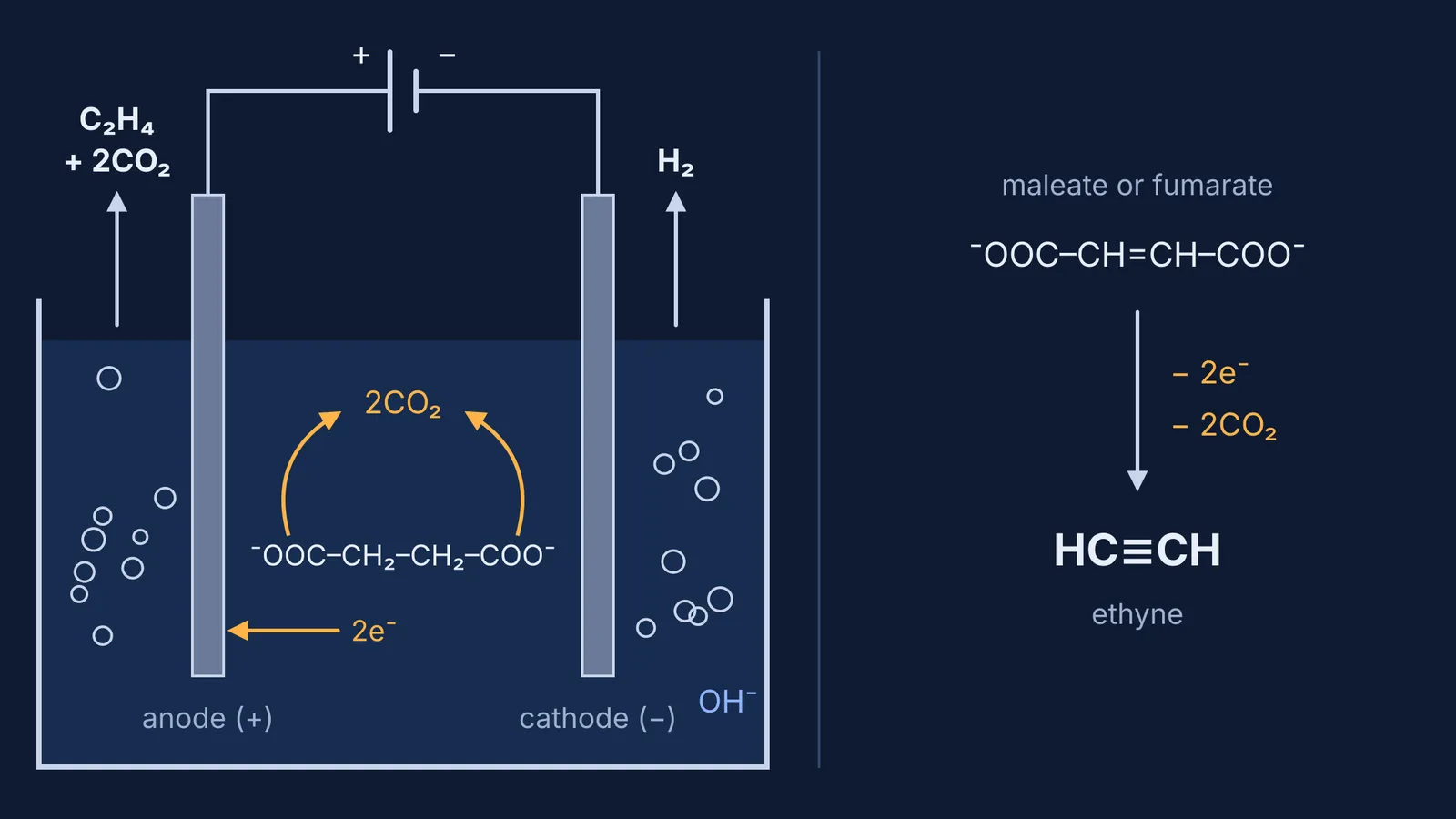
Kolbe electrolysis is usually taught with one carboxylate: electrolyse sodium or potassium acetate and two methyl groups join to give ethane. Now give the ion two carboxylate groups. Electrolyse concentrated aqueous potassium succinate and the gas at the anode is ethene, not an alkane. Potassium maleate gives ethyne. The rule behind both is short: when both CO₂ groups leave the same ion, the two carbons they were attached to bond to each other.
What happens at the anode in ordinary Kolbe electrolysis?
A quick recap at the radical level NCERT uses. At the anode, a carboxylate ion gives up one electron. The carboxyl radical that forms loses CO₂ at once, leaving an alkyl radical. Two alkyl radicals then pair up:
RCOO⁻ → RCOO• + e⁻
RCOO• → R• + CO₂
2R• → R–R
So one alkane needs two separate ions. Mixtures of salts give mixed products, which is covered in Kolbe electrolysis of a mixture: why two salts give three alkanes. At the cathode, water is reduced: 2H₂O + 2e⁻ → H₂ + 2OH⁻. The solution around the cathode becomes alkaline.
Why does potassium succinate give ethene and not butane?
The succinate ion is ⁻OOC–CH₂–CH₂–COO⁻. Each end behaves like an acetate end. Each carboxylate loses one electron and one CO₂. After both have reacted, the same ion now has an unpaired electron on each of its two carbons: •CH₂–CH₂•.
Those two unpaired electrons sit on neighbouring carbons that are already bonded to each other. They pair up as a second bond between the same two carbons, a π bond. The result is ethene:
⁻OOC–CH₂–CH₂–COO⁻ → CH₂=CH₂ + 2CO₂ + 2e⁻
Check the balance. Left: C₄H₄O₄ with charge 2−. Right: C₂H₄ + 2CO₂ is C₄H₄O₄, and 2e⁻ carries the 2− charge. Both atoms and charge match.
Compare it with acetate. Two acetate ions give C₂H₆, because each CH₃• brings three H and the new bond is a σ bond between two separate fragments. Succinate is like two acetate halves already joined. The two carbons are bonded before electrolysis starts, so the new bond can only be a π bond, and the product has two fewer hydrogens.
Do not write cyclopropane (there are only two carbons left), and do not couple the two ends to radicals from other ions. Real yields are modest and side products form, but the exam product is ethene.
What do potassium maleate and fumarate give?
Maleate is ⁻OOC–CH=CH–COO⁻, the cis isomer. The two carbons that lose CO₂ are already joined by a double bond. Adding one more π bond makes a triple bond:
⁻OOC–CH=CH–COO⁻ → HC≡CH + 2CO₂ + 2e⁻
Check: C₄H₂O₄ with charge 2− on the left; C₂H₂ + 2CO₂ = C₄H₂O₄ and 2e⁻ on the right. This electrolytic route to acetylene is usually credited to Kekulé in the 1860s.
Fumarate, the trans isomer, gives ethyne too. Cis and trans describe where the two COO⁻ groups sit across the double bond. Once both have gone as CO₂, that difference is gone, and ethyne is linear anyway. So the geometry of the starting acid does not matter here.
The same idea works with a substituent. Methylsuccinate, ⁻OOC–CH(CH₃)–CH₂–COO⁻, gives propene: ⁻OOC–CH(CH₃)–CH₂–COO⁻ → CH₃–CH=CH₂ + 2CO₂ + 2e⁻. The CH₃ group just rides along.
A quick carbon count helps: the hydrocarbon has two fewer carbons than the acid, because two carbons leave as CO₂. Succinic acid (C₄) gives C₂, maleic acid (C₄) gives C₂, methylsuccinic acid (C₅) gives C₃. Exams use 1,2-dicarboxylates like these, where the two carboxyl groups sit on neighbouring carbons.
How many moles of gas form? A worked example
Problem. A concentrated aqueous solution containing 0.10 mol potassium succinate is electrolysed with a steady current of 2.0 A until all the succinate has reacted. Assume all the charge goes into the Kolbe reaction. Find the charge passed, the time, the moles and volumes of each gas at STP (22.7 L/mol at 273 K and 1 bar), and the KOH formed.
Electrons per ion. The anode equation shows 2e⁻ per succinate ion. So 0.10 mol succinate needs 0.20 mol electrons, which is 0.20 F.
Charge. Q = 0.20 × 96485 ≈ 19 297 C, about 1.93 × 10⁴ C.
Time. t = Q ÷ I = 19 297 ÷ 2.0 ≈ 9649 s, about 2.68 hours.
Anode gases. 0.10 mol C₂H₄ and 0.20 mol CO₂.
Cathode gas. 2H₂O + 2e⁻ → H₂ + 2OH⁻. 0.20 mol electrons gives 0.10 mol H₂ and 0.20 mol OH⁻.
Volumes at STP. C₂H₄: 0.10 × 22.7 = 2.27 L. CO₂: 0.20 × 22.7 = 4.54 L. H₂: 2.27 L. The anode releases 6.81 L of gas and the cathode 2.27 L, a 3 : 1 ratio.
KOH. The 0.20 mol OH⁻ pairs with the 0.20 mol K⁺ left behind, so 0.20 mol KOH forms.
Overall equation. K₂C₄H₄O₄ + 2H₂O → C₂H₄ + 2CO₂ + H₂ + 2KOH. Atoms: K 2 = 2, C 4 = 4, H 8 = 8, O 6 = 6.
Two cautions for real cells. Some CO₂ dissolves in the alkaline solution as carbonate, so you collect less than 4.54 L. And not all the charge goes into the Kolbe reaction, so the hydrocarbon yield is lower too.
Now swap in 0.10 mol potassium maleate. The charge, CO₂ and H₂ are the same, but the anode now gives 0.10 mol C₂H₂. You can tell the two gases apart: ethene adds one Br₂ per molecule (0.10 mol), ethyne adds two (0.20 mol), and only ethyne gives a precipitate with ammoniacal silver nitrate.
How is this different from heating the same acids?
Heat does something else entirely. Succinic acid on heating loses water and closes a five-membered ring, succinic anhydride, keeping all four carbons. Maleic acid also forms an anhydride, but fumaric acid cannot close the ring directly because its two COOH groups are on opposite sides. The full series is in what dicarboxylic acids give on heating.
So the two methods test different things. Heating cares about geometry: cis and trans acids behave differently. Kolbe electrolysis removes both carboxyl groups as CO₂, so maleate and fumarate give the same ethyne. For how Kolbe fits among other routes to hydrocarbons, see Wurtz, Kolbe and decarboxylation compared.
If electrolysis numericals still trip you up, the Fermi Problem Library has a step-by-step solver that explains the reasoning at each stage.
Quick checklist
Monocarboxylate: two ions, two radicals, one alkane.
Dicarboxylate: one ion, two neighbouring radical carbons, one new π bond.
Succinate gives ethene, maleate and fumarate give ethyne, methylsuccinate gives propene.
Anode per 2 F: 1 mol hydrocarbon + 2 mol CO₂. Cathode per 2 F: 1 mol H₂ + 2 mol OH⁻.
The hydrocarbon has two fewer carbons than the acid.
Heating makes anhydrides; electrolysis removes both CO₂ groups.


