On this page
Kolbe's electrolytic method sits in the Hydrocarbons chapter of NCERT Class 11 Chemistry Part II, which states that an aqueous solution of the sodium or potassium salt of a carboxylic acid, on electrolysis, gives an alkane with an even number of carbon atoms at the anode. JEE-style questions add a twist: what if the solution holds two different salts? The answer is three alkanes, and the mechanism shows why.
What happens at the anode in Kolbe electrolysis?
Hermann Kolbe described the decomposition of valeric acid by electric current in 1848 (Justus Liebigs Annalen der Chemie, vol. 64). The NCERT chapter writes the path for sodium acetate in four steps:
In water the salt splits into ions: CH₃COO⁻ and Na⁺.
At the anode each acetate ion gives up one electron, forming an acetate free radical, CH₃COO•.
That radical loses a molecule of CO₂ and becomes a methyl free radical, CH₃•.
Two methyl radicals join: CH₃• + •CH₃ → CH₃–CH₃ (ethane).
The overall equation in the textbook is 2CH₃COO⁻Na⁺ + 2H₂O → CH₃–CH₃ + 2CO₂ + H₂ + 2NaOH. In plain words, Kolbe electrolysis is formally a decarboxylative dimerisation: two carboxylate ions lose their CO₂ and their leftover alkyl groups join (Wikipedia summary of the reaction).
Why does a mixture of two salts give three alkanes?
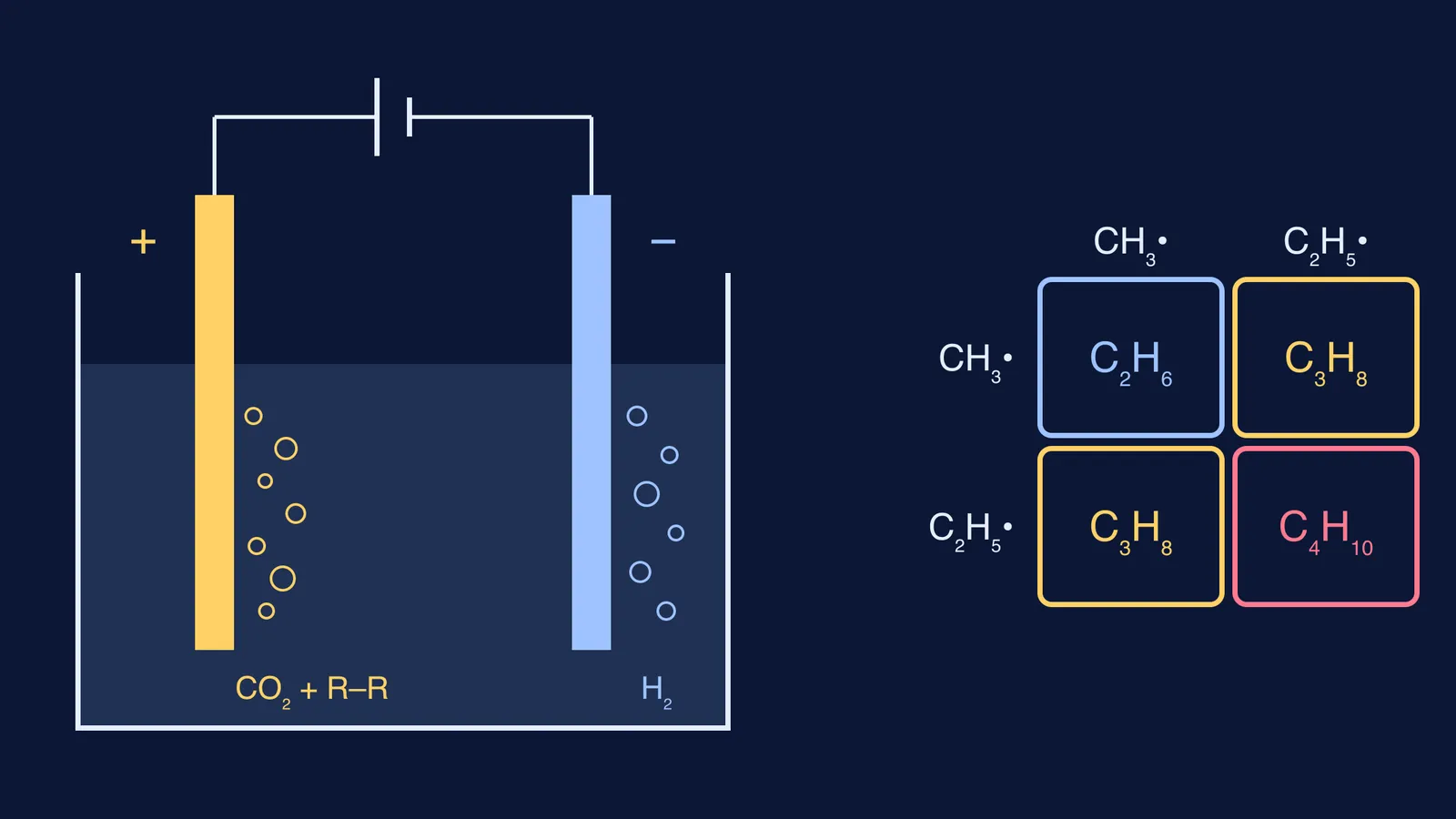
The anode does not sort radicals by parent, so any two radicals near its surface can pair. With a mixture of two carboxylates, the radical cross-coupling generally gives all combinations, R¹–R¹, R¹–R² and R²–R² (Kolbe electrolysis overview).
A quick way to see it is a 2 × 2 grid: write the two radicals across the top and down the side, and fill each box with the pair. Two boxes hold the same mixed product, so you get three different alkanes, not four. Pure random pairing from equal amounts would favour the mixed alkane, since it fills two boxes, but that is a counting idea, not a measured yield.
Worked example: sodium acetate and sodium propanoate
Start from the radicals. Acetate (CH₃COO⁻) loses CO₂ to give CH₃•. Propanoate (CH₃CH₂COO⁻) loses CO₂ to give CH₃CH₂•.
CH₃• + •CH₃ → C₂H₆, ethane
CH₃• + •CH₂CH₃ → C₃H₈, propane
CH₃CH₂• + •CH₂CH₃ → C₄H₁₀, n-butane
The balanced equation for the mixed product follows the textbook pattern: CH₃COONa + CH₃CH₂COONa + 2H₂O → C₃H₈ + 2CO₂ + H₂ + 2NaOH. Check it: 5 carbons, 12 hydrogens, 6 oxygens and 2 sodiums on each side.
Examiners often ask about each electrode separately:
Anode (+): CO₂ plus all three alkanes. Ethane, propane and butane are all gases at room temperature, because the first four alkanes, C₁ to C₄, are gases at 298 K (NCERT Class 11, Unit 9).
Cathode (−): water is reduced, H₂O + e⁻ → OH⁻ + H•, and two H atoms form H₂ gas.
Solution: Na⁺ and OH⁻ stay behind as NaOH, so the electrolyte becomes alkaline.
Why can't Kolbe electrolysis make methane?
The NCERT chapter ends the section with this question. Every product is two alkyl radicals joined, so the smallest possible alkane has two carbons, from two methyl radicals. Methane, with one carbon, cannot form this way. It is also why a single salt only gives even-carbon alkanes, while a mixture can give an odd one such as propane.
The same logic appears in our explainer on the Wurtz reaction with two different alkyl halides, and the Corey–House synthesis of unsymmetrical alkanes shows how chemists make one mixed alkane cleanly. Do not confuse it with the Kolbe reaction of phenol to salicylic acid, which needs no current.
Chemists are still improving the reaction. A 2023 study in Science noted that it has seen limited applications owing to extremely poor chemoselectivity and reliance on precious metal electrodes, and showed that rapidly alternating the polarity, instead of using direct current, lets it run on carbon-based electrodes (Hioki and colleagues, Science).
How should you answer a Kolbe mixture question?
Write each carboxylate and remove COO⁻ to get its radical.
Pair the radicals in every combination; drop duplicates.
Name the products and count carbons; each product's carbon count is the sum of its two R groups.
List gases at each electrode: CO₂ and alkanes at the anode, H₂ at the cathode.
Balance one equation and check C, H, O and Na.
If a step trips you up, the Fermi Problem Library has worked problems with a step-by-step solver that explains the reasoning rather than printing an answer. For free radicals and decarboxylation, the Fermi Concept Library gives each concept its own lesson.