

On this page
Eight original questions in two NEET-UG formats many students find slow. New to the chapter? Read how to prepare Kinetic Theory of Gases for NEET.
What do these questions cover?
The NMC syllabus for NEET (UG)-2026 lists Kinetic Theory of Gases as Physics Unit 9. Facts follow Chapter 12 of NCERT Class 11 Physics Part II (Reprint 2026-27). Take R = 8.3 J mol⁻¹ K⁻¹ and k_B = 1.38 × 10⁻²³ J K⁻¹.
Key for Q1 and Q3: (1) Both correct (2) Both incorrect (3) I correct, II incorrect (4) I incorrect, II correct.
Statement questions: which ones are true?
Q1 (easy, statements). Statement I: Kinetic theory assumes molecules attract each other strongly between collisions. Statement II: It treats all collisions as elastic.
Answer: (4). I is false: interactions are negligible, so molecules move in straight lines between collisions. II is true: NCERT takes every collision as elastic.
Trap: (1) mixes a real gas with the model.
Q2 (easy, statements). Which are correct?
A. Since no direction is special, ⟨v_x²⟩ = ⟨v²⟩/3. B. In a mixture at fixed temperature, heavier molecules move slower on average. C. Doubling the pressure of a gas at constant volume doubles its rms speed. D. Pressure exists everywhere in the gas, not only at the walls. E. The mean squared speed always equals the square of the mean speed.
(1) A, B and D only (2) A, C and D only (3) A, B, D and E only (4) B, C and E only
Answer: (1). A: NCERT calls the gas isotropic. B: ½m⟨v²⟩ = (3/2)k_BT, so larger m means lower speed. C: at fixed V, T doubles, so v_rms rises by √2. D is an NCERT point to ponder. E: ⟨v²⟩ need not equal ⟨v⟩².
Trap: (2) forgets the square root in C.
Q3 (medium, statements). A sealed 1.5 L flask holds nitrogen at −23 °C and 1.38 × 10⁵ Pa. Statement I: It contains about 6.0 × 10²² molecules. Statement II: Warming it raises the mean free path.
Answer: (3). I: N = PV/k_BT = (1.38 × 10⁵ × 1.5 × 10⁻³)/(1.38 × 10⁻²³ × 250) = 6.0 × 10²². II: l = 1/(√2 nπd²) depends on n, fixed in a sealed flask.
Trap: (1) links speed with path length.
Q4 (hard, statements). By equipartition, which are correct?
A. A rigid diatomic molecule has 3 translational and 2 rotational degrees of freedom. B. Rotation about the axis joining a diatomic molecule's atoms adds ½k_BT. C. A polyatomic gas with 3 translational, 3 rotational and f vibrational modes has C_v = (3 + f)R. D. A rigid diatomic gas has a larger γ than a monatomic gas. E. For such a polyatomic gas with f = 2, γ = 6/5.
(1) A, B and C only (2) C, D and E only (3) A, C and E only (4) A, B, C and E only
Answer: (3). A: NCERT's dumbbell. B: NCERT's footnote says this rotation does not come into play. C: each vibration carries k_BT. D: γ is 7/5 against 5/3. E: C_v = 5R, C_p = 6R, γ = 6/5.
Trap: (4) adds a third rotation.
Match-the-list questions: can you pair them in one pass?
Q5 (easy, match). List-I: (A) Boltzmann constant k_B (B) Universal gas constant R (C) Number density n (D) Mean free path l. List-II: (I) m⁻³ (II) J K⁻¹ (III) m (IV) J mol⁻¹ K⁻¹.
(1) A-IV, B-II, C-I, D-III (2) A-II, B-IV, C-I, D-III (3) A-II, B-IV, C-III, D-I (4) A-IV, B-II, C-III, D-I
Answer: (2). k_B is per molecule, R = N_A k_B per mole; n is per cubic metre; l is a distance.
Trap: (1) swaps k_B and R.
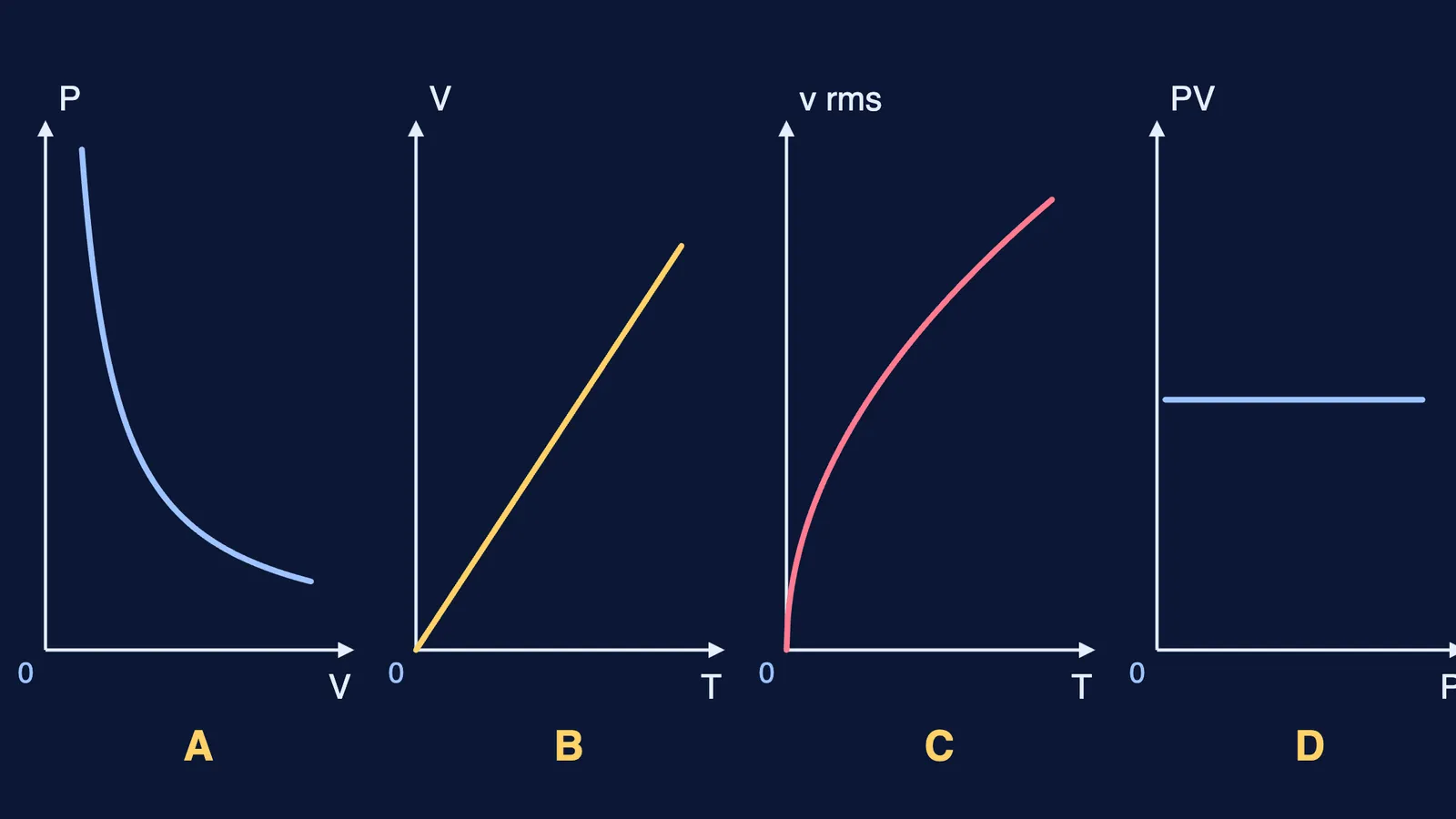
Q6 (medium, match). Fixed amount of ideal gas. List-I: (A) P against V at constant T (B) V against T (kelvin) at constant P (C) v_rms against T (D) PV against P at constant T. List-II: (I) Straight line through the origin (II) Rectangular hyperbola (III) Line parallel to the P-axis (IV) Curve rising as √T.
(1) A-II, B-IV, C-I, D-III (2) A-III, B-I, C-IV, D-II (3) A-II, B-I, C-IV, D-III (4) A-II, B-I, C-III, D-IV
Answer: (3). A: Boyle's law, PV = constant. B: Charles' law, V ∝ T. C: v_rms = √(3RT/M). D: PV = µRT is fixed at fixed T.
Trap: (1) makes v_rms ∝ T.
Q7 (medium, match). List-I: (A) A mixture's pressure is the sum of each gas's pressure alone (B) At equal temperature, helium diffuses faster than argon (C) A sealed rigid tank's pressure doubles as its kelvin temperature doubles (D) At the same T and P, one litre of any ideal gas holds the same number of molecules. List-II: (I) Avogadro's hypothesis (II) Dalton's law of partial pressures (III) Rate of diffusion ∝ 1/√(mass) (IV) PV = µRT with µ and V fixed.
(1) A-II, B-III, C-IV, D-I (2) A-II, B-I, C-IV, D-III (3) A-I, B-III, C-IV, D-II (4) A-II, B-III, C-I, D-IV
Answer: (1). A: P = P₁ + P₂ + …. B: NCERT's diffusion note. C: P ∝ T at fixed µ and V. D: N = PV/k_BT for any gas.
Trap: (2) swaps B and D.
Q8 (hard, match). Each sample is heated by 20 K; match the heat absorbed. List-I: (A) 2 mol neon, constant volume (B) 2 mol neon, constant pressure (C) 1 mol rigid diatomic, constant pressure (D) 1 mol diatomic with one vibrational mode, constant pressure. List-II: (I) 581 J (II) 830 J (III) 747 J (IV) 498 J.
(1) A-IV, B-II, C-III, D-I (2) A-I, B-II, C-IV, D-III (3) A-IV, B-III, C-I, D-II (4) A-IV, B-II, C-I, D-III
Answer: (4). Q = nCΔT. A: 2 × (3/2)R × 20 = 498 J. B: 2 × (5/2)R × 20 = 830 J. C: (7/2)R × 20 = 581 J. D: C_p = (9/2)R, so 747 J.
Trap: (1). 581 J is D at constant volume.
How do you work these faster?
Use kelvin first.
Note v ∝ √(T/M), l ∝ 1/n and U = (f/2)µRT; most statements reduce to one.
In a match, fix your surest pair and strike options that disagree.
Sketch the molecule to count degrees of freedom.
Next, read how to solve NEET match-the-list questions or try the Kinetic Theory NEET practice set.
Hard to picture molecules in motion? The Fermi Simulation Lab has interactive simulations for the ideas that are easier to see than to read.


