

On this page
Statement and List-I/List-II items appear in recent JEE Main papers. Here are eight original ones, easy to hard. New to the chapter? Read how to prepare Kinetic Theory of Gases for JEE Main.
What do these questions cover?
All sit inside Unit 9 of NTA's Syllabus for JEE (Main) - 2027, and results follow NCERT Class 11 Physics, Chapter 12 (Reprint 2026-27). Take R = 8.31 J mol⁻¹ K⁻¹; gases are ideal.
Key for Q1 and Q3: (1) Both correct (2) Both incorrect (3) I correct, II incorrect (4) I incorrect, II correct.
Statement questions: which ones are true?
Q1 (easy, statements). Identical sealed flasks at one temperature hold hydrogen (M = 2 g/mol) at 2.0 atm and oxygen (M = 32 g/mol) at 1.0 atm. Statement I: The hydrogen flask holds twice as many molecules. Statement II: The hydrogen is denser than the oxygen.
Answer: (3). I: N ∝ P at fixed V, T. II: ρ = PM/(RT) ∝ PM: hydrogen 2 × 2 = 4, oxygen 1 × 32 = 32, so hydrogen is 1/8 as dense.
Trap: (1), equating molecules with mass.
Q2 (medium, statements). Rigid 2.0 L of helium at 1.5 × 10⁵ Pa, 300 K. Which are correct?
A. Its total translational kinetic energy is 450 J. B. Equal moles of nitrogen at 300 K would also have 450 J of translational kinetic energy. C. That rigid nitrogen would have 450 J of internal energy. D. Heating the helium to 600 K doubles its rms speed. E. The vessel holds about 0.12 mol of helium.
(1) A, B and E only (2) A, C and E only (3) A, B and D only (4) B, D and E only
Answer: (1). A: E = (3/2)PV = 1.5 × 1.5 × 10⁵ × 2.0 × 10⁻³ = 450 J. B: (3/2)nRT for any gas. C: U = (5/2)PV = 750 J. D: v_rms ∝ √T, so it rises by √2. E: n = PV/RT = 300/(8.31 × 300) ≈ 0.120 mol.
Trap: (3) misses the root in D.
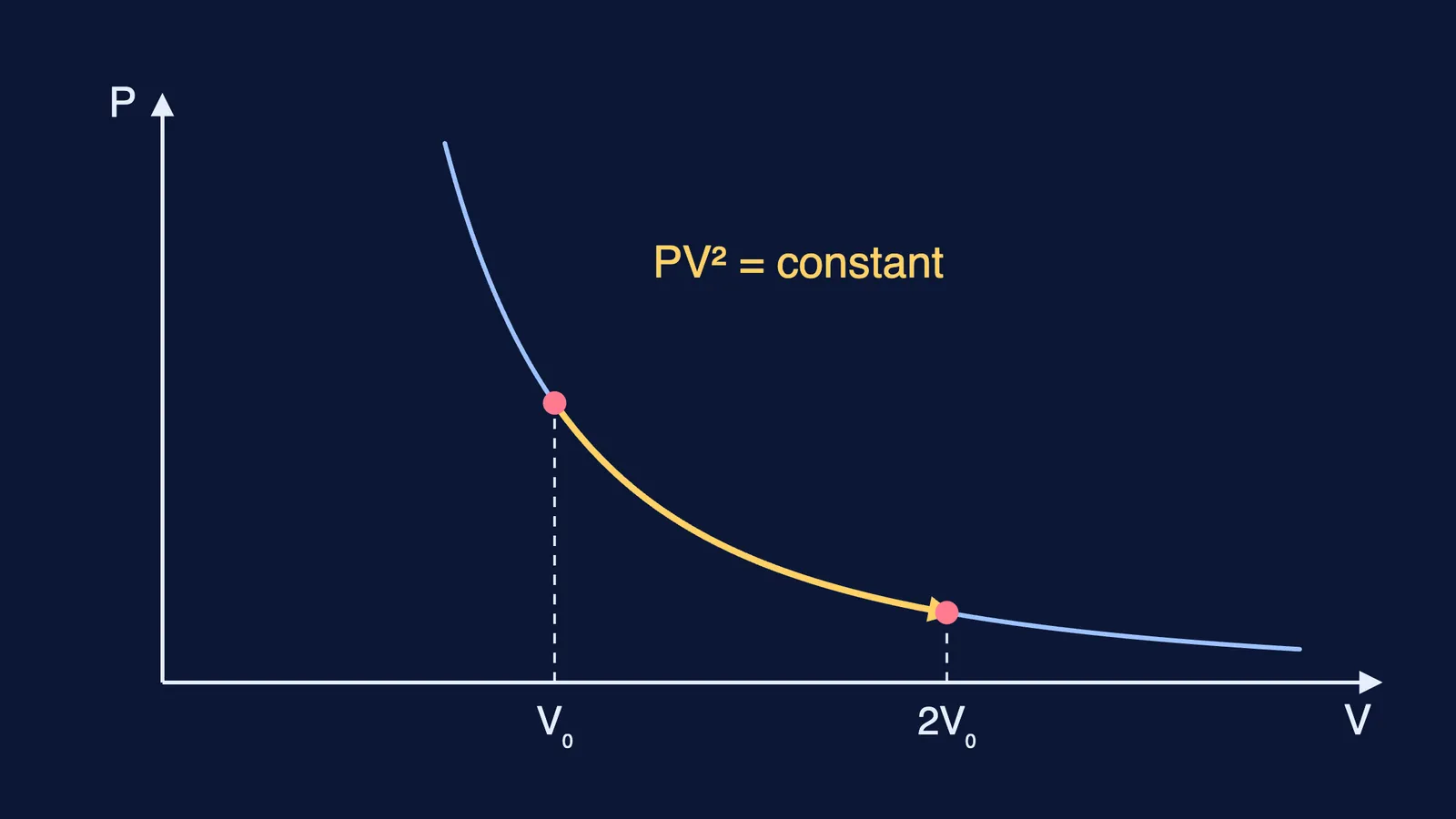
Q3 (medium, statements). A gas expands along PV² = constant until its volume doubles. Statement I: Its kelvin temperature falls to one quarter. Statement II: Its rms speed falls to 1/√2 of the start.
Answer: (4). I: P falls to P/4 and T ∝ PV, so T halves. II: v_rms ∝ √T, giving 1/√2.
Trap: (3), using the pressure factor 1/4 for T.
Q4 (hard, statements). Half the molecules in 1 mol of a rigid diatomic gas dissociate into atoms; it returns to its original temperature, same rigid container. Which are correct?
A. It now holds 1.5 mol of particles. B. Its pressure has doubled. C. Its heat capacity at constant volume rises from 5R/2 to 11R/4. D. γ of the mixture is 17/11. E. Average translational kinetic energy per particle has halved.
(1) A, B and C only (2) A, C and D only (3) A, C, D and E only (4) B, D and E only
Answer: (2). B: at fixed V and T, P ∝ moles, so ×1.5. C: 0.5 × (5/2)R + 1 × (3/2)R = 11R/4. D: C_p = 11R/4 + 1.5R = 17R/4, so γ = 17/11 ≈ 1.55. E: it is (3/2)k_BT, set by T alone.
Trap: (3), linking E to the halved mass.
Match-the-list questions: can you pair them in one pass?
Q5 (easy, match). ρ = density, d = molecular diameter. List-I: (A) √(3P/ρ) (B) (3/2)P (C) PV/(k_BT) (D) k_BT/(√2 πd²P). List-II: (I) Mean free path (II) Number of molecules (III) rms speed (IV) Translational kinetic energy per unit volume.
(1) A-III, B-II, C-IV, D-I (2) A-III, B-IV, C-II, D-I (3) A-IV, B-III, C-II, D-I (4) A-III, B-IV, C-I, D-II
Answer: (2). A: P = (1/3)ρv², so v_rms = √(3P/ρ). B: P = (2/3)E/V. C: PV = Nk_BT. D: l = 1/(√2 nπd²) with n = P/(k_BT); a length.
Trap: (4), swapping the count and the length.
Q6 (medium, match). Fixed mass of gas; match the factor. List-I: (A) Volume, T doubled at constant P (B) v_rms, T doubled at constant V (C) Mean free path, P doubled at constant T (D) v_rms, P doubled at constant T. List-II: (I) 1/2 (II) √2 (III) 2 (IV) 1.
(1) A-III, B-IV, C-I, D-II (2) A-I, B-II, C-III, D-IV (3) A-II, B-III, C-I, D-IV (4) A-III, B-II, C-I, D-IV
Answer: (4). A: Charles' law, V ∝ T. B: v_rms ∝ √T. C: n ∝ P at fixed T, and l ∝ 1/n. D: v_rms depends on T only.
Trap: (1) swaps B and D.
Q7 (medium, match). Rigid molecules unless stated. Match the rotational fraction of internal energy. List-I: (A) Argon (B) Carbon dioxide, linear O=C=O (C) Methane, non-linear (D) Nitrogen with one vibrational mode active. List-II: (I) 1/2 (II) 0 (III) 2/7 (IV) 2/5.
(1) A-II, B-IV, C-I, D-III (2) A-II, B-I, C-IV, D-III (3) A-II, B-IV, C-III, D-I (4) A-IV, B-II, C-I, D-III
Answer: (1). A: no rotation, 0. B: a linear molecule has 2 rotations (NCERT's dumbbell): 2/5. C: 3 rotations of 6 modes, 1/2. D: vibration adds k_BT, so U = (7/2)k_BT: 2/7.
Trap: (2), giving linear CO₂ three rotations.
Q8 (hard, match). A rigid 0.50 m³ tank holds carbon monoxide at 1.66 × 10⁵ Pa and 500 K with vibration active. List-I: (A) Total translational kinetic energy (B) Total vibrational energy, kinetic plus potential (C) Total internal energy (D) Heat to warm it by 50 K. List-II: (I) 83.0 kJ (II) 124.5 kJ (III) 290.5 kJ (IV) 29.05 kJ.
(1) A-I, B-II, C-III, D-IV (2) A-II, B-I, C-IV, D-III (3) A-II, B-I, C-III, D-IV (4) A-II, B-IV, C-III, D-I
Answer: (3). PV = nRT = 83.0 kJ. A: (3/2)PV = 124.5 kJ. B: k_BT per molecule, so PV = 83.0 kJ. C: (7/2)PV = 290.5 kJ. D: nC_vΔT = (7/2)(PV/T)(50) = 29.05 kJ.
Trap: (2), confusing U with the 50 K change.
How do you work these faster?
Convert to kelvin and SI first.
In a match, fix your surest pair and strike every code that disagrees.
Count rotations from shape: linear 2, non-linear 3.
For mixtures, add heat capacities mole by mole; never average γ.
Next, try the first Kinetic Theory JEE Main practice set.
Right factor, wrong route? The Fermi Problem Library has worked problems with a step-by-step solver that explains the reasoning rather than printing an answer.


