

On this page
Statement and match-the-list questions appear in recent JEE Main papers. Here are 8 original kinematics items, easy to hard.
What do these kinematics questions cover?
All sit inside Unit 2 of NTA's Syllabus for JEE (Main) - 2027, checked against NCERT Class 11 Physics Chapter 2 and Chapter 3 (Reprint 2026-27). New to the chapter? Read how to prepare Kinematics for JEE Main. g = 10 m/s², no air resistance.
Can you solve these statement questions?
Options: (1) Both correct (2) Both incorrect (3) I correct, II incorrect (4) I incorrect, II correct
Q1 (easy, statements). A particle moves at constant speed v on a circle of radius R. Statement I: Over half a revolution, its average velocity has magnitude 2v/π. Statement II: Its average acceleration over that time has magnitude v²/R.
Answer: (3). Half a turn takes πR/v. I correct: displacement 2R gives 2v/π. II incorrect: velocity change 2v gives 2v²/πR; v²/R is instantaneous.
Trap: (1), treating v²/R as the average.
Q2 (medium, statements). A train moves at a steady 20 m/s. A passenger drops a coin from a window 1.8 m above the ground. Which are correct? A. The passenger sees it fall vertically. B. Someone on the platform sees a parabola. C. It lands 12 m ahead of where it was released. D. It hits the ground at 6 m/s relative to the ground. E. Had the train been speeding up, the passenger would see it land behind the spot below the window.
(1) A, B and C only (2) A, B, C and E only (3) A, C and D only (4) B, C, D and E only
Answer: (2). Fall time √(2 × 1.8/10) = 0.6 s. A, B true: coin and train share 20 m/s horizontally. C true: 20 × 0.6 = 12 m. D false: 6 m/s is the vertical part; √(20² + 6²) ≈ 20.9 m/s. E true: the train gains on the coin.
Trap: (1), giving the released coin the train's acceleration.
Q3 (medium, statements). Statement I: For v = 3x² (SI), acceleration at x = 1 m is 18 m/s². Statement II: For v = 2x (SI), acceleration at x = 2 m is 8 m/s².
Answer: (1). a = v dv/dx. I: 18x³, so 18 m/s² at x = 1 m. II: 4x, so 8 m/s² at x = 2 m.
Trap: (2), taking dv/dx (6 and 2) as the acceleration.
Q4 (hard, statements). In a lift rising at 5 m/s and accelerating up at 2 m/s², a bolt falls off a shelf 1.5 m above the floor. Statement I: Its fall takes as long as in a lift at rest. Statement II: Relative to the ground, the bolt rises 1.25 m before landing.
Answer: (4). Relative acceleration is 12 m/s², so t = √(2 × 1.5/12) = 0.5 s, not 0.55 s: I incorrect. II correct: 5 × 0.5 − 5 × 0.5² = 1.25 m up; the floor rises 2.75 m.
Trap: (2), assuming falling means moving down.
Can you solve these match-the-list questions?
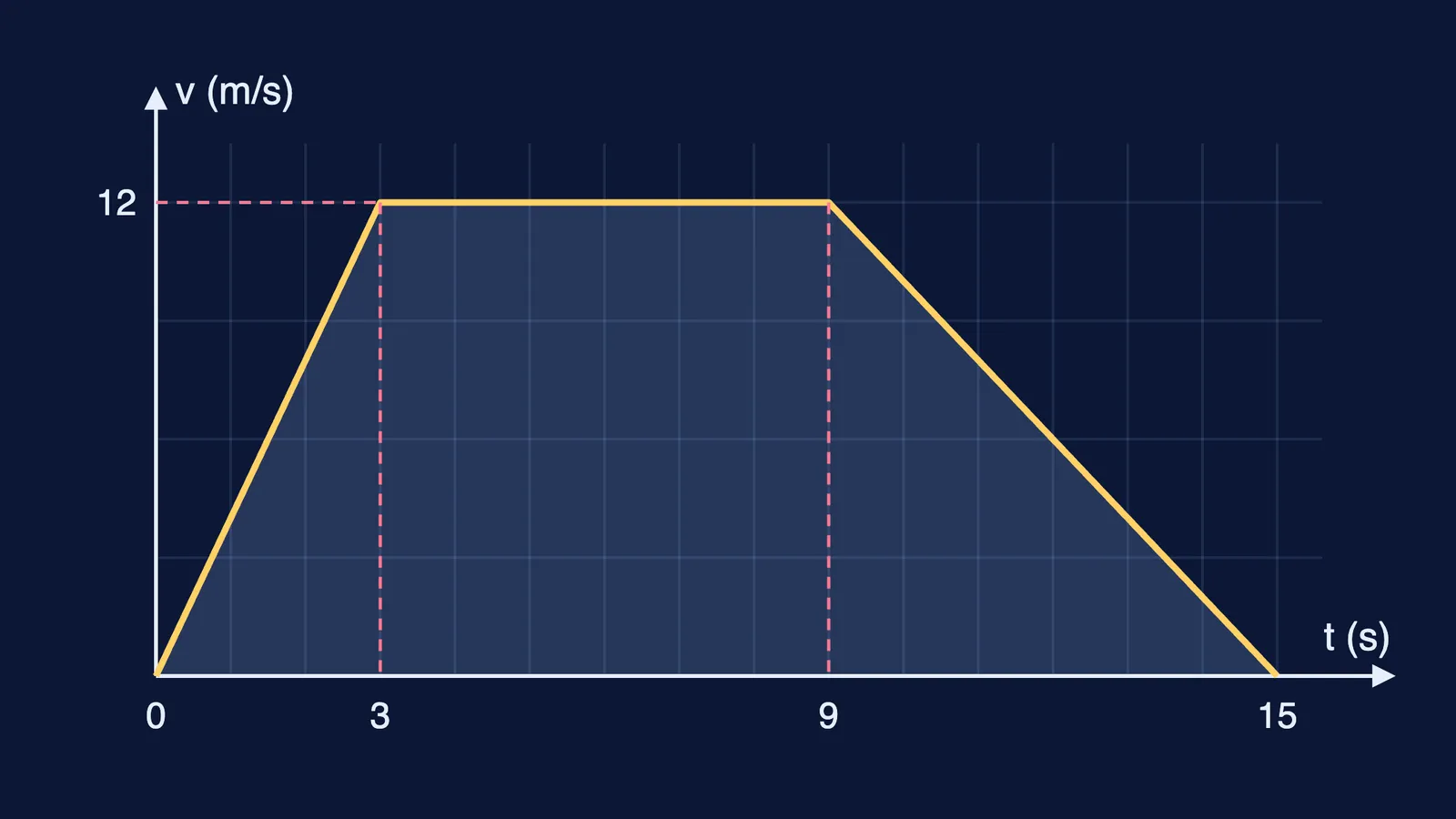
Q5 (easy, match). A car speeds up uniformly from rest to 12 m/s in 3 s, holds that speed until t = 9 s, then slows uniformly to rest at t = 15 s. Match SI values.
List-I: A. Acceleration, first 3 s. B. Distance, last 6 s. C. Distance, t = 3 s to 9 s. D. Average speed, 15 s.
List-II: I. 4 II. 8.4 III. 36 IV. 72
(1) A-I, B-IV, C-III, D-II (2) A-I, B-III, C-IV, D-II (3) A-II, B-III, C-IV, D-I (4) A-I, B-III, C-II, D-IV
Answer: (2). A: 12/3 = 4. B: ½ × 6 × 12 = 36. C: 12 × 6 = 72. D: (18 + 72 + 36)/15 = 8.4.
Trap: (1), dropping the ½ in B.
Q6 (medium, match). A walkway 60 m long moves at 1.5 m/s. Riya walks at 2.5 m/s relative to it. Match the times.
List-I: A. Walking with the belt. B. Standing. C. Walking against it. D. Out with it, back against it.
List-II: I. 15 s II. 40 s III. 60 s IV. 75 s
(1) A-I, B-II, C-III, D-IV (2) A-II, B-I, C-III, D-IV (3) A-I, B-III, C-II, D-IV (4) A-I, B-II, C-IV, D-III
Answer: (1). Ground speeds 4, 1.5, 1 m/s give 15, 40, 60 s; D is 15 + 60 = 75 s.
Trap: assuming the belt cancels in D (48 s).
Q7 (medium, match). Balls P and Q leave level ground at equal speeds at angles α and β, with sin α = 0.6 and sin β = 0.8. Match each ratio (P : Q).
List-I: A. Ranges. B. Maximum heights. C. Times of flight. D. Speeds at the top.
List-II: I. 3 : 4 II. 4 : 3 III. 9 : 16 IV. 1 : 1
(1) A-IV, B-I, C-III, D-II (2) A-IV, B-III, C-II, D-I (3) A-IV, B-III, C-I, D-II (4) A-I, B-III, C-IV, D-II
Answer: (3). α + β = 90°, so A: equal ranges. B: H ∝ sin²θ. C: T ∝ sin θ. D: top speed u cos θ, 0.8 : 0.6.
Trap: (2), swapping C and D.
Q8 (hard, match). A ball leaves level ground at (10 î + 20 ĵ) m/s. Match events with times.
List-I: A. Velocity perpendicular to launch velocity. B. Velocity 45° below horizontal. C. Displacement 45° above horizontal. D. Velocity 45° above horizontal.
List-II: I. 1 s II. 2 s III. 2.5 s IV. 3 s
(1) A-III, B-IV, C-I, D-II (2) A-II, B-IV, C-III, D-I (3) A-IV, B-III, C-II, D-I (4) A-III, B-IV, C-II, D-I
Answer: (4). v = (10, 20 − 10t). A: 100 + 20(20 − 10t) = 0 at 2.5 s. B: 20 − 10t = −10 at 3 s. C: 20t − 5t² = 10t at 2 s. D: 20 − 10t = 10 at 1 s.
Trap: (1), swapping velocity and displacement angles.
How do you work these faster?
Test the easier statement first; if false, two options go.
For v as a function of x, use a = v dv/dx.
In a lift or train, use its frame and the relative acceleration.
In a match grid, fix the most distinctive pair and strike codes that disagree.
Can't picture the coin's two paths? The Fermi Simulation Lab has interactive simulations for the ideas that are easier to see than to read.
For timed practice, try Kinematics JEE Main practice questions with full solutions.


