

On this page
The CBSE Class 12 practical list gives two ways to study how concentration changes the rate of a reaction. One uses potassium iodate and sodium sulphite, and it is explained in the potassium iodate and sodium sulphite rate practical. The other is the reaction of iodide ion with hydrogen peroxide at room temperature, using different concentrations of iodide. You mix the solutions, start a stopwatch and wait for a blue colour. With more KI, the blue comes sooner. This post explains what happens during the wait, why the time measures the rate, and how to get the order in iodide from three readings.
What reaction happens between iodide and hydrogen peroxide?
In acid, hydrogen peroxide oxidises iodide to iodine:
H₂O₂ + 2I⁻ + 2H⁺ → I₂ + 2H₂O
Iodine goes from −1 to 0, and the oxygen in H₂O₂ goes from −1 to −2. The equation balances: four H, two O and two I on each side, and zero net charge on both sides.
At room temperature this reaction is slow, which is what makes it useful for a practical. Its rate law is:
rate = k[H₂O₂][I⁻]
In acid there is an extra term that grows with [H⁺]. You do not need its exact form. You only need to keep the acid concentration the same in every run, so that it cannot be the reason the times differ.
This is a different reaction from the decomposition 2H₂O₂ → 2H₂O + O₂, which is followed by titration in the first-order H₂O₂ decomposition experiment with KMnO₄.
Why does the solution stay colourless and then turn blue suddenly?
Each mixture contains a small, fixed amount of sodium thiosulphate and some starch. Thiosulphate reacts with iodine almost instantly:
I₂ + 2S₂O₃²⁻ → 2I⁻ + S₄O₆²⁻
Check it: two I, four S and six O on each side, and a charge of −4 on both sides.
So every I₂ molecule that H₂O₂ makes is turned straight back into two I⁻. Two things follow:
No free iodine builds up while thiosulphate is left, so the starch stays colourless.
The iodide is regenerated as fast as it is used, so [I⁻] stays at its starting value for the whole wait.
When the last thiosulphate is used up, the next I₂ that forms is not removed. It joins I⁻ as I₃⁻, which gives the deep blue starch complex. The colour change is sudden because it marks one exact moment: the thiosulphate running out.
Starch goes in at the start. In an iodometric titration you add starch near the end point, but here it must be present from the beginning to show the moment the free iodine appears.
How do you set up the iodide and H₂O₂ practical?
A typical plan for three runs, each made up to the same total volume of 50 mL:
Put a fixed volume of dilute H₂SO₄, 2 mL of starch solution and 5.0 mL of 0.010 M Na₂S₂O₃ in each flask.
Add 0.50 M KI: 2.0 mL, 4.0 mL and 8.0 mL. This gives [I⁻] = 0.02, 0.04 and 0.08 M in the final mixture.
Add water so that each flask will reach 50 mL once the peroxide goes in.
Add 10 mL of 0.10 M H₂O₂ last, start the stopwatch at once and swirl.
Stop the watch when the blue first appears and stays.
Only the KI volume changes. The acid, starch, thiosulphate, peroxide, total volume and temperature stay the same in every run.
Why is 1/t a measure of the rate here?
The key is that every run makes the same amount of iodine before the blue appears.
Thiosulphate taken: 5.0 mL × 0.010 M = 5.0 × 10⁻⁵ mol.
Iodine it can remove: half of that, 2.5 × 10⁻⁵ mol, because the ratio is 1 I₂ : 2 S₂O₃²⁻.
In 50 mL, that is 5.0 × 10⁻⁴ mol L⁻¹ of I₂ formed before the colour change.
H₂O₂ is in large excess. The flask contains 1.0 × 10⁻³ mol of it, and only 2.5 × 10⁻⁵ mol (2.5%) reacts before the blue. Since [I⁻] is held constant by the thiosulphate and [H₂O₂] barely falls, the rate is constant during the wait. So:
rate = (5.0 × 10⁻⁴ mol L⁻¹) / t
The numerator is the same in every run, so rate ∝ 1/t. A shorter time means a faster reaction, in direct proportion.
How do you find the order with respect to iodide? Worked example
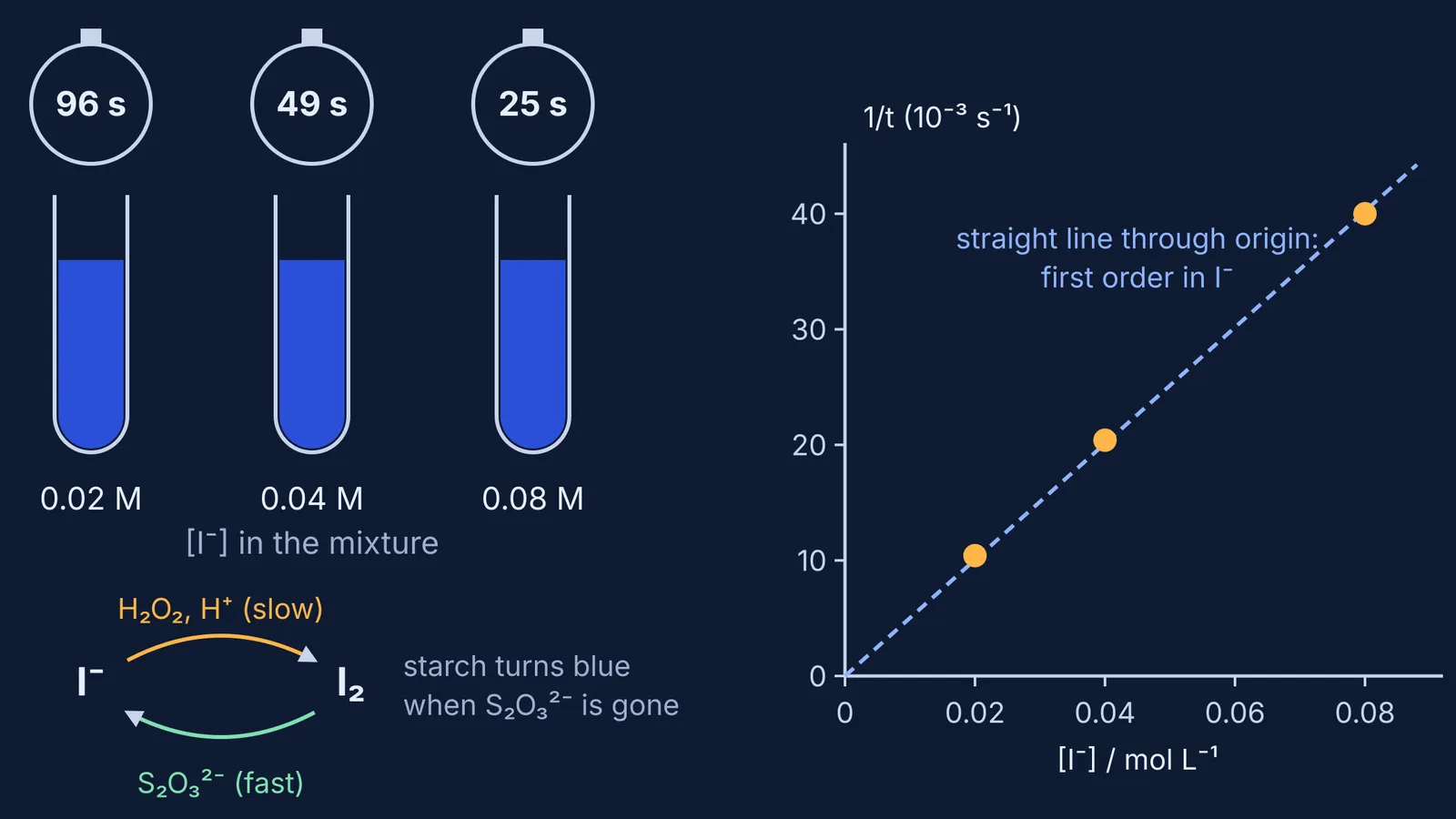
Here is an illustrative data set (not measured values) of the kind you would record:
[I⁻] = 0.02 M: t = 96 s
[I⁻] = 0.04 M: t = 49 s
[I⁻] = 0.08 M: t = 25 s
Step 1. Work out 1/t. 1/96 = 0.0104 s⁻¹, 1/49 = 0.0204 s⁻¹, 1/25 = 0.0400 s⁻¹.
Step 2. Compare runs. Doubling [I⁻] from 0.02 to 0.04 M raises 1/t by 0.0204/0.0104 = 1.96. Doubling again raises it by 0.0400/0.0204 = 1.96.
Step 3. Find the order. If rate ∝ [I⁻]ⁿ, then 2ⁿ = 1.96, so n = log 1.96 / log 2 = 0.97. Round it to 1: the reaction is first order in iodide.
Step 4. Confirm with a graph. A plot of log(1/t) against log[I⁻] has a slope of 0.97. A plot of 1/t against [I⁻] is a straight line through the origin. Either graph confirms first order; the method is the same one used in finding the order of a reaction from initial rates data.
Step 5. Get the rate and the rate constant. For the first run, rate = 5.0 × 10⁻⁴ / 96 = 5.2 × 10⁻⁶ mol L⁻¹ s⁻¹. With [H₂O₂] = 0.020 M, k = 5.2 × 10⁻⁶ / (0.020 × 0.02) ≈ 0.013 L mol⁻¹ s⁻¹. The other two runs give 0.0128 and 0.0125. This k applies only to this acid concentration and temperature, because of the acid term.
Step 6. Predict. At [I⁻] = 0.03 M, t ≈ 96 × 0.02 / 0.03 = 64 s.
If you want more order-from-data problems worked through like this, the Fermi Problem Library has a step-by-step solver that explains the reasoning.
What errors spoil the readings?
Different total volumes. Adding more KI without reducing the water changes every concentration, not just [I⁻].
Changing the acid. The acid-dependent term means more acid gives a shorter time even at the same [I⁻].
Temperature drift. Run all three flasks at the same room temperature, and do not hold the flask in your palm.
Starting the clock late. Start the stopwatch the moment the last reagent goes in.
Too much thiosulphate. The wait becomes long and H₂O₂ is no longer in large excess. Keep it small compared with the peroxide.
Strong acid. Thiosulphate slowly decomposes in strong acid, giving a cloudy sulphur deposit. Use dilute acid.
Quick checklist
H₂O₂ + 2I⁻ + 2H⁺ → I₂ + 2H₂O is the slow reaction being timed.
Thiosulphate turns I₂ back into I⁻, so [I⁻] stays constant during the wait.
Starch is added at the start; blue means the thiosulphate is gone.
Same amount of I₂ in every run, so rate ∝ 1/t.
Keep acid, H₂O₂, thiosulphate, total volume and temperature fixed; vary only KI.
Doubling [I⁻] doubles 1/t: first order in iodide.


