

On this page
The reaction between potassium iodate and sodium sulphite is one of the most striking experiments in the chemistry laboratory. It was first observed by Hans Heinrich Landolt in 1886. Two colourless liquids are mixed, and nothing appears to happen for several seconds. Then, suddenly, the entire solution turns a deep blue-black, as if by magic.
This dramatic delay gives it the name "iodine clock reaction". By timing exactly how long the clock takes to "ring" (when the colour appears), you can measure the rate of the reaction and see how it changes when you alter the concentration of the reactants or the thermal energy of the system. This practical provides a vivid demonstration of chemical kinetics in action.
What are the reactions for potassium iodate and sodium sulphite?
Although you only mix a few solutions together, the chemistry happens in three distinct, sequential steps. In an acidic medium, the sodium sulphite (Na₂SO₃) acts as bisulfite (HSO₃⁻). These steps determine how fast the final product is formed.
First, the iodate ions react slowly with the bisulfite to produce iodide ions. Because this is the slowest step, it acts as the rate-determining step for the entire process: IO₃⁻ + 3HSO₃⁻ → I⁻ + 3HSO₄⁻
Next, the remaining iodate reacts with the newly formed iodide to create molecular iodine (I₂): IO₃⁻ + 5I⁻ + 6H⁺ → 3I₂ + 3H₂O
You might expect the iodine to immediately turn the starch indicator blue. However, a third, practically instantaneous reaction prevents this from happening. As long as there is still bisulfite in the flask, it reduces the iodine straight back to iodide: I₂ + HSO₃⁻ + H₂O → 2I⁻ + HSO₄⁻ + 2H⁺
The clock only stops when the bisulfite is completely consumed. At that exact moment, the iodine survives long enough to bind with the starch, forming the sudden blue-black complex. If you have gaps in your understanding of the underlying redox equations, you can find them explained step by step in the Fermi Concept Library.
How to study the effect of concentration?
To see how concentration affects the rate, you keep the total volume and the amount of sodium sulphite constant, but vary the amount of potassium iodate. These standard volumes and concentrations (like 0.1 M KIO₃) are widely used in introductory kinetic experiments.
Prepare four conical flasks and label them A to D.
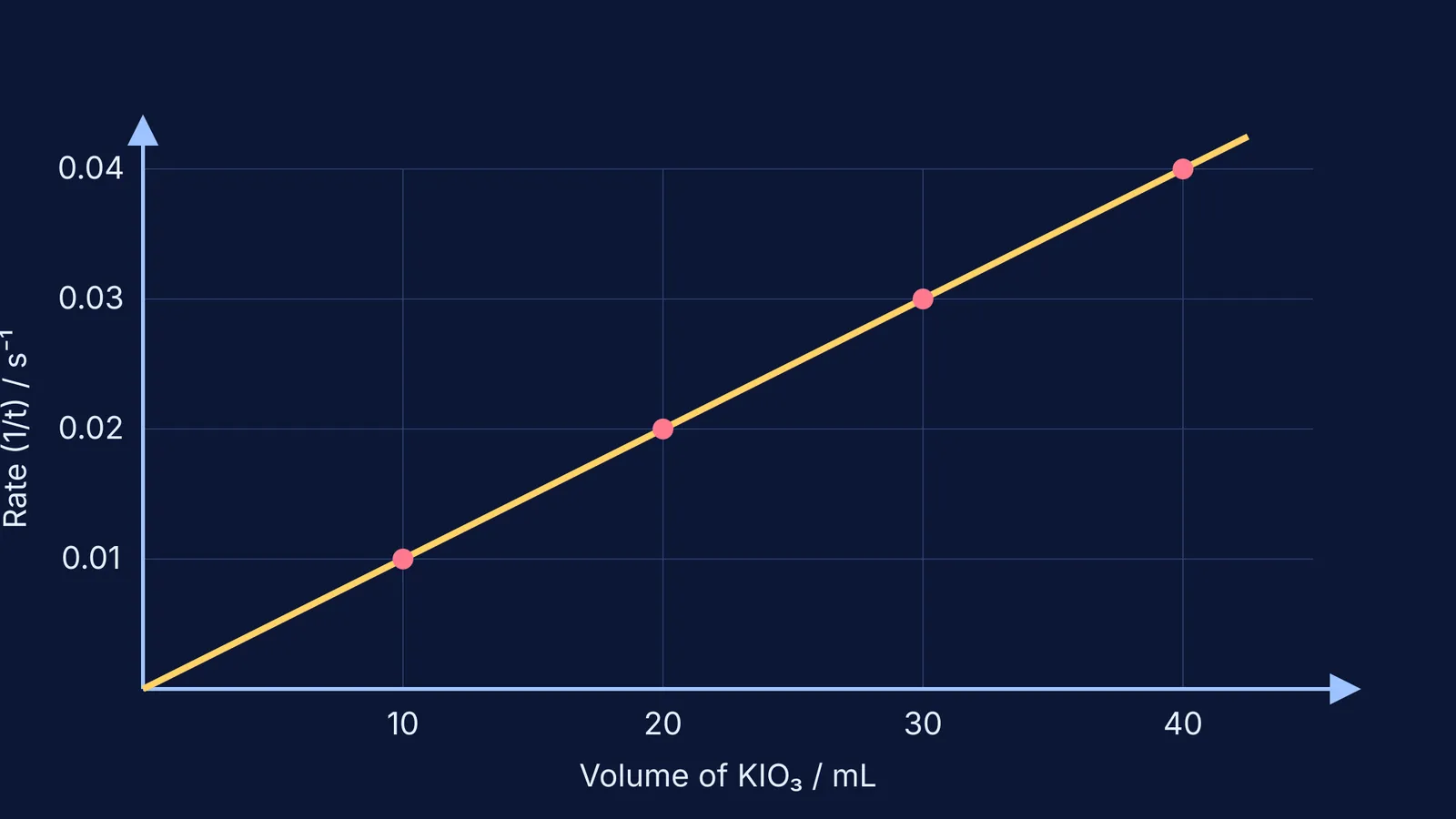
Add different volumes of 0.1 M potassium iodate (KIO₃) to each flask (for example: 10 mL, 20 mL, 30 mL, and 40 mL).
Add distilled water to each so that the total volume of KIO₃ and water is identical in every flask (e.g., 90 mL).
Add equal amounts of dilute sulphuric acid and freshly prepared starch solution to each flask.
Finally, pour a fixed volume of 0.01 M sodium sulphite into the first flask and start your stopwatch immediately.
Stop the timer the exact second the solution turns blue. Repeat the process for the other flasks.
Because the rate of a reaction is inversely proportional to the time taken (Rate ∝ 1/t), you can plot 1/t on the y-axis against the volume of potassium iodate on the x-axis. As seen in many integrated rate law graphs, this yields a straight line passing through the origin. This straight line proves that the reaction rate is directly proportional to the initial concentration of KIO₃.
How to study the effect of temperature?
The iodine clock reaction is highly sensitive to changes in thermal energy. When you heat the reactant solutions, the molecules move faster and collide more frequently, with a greater proportion of them possessing the required activation energy for the reaction to proceed.
To study this, you use the exact same volumes of reactants for every trial—meaning concentration is no longer a variable—but you heat the mixtures in a water bath to different temperatures before combining them.
You might run one trial at room temperature, one at 10 °C above room temperature, and one at 20 °C higher. You will find that the blue colour appears significantly faster in the warmer flasks. In fact, for many reactions at room temperature, the rate roughly doubles for every 10 °C rise, a rule of thumb governed by the temperature coefficient of rate.
If you want to see how the invisible concentration changes trigger the sudden colour flash without setting up the glassware, you can run the clock reaction in the Fermi Simulation Lab. Whether you alter the concentration or the temperature, the delay before the colour change provides a perfect, visible measure of chemical kinetics.


