On this page
You have met inverse functions at school: undo sin with sin⁻¹, undo eˣ with ln x. Given a map that sends (r, θ) to (x, y), when can you run it backwards? The inverse function theorem gives a clean test, and it uses one object you may already know: the Jacobian matrix.
What does the inverse function theorem say?
According to the Wikipedia article on the inverse function theorem, if f is continuously differentiable on an open subset of ℝⁿ and its derivative f′(a) is invertible (the Jacobian determinant at a is non-zero), then there are open neighbourhoods U of a and V of f(a) such that f maps U one-to-one onto V.
The inverse is also continuously differentiable, and its Jacobian at b = f(a) is the matrix inverse of the Jacobian of f at a.
The Wikipedia article on the Jacobian puts it in one line: if the Jacobian determinant is not zero at a point, the function is locally invertible near that point. Note the word "locally": near the point, not everywhere.
What is the one-variable version?
In one variable the Jacobian is just f′(x). The inverse function theorem article states that if f is differentiable on an open interval and f′ is never zero there, f has a differentiable inverse on the whole interval, with (f⁻¹)′(y) = 1/f′(f⁻¹(y)). That is the formula you use in JEE when you write dx/dy = 1/(dy/dx). For the area view of an inverse, our post on the integral of an inverse function using area uses the same graph reflected in y = x.
The same article gives f(x) = x³ as a warning: it is one-to-one even though f′(0) = 0. The inverse, the cube root, exists but has no derivative at 0, because 1/f′ would mean dividing by zero.
Worked example: how do polar coordinates use the Jacobian?
Take F(r, θ) = (r cos θ, r sin θ). The Jacobian article works this example and finds that the Jacobian determinant is equal to r. Here are the steps to redo on paper. If partial derivatives are new to you, read what a partial derivative means first.
Write the four partial derivatives: ∂x/∂r = cos θ, ∂x/∂θ = −r sin θ, ∂y/∂r = sin θ, ∂y/∂θ = r cos θ.
Take the determinant: cos θ · r cos θ − (−r sin θ) · sin θ = r(cos²θ + sin²θ) = r.
Apply the test: wherever r > 0, the determinant is nonzero, so F has a local inverse there.
Invert the 2×2 matrix to get the inverse's derivatives: ∂r/∂x = cos θ, ∂r/∂y = sin θ, ∂θ/∂x = −sin θ / r, ∂θ/∂y = cos θ / r.
Check at (r, θ) = (2, π/6), the point (√3, 1). Step 4 gives ∂θ/∂x = −1/4 and ∂θ/∂y = √3/4. Differentiating θ = tan⁻¹(y/x) directly gives −y/(x² + y²) = −1/4 and x/(x² + y²) = √3/4, the same.
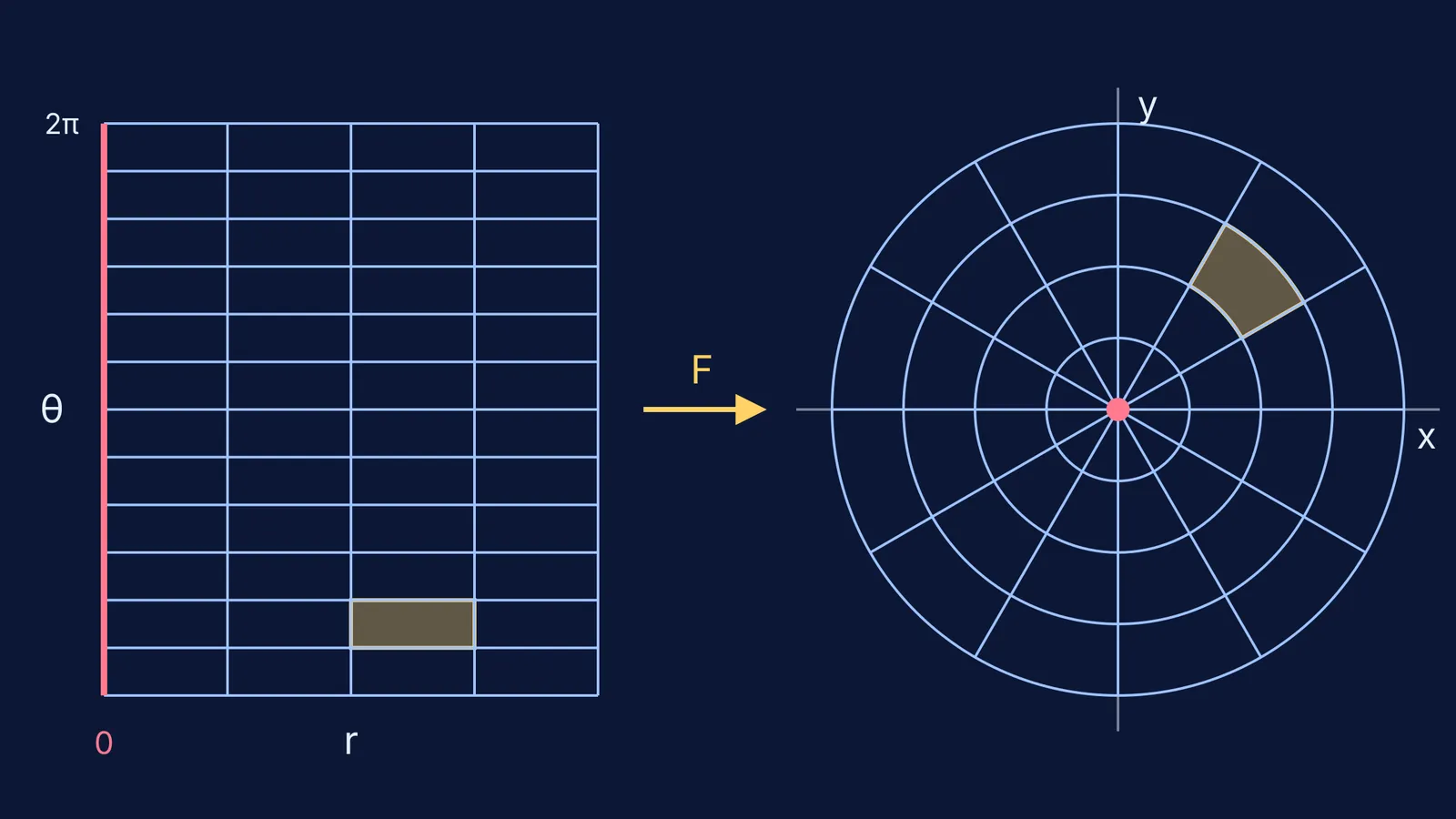
Step 4 gave the inverse's derivatives without a formula for the inverse. The same determinant r is the area factor in r dr dθ, which our post on the Jacobian and change of variables explains. In the diagram above, the yellow cell in the (r, θ) rectangle becomes a curved sector whose area grows with r.
Why does a local inverse not mean a global one?
The Jacobian determinant can be nonzero everywhere and the map can still fail to be one-to-one. The inverse function theorem article gives F(x, y) = (eˣ cos y, eˣ sin y): its Jacobian determinant is e²ˣ, never zero, yet F(x, y) = F(x, y + 2π), so F is not injective.
Near any one point you can undo F; globally you cannot, because adding 2π to y lands on the same point. Polar coordinates repeat in the same way, and the Jacobian article defines the polar map only for r > 0 and θ in [0, 2π).
What goes wrong at r = 0?
At r = 0 the determinant is 0 and the theorem gives nothing. In the diagram, the whole pink edge r = 0 of the rectangle is squashed to a single point. The Wikipedia article on polar coordinates notes that the pole can be written as (0, φ) for any angle φ, and that the angle from the atan2 formula is undefined when x = 0 and y = 0. No inverse can tell you which θ you came from.
If the Jacobian itself still feels shaky, the Fermi Concept Library gives every concept in mathematics its own lesson and its place in the map, so you can go back to determinants or partial derivatives first. To practise, the Fermi Problem Library has worked problems with a step-by-step solver that explains the reasoning rather than printing an answer.
Try the five steps on spherical coordinates next, and find where that Jacobian vanishes.