

On this page
A friend coughs on you on Monday and you feel fine on Tuesday. Are you in the clear? Not necessarily, and the reason is the incubation period. It explains why some infections strike within hours, why rabies can surface months after a bite, and why health officials watch contacts for weeks rather than days.
What is the incubation period of a disease?
The incubation period is the stage of infection from the time of exposure to the onset of symptoms, as defined in the US CDC's Principles of Epidemiology. The germ is already in your body, but you do not feel ill yet.
The same CDC lesson gives each disease a range, not a fixed number: Salmonella usually takes 6 to 48 hours, chickenpox 10 to 21 days and hepatitis B 50 to 180 days.
No symptoms does not mean no spread: most people infected with cholera never develop symptoms, yet can spread the bacteria through their faeces for 1 to 10 days (WHO).
How long are incubation periods for common diseases?
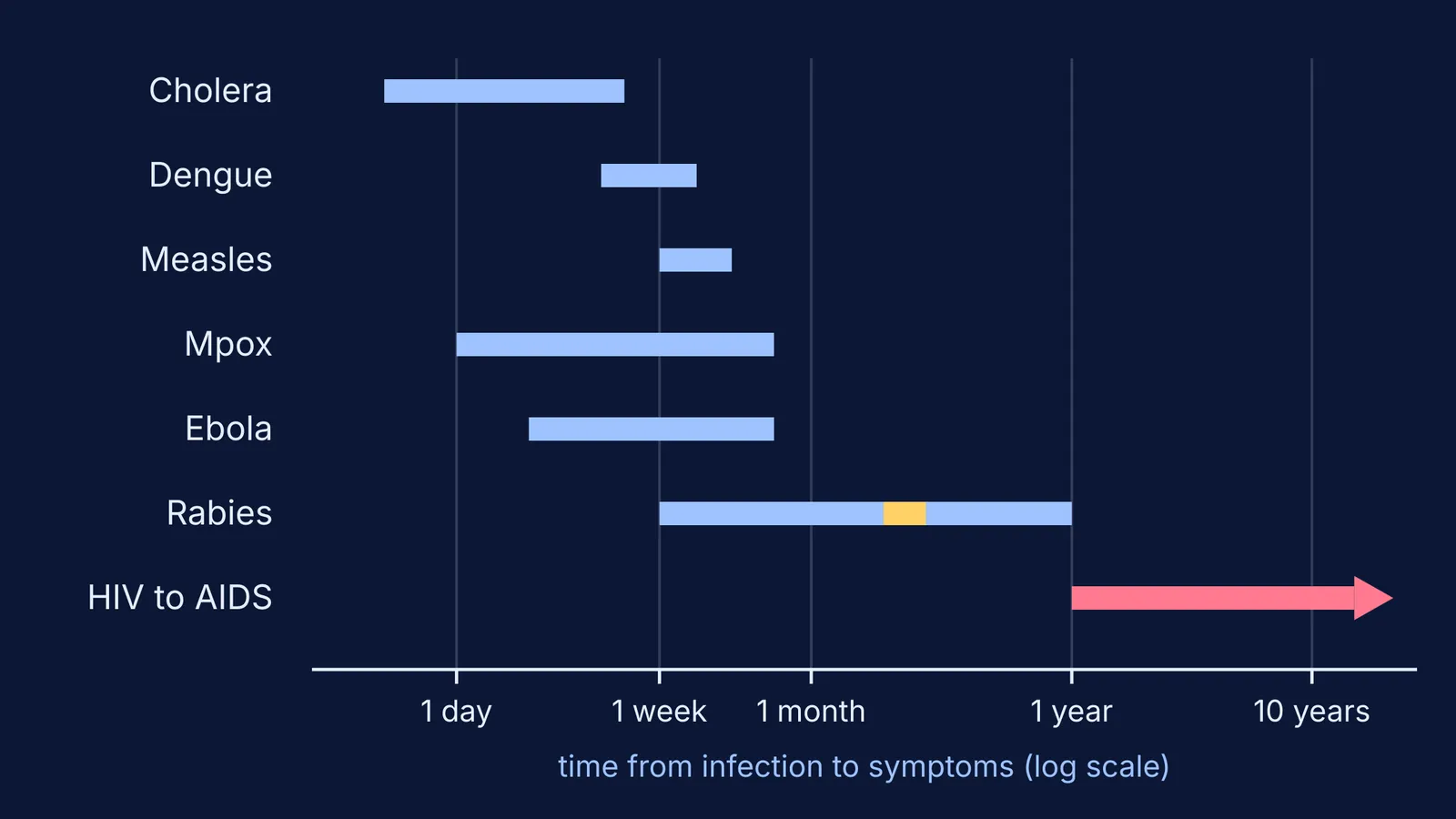
These ranges, plotted in the chart above, come from WHO fact sheets and, for HIV, the CDC table.
Cholera: 12 hours to 5 days (WHO)
Dengue: usually 4 to 10 days after infection (WHO)
Measles: usually 7 to 14 days after exposure (WHO)
Mpox: usually within a week, but 1 to 21 days (WHO)
Ebola: 2 to 21 days (WHO)
Rabies: typically 2 to 3 months, but one week to one year (WHO)
HIV to AIDS: under 1 year to more than 15 years (CDC)
HIV is a special case. The WHO HIV fact sheet says people may have no symptoms in the first few weeks and that untreated HIV can progress to AIDS, often after many years. The long number is the time to AIDS, not to a first fever.
Why do incubation periods range from hours to years?
Three things help set the clock: what the germ has to do before you notice it, how much of it got in, and where it entered.
The job the germ must do. HIV works slowly: it attacks helper T cells and weakens the immune system over years, which you can follow step by step in our post on how HIV replicates and destroys helper T cells.
The dose. A bigger dose tends to mean a shorter wait. In a 1986 Salmonella outbreak at a medical conference in Wales, people who ate two or more pieces of the contaminated chicken had an average incubation period of 16.6 hours, against 20.7 hours for those who ate one piece (Glynn and Palmer, American Journal of Epidemiology, 1992).
The route and site of entry. WHO says the rabies incubation period depends on factors such as where the virus enters and the viral load. How a germ reaches you in the first place is covered in our guide to direct and indirect disease transmission.
How does the incubation period decide quarantine length?
WHO defines quarantine as separating contacts from others after exposure to a case, when they may or may not be infected; isolation is for people known to be infected (WHO).
The key is which part of the range you use. A systematic review of nine respiratory viruses advised using the right tail, the longest waits, for quarantine policy (Lessler and colleagues, Lancet Infectious Diseases, 200970069-6)).
COVID-19 shows how this works. One study estimated a median incubation of 5.1 days, with 97.5% of people who develop symptoms doing so within 11.5 days (Lauer and colleagues, Annals of Internal Medicine, 2020). Even so, under conservative assumptions, about 101 in every 10,000 cases would develop symptoms after 14 days of quarantine, so WHO's 14-day quarantine advice catches most cases, not all.
Ebola contacts are monitored for 21 days, the top of its range (WHO). In January 2023, WHO reported that Uganda declared its Sudan ebolavirus outbreak over 42 days, twice the maximum incubation period, after the last patient tested negative (WHO). Mpox contacts should watch for symptoms for 21 days (WHO).
How do you use the incubation period in a question?
Treat each disease as three numbers: shortest, typical and longest.
Work backwards to find when someone was infected. A guest at a wedding falls sick with Salmonella on Tuesday at 8 pm. Subtract 6 to 48 hours: they ate the contaminated food between Sunday 8 pm and Tuesday 2 pm. Check which meals fall in that window.
Work forwards to set a watch period. An Ebola contact was last exposed on 3 June. Add the longest incubation, 21 days: watch them until 24 June.
To see how these delays play out across a whole town, try our herd immunity outbreak simulation. If a term such as latency, isolation or viral load is shaky, the Fermi Concept Library gives every biology concept its own lesson and shows its place in the map.
This article is for learning, not diagnosis. If you think you have been exposed to an infection, speak to a doctor or follow your local health authority's advice.


