

On this page
A weak acid lowers water's freezing point a little more than its molality predicts, because some molecules split into H⁺ and A⁻. How much more depends on Ka. NCERT uses this link in two numericals, one going from Ka to ΔTf and one going from ΔTf back to Ka, and in a reasoning question about acetic, trichloroacetic and trifluoroacetic acid. This post works through all three. If you only need the degree of dissociation from a measured freezing point, finding percentage dissociation from the van 't Hoff factor covers that step. Here we carry it on to Ka and back.
How does Ka connect to the van 't Hoff factor?
Take a weak acid HA at molality m, with degree of dissociation α.
HA ⇌ H⁺ + A⁻
Particles left as HA: m(1 − α). Particles of H⁺: mα. Particles of A⁻: mα.
Total: m(1 − α) + mα + mα = m(1 + α), so i = 1 + α.
ΔTf = i × Kf × m.
Ka = (mα)(mα) / m(1 − α) = mα² / (1 − α).
When α is small, 1 − α is close to 1, and Ka ≈ mα², so α ≈ √(Ka/m). A common rule is that this shortcut is safe when α comes out below about 0.05.
Two cautions. First, i = 1 + α holds only for a 1:1 acid; a diprotic acid needs a different count. Second, Ka is defined with mol L⁻¹, and NCERT puts molality in its place. In dilute aqueous solution 1 kg of water is close to 1 L of solution, so this is a fair approximation, but it is an approximation.
How do you find ΔTf when Ka is given?
Problem (NCERT). 10 g of 2-chlorobutanoic acid, CH₃CH₂CHClCOOH (M = 122.5 g mol⁻¹), is dissolved in 250 g of water. Ka = 1.4 × 10⁻³ and Kf = 1.86 K kg mol⁻¹. Find the depression in freezing point.
Moles of acid: 10 / 122.5 = 0.0816 mol.
Molality: 0.0816 / 0.250 = 0.327 mol kg⁻¹.
Degree of dissociation: α ≈ √(1.4 × 10⁻³ / 0.327) = √(4.29 × 10⁻³) = 0.0655.
Van 't Hoff factor: i = 1 + 0.0655 = 1.065.
Depression: ΔTf = 1.86 × 0.327 × 1.065 = 0.65 K.
α is slightly above 0.05, so check with the full equation: 0.327α² + (1.4 × 10⁻³)α − 1.4 × 10⁻³ = 0 gives α = 0.0634. That makes ΔTf = 0.646 K, still 0.65 K. The shortcut barely matters because α enters only as 1 + α. Ignoring dissociation altogether would give 1.86 × 0.327 = 0.61 K, about 6% too low.
How do you find Ka from a freezing point?
Problem (NCERT). 19.5 g of fluoroacetic acid, CH₂FCOOH (M = 78 g mol⁻¹), is dissolved in 500 g of water. The freezing point falls by 1.0 °C. Find Ka. Take Kf = 1.86 K kg mol⁻¹.
Moles: 19.5 / 78 = 0.250 mol.
Molality: 0.250 / 0.500 = 0.500 mol kg⁻¹.
ΔTf with no dissociation: 1.86 × 0.500 = 0.93 K.
Van 't Hoff factor: i = observed / calculated = 1.0 / 0.93 = 1.0753.
Degree of dissociation: α = i − 1 = 0.0753.
Concentrations: [H⁺] = [A⁻] = 0.500 × 0.0753 = 0.0377. [HA] = 0.500 × (1 − 0.0753) = 0.462.
Ka: (0.0377)² / 0.462 = 3.07 × 10⁻³.
The literature Ka of fluoroacetic acid is about 2.6 × 10⁻³ (pKa ≈ 2.59), so treat 3.07 × 10⁻³ as the exercise's value, not a measured constant.
Why the gap? Ka depends on α², and α is the small difference between i and 1. If the measured ΔTf were 0.99 K instead of 1.00 K, i would be 1.0645, α would be 0.0645 and Ka would come out as 2.2 × 10⁻³. If it were 1.01 K, Ka would be 4.0 × 10⁻³. So a 1% error in the temperature moves Ka by about 30%. Freezing points suit exam practice, not real Ka measurement.
Why do acetic, trichloroacetic and trifluoroacetic acid lower the freezing point more and more?
NCERT asks why the depression grows in the order CH₃COOH < CCl₃COOH < CF₃COOH for the same amount of each acid in the same mass of water. "Same amount" has to mean the same number of moles. Their molar masses are about 60, 163 and 114 g mol⁻¹, so equal masses would give different molalities and the comparison would change.
With equal molality, the only difference is α, and α follows acid strength.
CH₃COOH: pKa 4.76. A weak acid, mostly un-ionised.
CCl₃COOH: pKa about 0.5 to 0.77, depending on the source.
CF₃COOH: pKa about 0.2 to 0.5, depending on the source.
Three halogen atoms pull electron density away from the carboxylate group by the inductive effect. This stabilises the anion, so the acid ionises more. Fluorine is more electronegative than chlorine, so CF₃ pulls harder. The step-by-step reasoning is in the inductive effect on the acid strength of chloroacetic acid.
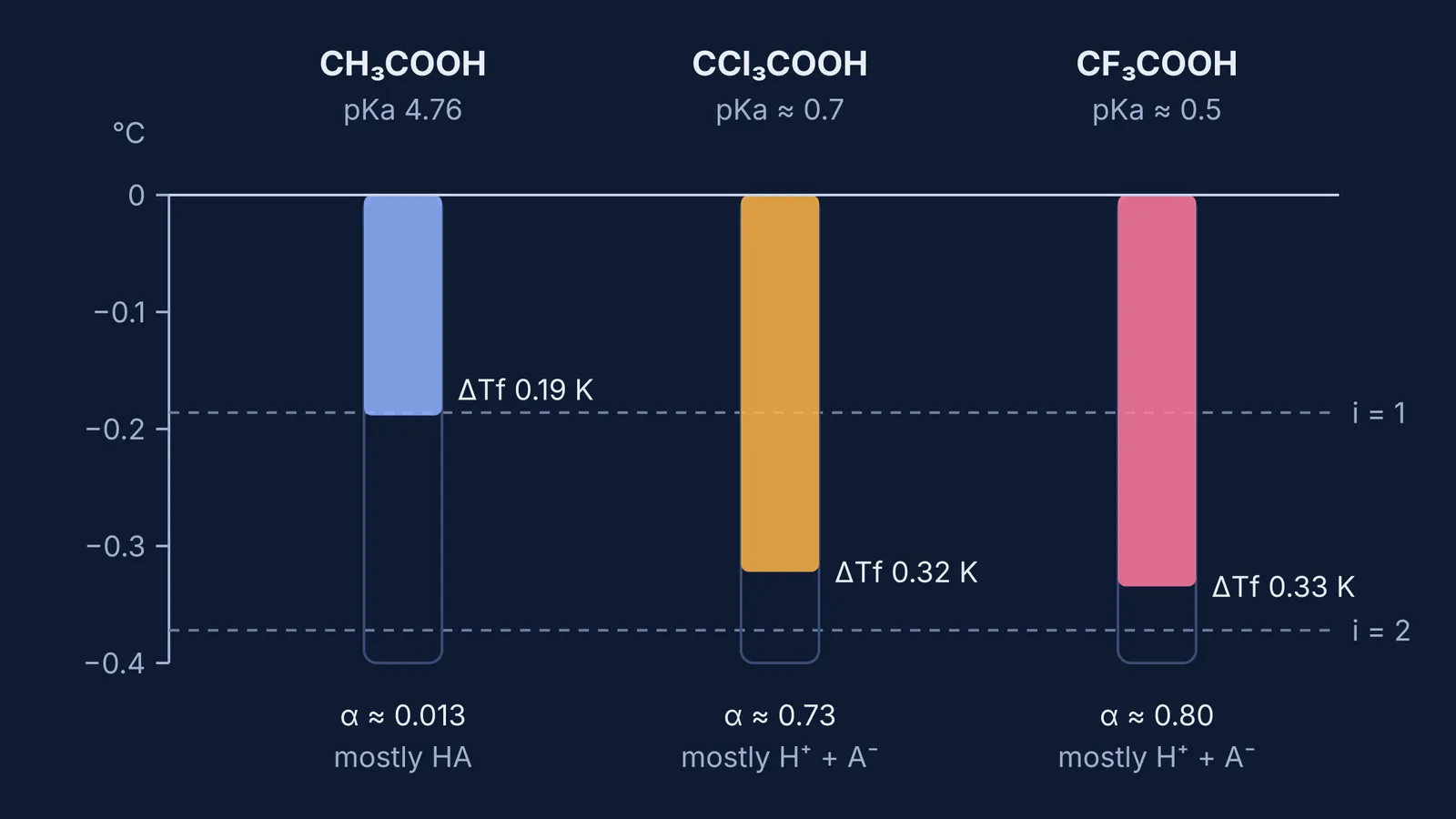
Now put numbers on it. At 0.10 mol kg⁻¹, using pKa 4.76, 0.7 and 0.5 and solving the full equation for α:
CH₃COOH: α ≈ 0.013, i ≈ 1.01, ΔTf ≈ 0.19 K.
CCl₃COOH: α ≈ 0.73, i ≈ 1.73, ΔTf ≈ 0.32 K.
CF₃COOH: α ≈ 0.80, i ≈ 1.80, ΔTf ≈ 0.33 K.
The order answers the NCERT question. The small gap between the last two depends on which pKa you use, and at such high α the ideal model is rough.
Why does the √(Ka/m) shortcut fail for trifluoroacetic acid?
Try it at 0.10 mol kg⁻¹ with Ka = 10⁻⁰·⁵ ≈ 0.316. The shortcut gives α = √(0.316 / 0.10) = 1.78. That is impossible, because α cannot be more than 1. The shortcut assumed 1 − α ≈ 1, and for a strong-ish acid that is false.
Solve the full equation instead. Rearranging Ka = mα² / (1 − α) gives mα² + Kaα − Ka = 0, so:
α = [−Ka + √(Ka² + 4mKa)] / 2m
Ka² = 0.100 and 4mKa = 0.126, so the square root is √0.226 = 0.476.
α = (−0.316 + 0.476) / 0.20 = 0.80.
Always check the shortcut's α. Above about 0.05, use the quadratic.
The same logic runs the other way in a non-polar solvent. There, acids pair up instead of splitting, and i falls below 1, as in why acetic acid shows a molar mass of 120 in benzene.
To practise more problems that link Ka, α and colligative properties, the Fermi Problem Library has a step-by-step solver that explains the reasoning at each stage.
Quick checklist
For a 1:1 weak acid, i = 1 + α and Ka = mα² / (1 − α).
Ka → ΔTf: find m, then α ≈ √(Ka/m), then ΔTf = (1 + α)Kf m.
ΔTf → Ka: i = observed ÷ calculated, α = i − 1, then Ka.
Molality in Ka is an approximation for dilute solutions.
"Same amount" of different acids means equal moles.
Check α after the shortcut; use the quadratic if it is above about 0.05.


