On this page
A freezing-point reading tells you how many particles are really in a solution. Compare that with how many there would be if every unit of salt split apart, and you get the degree of dissociation, α. Here is the method, a full K₂SO₄ example, and the slips that cost marks.
What does the van 't Hoff factor measure?
The van 't Hoff factor i is the apparent number of particles in solution divided by the number of moles of solute dissolved, as defined in LibreTexts' chapter on solutions of electrolytes/13:_Solutions_and_their_Physical_Properties/13.09:_Solutions_of_Electrolytes). Glucose stays whole, so its i is 1; a salt that splits into ions has a larger i.
Freezing-point depression for an electrolyte is ΔTf = i Kf b, where b is molality (Wikipedia: Cryoscopic constant). That same page gives Kf for water as 1.853 K kg/mol, and introductory textbooks such as CK-12 round it to 1.86 (LibreTexts: Freezing Point Depression/16:_Solutions/16.13:_Freezing_Point_Depression)). Use whatever value the question gives you.
For the basic version of this calculation, see how to find molar mass from depression in freezing point.
How do you get percentage dissociation from the van 't Hoff factor?
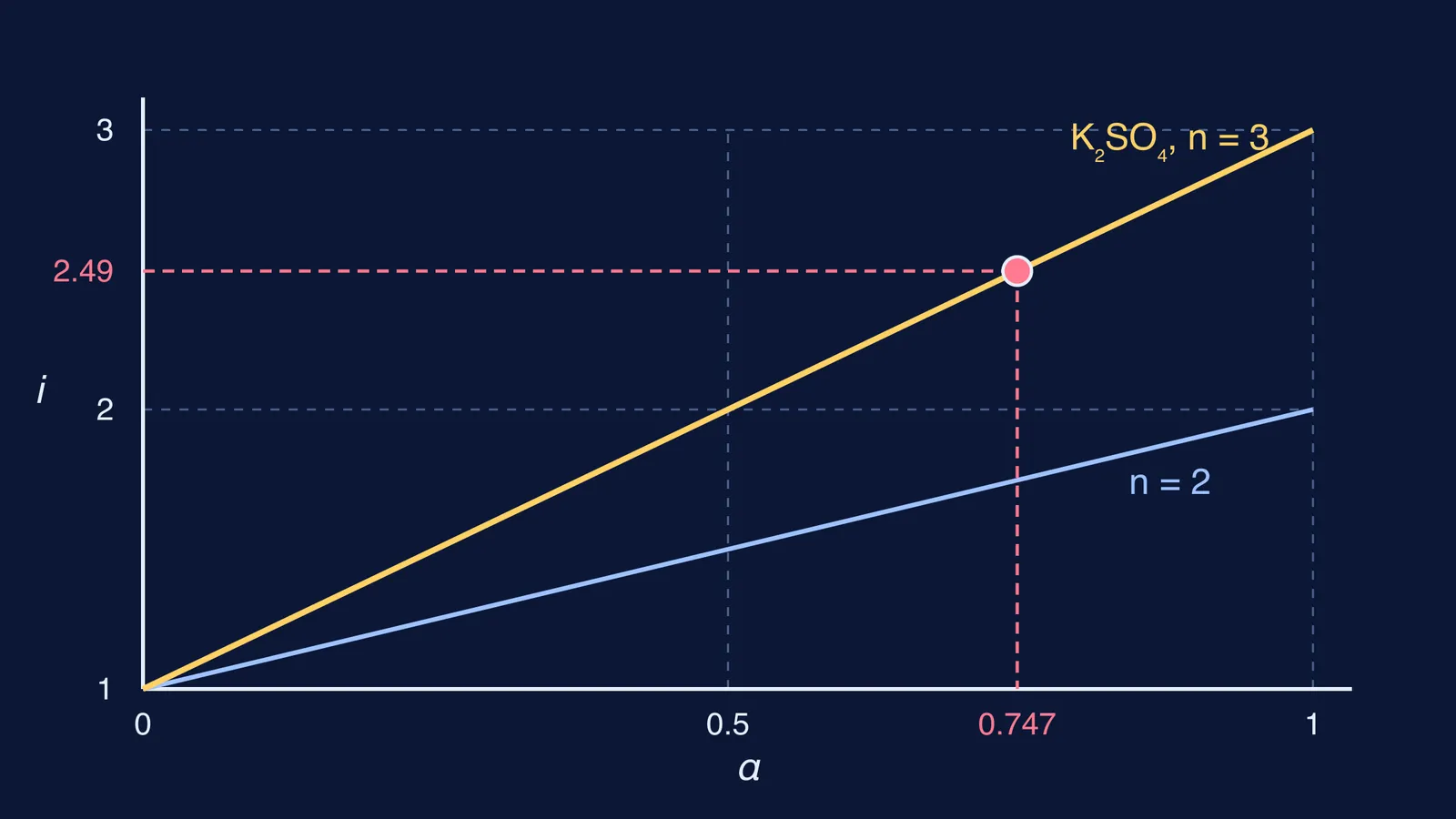
The link between them is i = 1 + α(n − 1), where n is the number of ions one formula unit gives (Wikipedia: Van 't Hoff factor). It comes from counting particles: start with 1 mole, α of it splits into n particles each, and 1 − α stays whole, so the total is αn + (1 − α), which tidies up to the formula. ChemTeam's worked examples show both forms side by side.
Rearrange it and you have the working formula: α = (i − 1)/(n − 1). Multiply by 100 for percentage dissociation.
For K₂SO₄, one formula unit gives 2 K⁺ and 1 SO₄²⁻, so n = 3 and the largest possible i is 3.
Worked example: how dissociated is K₂SO₄ in this solution?
You dissolve 0.871 g of K₂SO₄ in 100 g of water. The solution freezes at −0.232 °C. Take Kf = 1.86 K kg/mol and the molar mass of K₂SO₄ as 174.3 g/mol (2 × 39.10 + 32.06 + 4 × 16.00).
Moles of solute: 0.871 ÷ 174.3 = 0.00500 mol.
Molality: 0.00500 mol ÷ 0.100 kg = 0.0500 mol/kg.
Depression: pure water freezes at 0 °C, so ΔTf = 0.232 K (a 1 °C change equals 1 K).
Van 't Hoff factor: i = ΔTf ÷ (Kf × m) = 0.232 ÷ (1.86 × 0.0500) = 0.232 ÷ 0.0930 = 2.49.
Degree of dissociation: α = (2.49 − 1) ÷ (3 − 1) = 1.49 ÷ 2 = 0.747.
Percentage dissociation: about 74.7%, which rounds to 75%.
Sanity check: i must lie between 1 and 3, so α lies between 0 and 1. If i comes out above n, re-check your molality.
Why is real dissociation less than 100%?
In real solutions, some oppositely charged ions stay close together for a short time as ion pairs, so they count as one particle. LibreTexts' table of measured van 't Hoff factors/13:_Solutions_and_their_Physical_Properties/13.09:_Solutions_of_Electrolytes) lists, for 0.0500 M solutions, NaCl at 1.9 against an ideal 2.0 and MgSO₄ at 1.4 against an ideal 2.0. Put MgSO₄'s numbers into α = (i − 1)/(n − 1) and you get 0.4, so it behaves as only about 40% dissociated. The same source explains that highly charged ions such as Mg²⁺ and SO₄²⁻ have a greater tendency to form ion pairs because of their strong electrostatic attraction.
So the "degree of dissociation" you calculate for a strong electrolyte like K₂SO₄ is really an apparent value. The salt is fully ionic, but ion pairing makes it behave as though some has not split.
When particles join up rather than split, i drops below 1. That is the case in why acetic acid shows a molar mass of 120 in benzene.
What mistakes cost marks on these questions?
Using n = 2 for K₂SO₄, or n = 4 for Al₂(SO₄)₃ (it is 5).
Putting grams of solution or millilitres into the molality instead of kilograms of solvent.
Leaving ΔTf negative. The depression is the drop in freezing point, written as a positive number.
Dividing by n instead of n − 1 in the last step.
Forgetting to multiply α by 100 when the question asks for a percentage.
For more on ranking solutions by i × m and other common slips, see colligative properties: the van 't Hoff factor and common slips.
If you cannot see which step went wrong, try a similar question in the Fermi Problem Library. It has worked problems with a step-by-step solver that explains the reasoning rather than printing an answer, so you can find the exact line where your working went off. If ion pairing or molality itself still feels shaky, the Fermi Concept Library covers every concept in chemistry, each with its own lesson.