

On this page
Statement and match-the-list questions appear in recent NEET papers and take time. These eight original questions run easy to hard within Physics Unit 6 of the NMC's NEET (UG)-2026 syllabus and Chapter 7 of NCERT Class 11 Physics (Reprint 2026-27). Take g = 9.8 m/s² and R = 6400 km. New to the chapter? Read our Gravitation for NEET guide.
Which Gravitation statements are true or false?
Options for Q1 and Q3: (1) Both correct. (2) Both incorrect. (3) I correct, II incorrect. (4) I incorrect, II correct.
Q1 (easy, statements). Statement I: A uniform solid sphere attracts a particle outside it as if all its mass were at its centre. Statement II: The gravitational force between two finite rigid bodies of any shape acts along the line joining their centres of mass.
Answer: (3). I is correct for any spherically symmetric body, per NCERT. II is incorrect: NCERT says that force is not necessarily along that line.
Trap: (1) treats every body as a point mass.
Q2 (medium, statements). Which statements about a planet orbiting the Sun are correct? A. It moves fastest at perihelion. B. Its areal velocity about the Sun stays constant. C. Its linear momentum is conserved. D. The Sun is at the centre of the ellipse. E. Its total mechanical energy stays constant.
(1) A, B and E only (2) A, D and E only (3) B, C and E only (4) A, B, C and E only
Answer: (1). A is true: equal areas in equal times. B is true: that is Kepler's second law. C is false: velocity keeps turning. D is false: the Sun is at a focus. E is true: gravity is conservative.
Trap: (4) assumes linear momentum is conserved along with angular momentum.
Q3 (medium, statements). Statement I: mgh for a change in gravitational potential energy is an approximation valid when h is much smaller than Earth's radius. Statement II: Moving the zero of gravitational potential energy changes the gravitational force between two particles.
Answer: (3). I is correct: NCERT gets mgh from −GMm/r for small heights. II is incorrect: the zero is an arbitrary constant, which leaves the force unchanged.
Trap: (1) treats the zero as physical.
Q4 (hard, statements). For a satellite skimming Earth's surface, which are correct? A. Its orbital speed is about 7.9 km/s. B. Its orbital speed is 1/√2 times the surface escape speed. C. Its period is about 85 minutes. D. To escape, its kinetic energy must at least double. E. A satellite of twice the mass in the same orbit has twice the period.
(1) A, B and C only (2) A, B, C and D only (3) A, C and E only (4) B, C, D and E only
Answer: (2). A: v = √(gR) = √(9.8 × 6.4 × 10⁶) ≈ 7.92 km/s. B: escape speed is √(2gR) ≈ 11.2 km/s. C: T = 2π√(R/g) ≈ 84.6 min. D: E = −K, so reaching E = 0 needs another K. E is false: the satellite's mass cancels.
Trap: (1) confuses doubling speed with doubling kinetic energy.
How do you match Gravitation quantities and cases?
Q5 (easy, match). Match each quantity with its dimensions.
List-I: A. G; B. Gravitational potential; C. Gravitational field intensity; D. Gravitational potential energy.
List-II: I. [ML²T⁻²]; II. [M⁻¹L³T⁻²]; III. [L²T⁻²]; IV. [LT⁻²].
(1) A-II, B-IV, C-III, D-I (2) A-I, B-III, C-IV, D-II (3) A-II, B-III, C-IV, D-I (4) A-II, B-I, C-IV, D-III
Answer: (3). A-II: G = Fr²/m². B-III: potential is J/kg. C-IV: field is N/kg. D-I: energy is in joules.
Trap: (1) swaps potential (J/kg) and field (N/kg).
Q6 (medium, match). Match each situation with its explanation.
List-I: A. A comet moves fastest nearest the Sun; B. The Moon has no atmosphere; C. An astronaut in an orbiting craft feels weightless; D. A ball launched straight up at 8 km/s, ignoring air, falls back.
List-II: I. Astronaut and craft are both in free fall; II. Angular momentum is conserved under a central force; III. Gas molecules can exceed the Moon's escape speed; IV. Launch kinetic energy is less than GMm/R.
(1) A-II, B-III, C-I, D-IV (2) A-II, B-IV, C-I, D-III (3) A-I, B-III, C-II, D-IV (4) A-IV, B-III, C-I, D-II
Answer: (1). A-II: fixed L means faster when closer. B-III: NCERT gives the Moon's escape speed as 2.3 km/s. C-I: NCERT attributes weightlessness to free fall. D-IV: per kg, ½ × 8000² = 3.2 × 10⁷ J is below gR = 6.27 × 10⁷ J.
Trap: (3) assumes gravity vanishes in orbit.
Q7 (medium, match). Match each quantity with its dependence on r, the distance from Earth's centre.
List-I: A. g inside Earth; B. Magnitude of potential outside Earth; C. Orbital speed of a satellite; D. Period of a satellite.
List-II: I. ∝ r^(3/2); II. ∝ r; III. ∝ 1/r; IV. ∝ 1/√r.
(1) A-II, B-IV, C-III, D-I (2) A-III, B-II, C-IV, D-I (3) A-II, B-III, C-I, D-IV (4) A-II, B-III, C-IV, D-I
Answer: (4). A-II: g(1 − d/R) = gr/R. B-III: V = −GM/r. C-IV: v = √(GM/r). D-I: T² ∝ r³.
Trap: (1) swaps 1/r and 1/√r.
Q8 (hard, match). Match each case with its g.
List-I: A. Height R/2 above Earth; B. Depth R/4 below Earth; C. Surface of a planet with four times Earth's mass and four times its radius; D. Surface of a planet with half Earth's mass and twice its radius.
List-II: I. 1.23 m/s²; II. 2.45 m/s²; III. 4.36 m/s²; IV. 7.35 m/s².
(1) A-III, B-IV, C-I, D-II (2) A-III, B-IV, C-II, D-I (3) A-IV, B-III, C-II, D-I (4) A-II, B-IV, C-III, D-I
Answer: (2). A-III: 9.8 × 4/9 ≈ 4.36. B-IV: 9.8 × 3/4 = 7.35. C-II: g = GM/R², so 9.8 × 4/16 = 2.45. D-I: 9.8 × 0.5/4 ≈ 1.23.
Trap: (1) uses g ∝ M/R for D, giving 9.8 × 0.5/2 = 2.45.
How do you work these Gravitation questions faster?
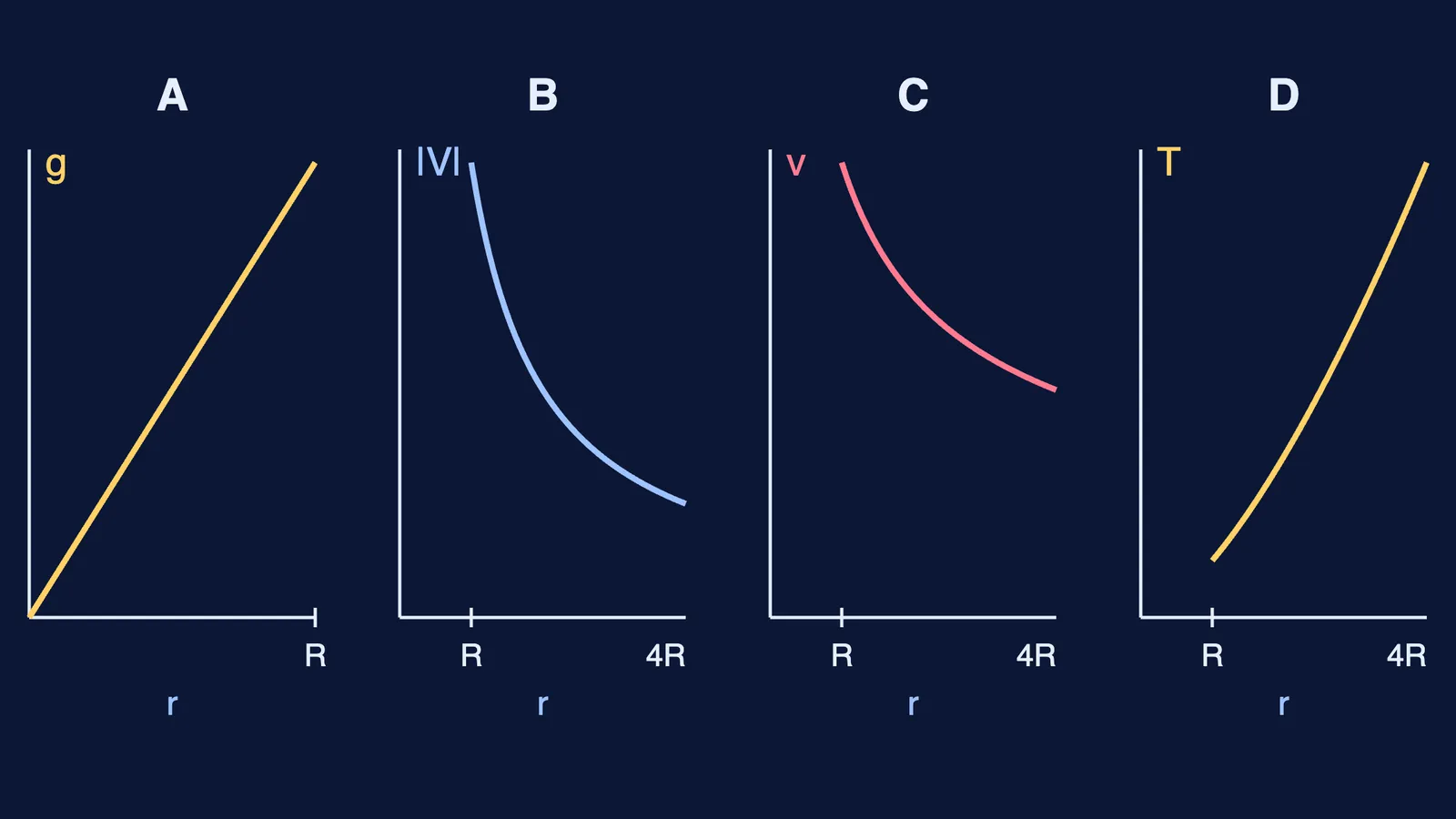
Write the power of r first: g goes as r inside and 1/r² outside.
Convert heights to r = R + h before any formula.
When a planet changes size, ask whether mass or density stays fixed.
In match questions, lock your surest pair and strike options without it.
Struggling to picture these curves? The Fermi Simulation Lab has interactive simulations for the ideas that are easier to see than to read.
Next, read our NEET match-the-list method or try Gravitation NEET practice questions.


