

On this page
Statement and match-the-list questions appear in recent JEE Main papers. These eight original Gravitation questions, easy to hard, stay within Unit 6 of the NTA syllabus for JEE (Main) 2027 and NCERT Class 11 Physics Chapter 7 (Reprint 2026-27). R and g are Earth's radius and surface gravity; ignore air. New to the chapter? Read our Gravitation for JEE Main guide.
Which Gravitation statements are correct?
Options for Q1 and Q3: (1) Both correct. (2) Both incorrect. (3) I correct, II incorrect. (4) I incorrect, II correct.
Q1 (easy, statements). Statement I: At a small height h, g falls by the same fraction as at a depth h. Statement II: If Earth shrank to three-quarters of its radius at the same density, surface g would become three-quarters of its present value.
Answer: (4). I is incorrect: for h ≪ R, g at height is g(1 − 2h/R) but at depth g(1 − h/R), twice the fall. II is correct: g = (4/3)πGρR, so with ρ fixed g scales with R.
Trap: (2) assumes a smaller Earth always has larger g.
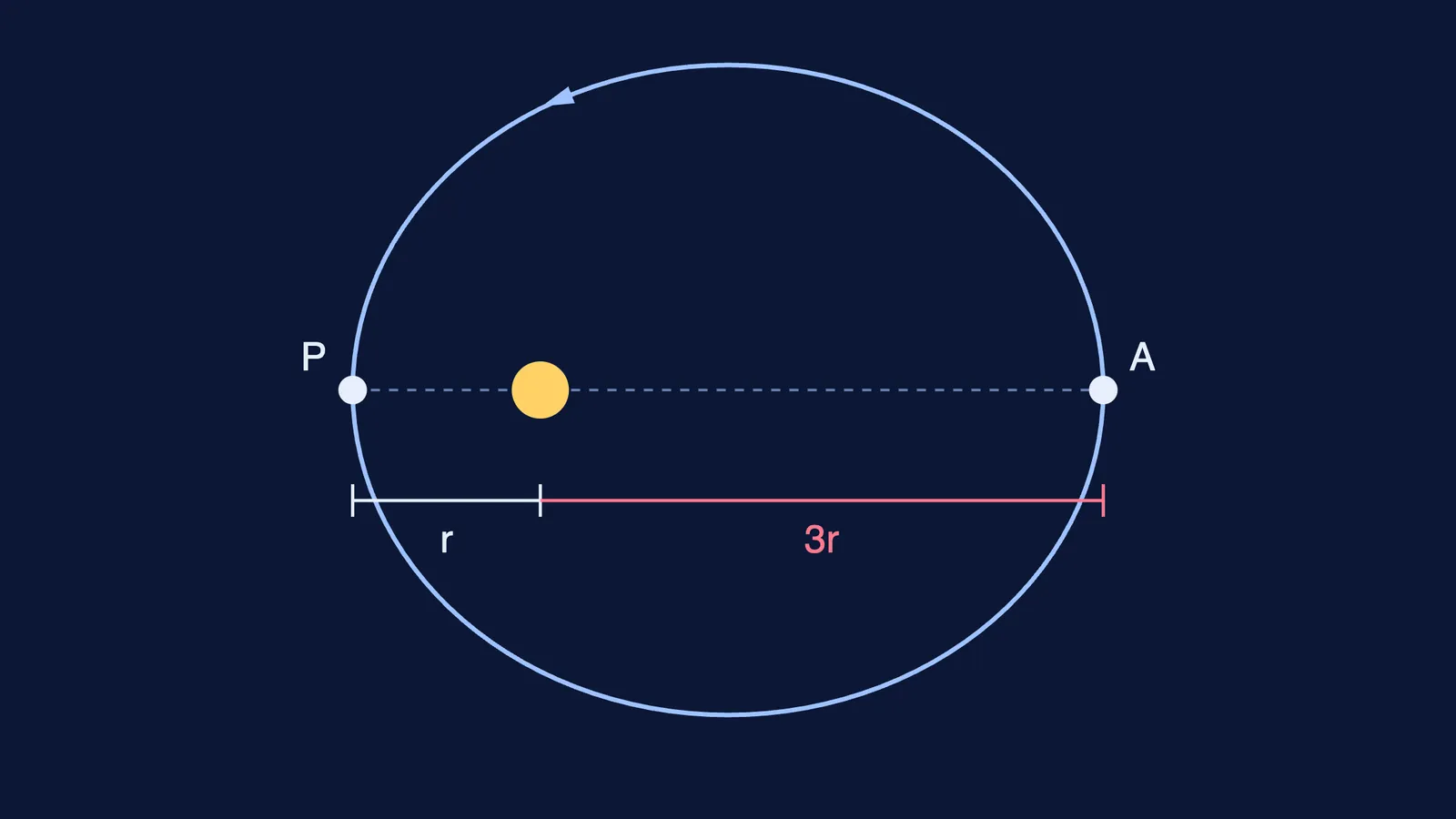
Q2 (medium, statements). A planet's orbit has its closest point P at r from the Sun and its farthest point A at 3r. Which are correct? A. Its speed at P is three times that at A. B. The orbit's semi-major axis is 2r. C. Its period equals that of a circular orbit of radius 3r. D. Its kinetic energy at P is nine times that at A. E. Its angular momentum about the Sun at P is three times that at A.
(1) A, B and E only (2) A, B and D only (3) A, C and D only (4) B, D and E only
Answer: (2). A is true: v_P × r = v_A × 3r, as velocity is perpendicular to the radius there. B is true: 2a = 4r. C is false: T² ∝ a³ uses the semi-major axis, 2r. D is true: KE ∝ v². E is false: a central force conserves angular momentum.
Trap: (3) puts 3r into T² ∝ a³.
Q3 (medium, statements). Statement I: At the centre of a thin uniform ring of mass M and radius R, the field is zero but the potential is −GM/R. Statement II: If the Sun's mass doubled, a planet's period in the same circular orbit would halve.
Answer: (3). I is correct: opposite pulls cancel; potentials, all at distance R, add. II is incorrect: T = 2π√(r³/GM) falls by √2.
Trap: (1) takes T ∝ 1/M.
Q4 (hard, statements). A body is projected straight up from Earth's surface at (2√2/3)v_e, where v_e is the escape speed. Which are correct? A. It rises to a height 8R above the surface. B. At its highest point the gravitational field is g/81. C. Treating g as constant would overestimate the height. D. The body-Earth system's total energy is negative. E. Launched at half this speed, it would rise to 2R.
(1) A, B and D only (2) A, B, D and E only (3) A, C and D only (4) B, D and E only
Answer: (1). A is true: ½v² = (8/9)gR = gRh/(R + h) gives h = 8R. B is true: the top is at r = 9R. C is false: v²/2g = 8R/9 underestimates. D is true: v < v_e. E is false: ½v² = (2/9)gR gives h = 2R/7.
Trap: (2) scales height with v².
How do you match Gravitation lists in JEE Main?
Q5 (easy, match). Match each quantity with its value.
List-I: A. Escape speed from the surface; B. Orbital speed at height R; C. Potential at height R; D. Energy per kg to free a satellite from a circular orbit of radius 2R.
List-II: I. √(gR/2); II. gR/4; III. √(2gR); IV. −gR/2.
(1) A-I, B-III, C-IV, D-II (2) A-III, B-I, C-II, D-IV (3) A-III, B-I, C-IV, D-II (4) A-III, B-IV, C-I, D-II
Answer: (3). With GM = gR²: A-III: ½v² = GM/R. B-I: v² = GM/2R. C-IV: V = −GM/r at r = 2R. D-II: the orbit's energy per kg is −GM/4R = −gR/4.
Trap: (1) swaps the two speeds.
Q6 (medium, match). Match each change to a planet with its escape-speed factor.
List-I: A. Mass doubled, radius unchanged; B. Radius made four times, mass unchanged; C. Radius doubled, density unchanged; D. Density doubled, radius halved.
List-II: I. 2; II. 1/√2; III. √2; IV. 1/2.
(1) A-III, B-IV, C-I, D-II (2) A-III, B-IV, C-II, D-I (3) A-I, B-IV, C-III, D-II (4) A-III, B-II, C-I, D-IV
Answer: (1). v_e = √(2GM/R) ∝ R√ρ. A-III: √2. B-IV: √(1/4). C-I: 2. D-II: (1/2)√2.
Trap: (3) takes v_e ∝ M.
Q7 (medium, match). A satellite moves from a circular orbit of radius r to one of radius 4r. Match each quantity with its factor.
List-I: A. Kinetic energy; B. Angular speed; C. Angular momentum about Earth's centre; D. Centripetal acceleration.
List-II: I. 2; II. 1/16; III. 1/4; IV. 1/8.
(1) A-III, B-II, C-I, D-IV (2) A-IV, B-III, C-I, D-II (3) A-III, B-IV, C-II, D-I (4) A-III, B-IV, C-I, D-II
Answer: (4). A-III: KE = GMm/2r. B-IV: ω ∝ r^(−3/2). C-I: L = m√(GMr). D-II: a = GM/r².
Trap: (1) swaps ω and a.
Q8 (hard, match). For a uniform solid sphere of mass M and radius R, match each with its value.
List-I: A. Field magnitude at r = R/3; B. Potential at r = R/3; C. Potential at r = 3R; D. Field magnitude at r = 3R.
List-II: I. −GM/(3R); II. GM/(9R²); III. −13GM/(9R); IV. GM/(3R²).
(1) A-II, B-III, C-I, D-IV (2) A-IV, B-III, C-I, D-II (3) A-IV, B-I, C-III, D-II (4) A-II, B-I, C-III, D-IV
Answer: (2). A-IV: inside, E = GMr/R³. B-III: inside, V = −GM(3R² − r²)/(2R³) = −(13/9)GM/R. C-I: V = −GM/r outside. D-II: E = GM/r².
Trap: (3) swaps the two potentials.
How do you work these questions faster?
Convert every height or depth to r, the distance from the centre.
For a changed planet, ask whether mass or density is fixed.
Use v²/2g only for h ≪ R; otherwise use energy with −GMm/r.
In match questions, lock your surest pair and strike options without it.
Orbits hard to picture? The Fermi Simulation Lab has interactive simulations for the ideas that are easier to see than to read.
Next, try our Gravitation JEE Main practice questions.


