

On this page
These eight Gravitation questions suit Section B of JEE Main Physics, where you type a number, not pick an option. All eight are original.
How are numerical-value questions marked in JEE Main?
The Information Bulletin for JEE (Main) 2027 gives Physics 20 multiple-choice questions in Section A and 5 numerical-value questions in Section B. You enter an integer on an on-screen keypad; the answer "should be rounded off to the nearest integer". A correct answer earns +4, a wrong one −1 and a blank 0.
All eight questions stay inside Unit 6, Gravitation, of the Syllabus for JEE (Main) - 2027 and Chapter 7 of the NCERT Class 11 Physics Part I textbook (Reprint 2026-27). Take g = 9.8 m/s² and R = 6400 km for Earth, as that chapter does; treat Earth as a uniform sphere and ignore rotation and air.
New to the chapter? Start with how to prepare Gravitation for JEE Main, then try Gravitation JEE Main practice questions, set 1.
Easy: potential energy, g with height, escape speed
Q1 (easy). Point masses of 2 kg, 3 kg and 4 kg sit at the corners of a right-angled triangle: the 2 kg and 3 kg masses are 0.3 m apart, the 3 kg and 4 kg masses 0.4 m apart, and the 2 kg and 4 kg masses 0.5 m apart. The least work needed to separate them to infinity is k × G joules, with G in SI units. Find k.
Answer: 66. Add −Gm₁m₂/r over the three pairs: U = −G(2 × 3/0.3 + 3 × 4/0.4 + 2 × 4/0.5) = −G(20 + 30 + 16) = −66G. The work needed is +66G, so k = 66.
Trap: 132, from counting every pair twice, once from each mass.
Q2 (easy). At what height above Earth's surface, in km, is g equal to 81% of its surface value? Give the nearest integer.
Answer: 711. g′/g = (R/(R + h))² = 0.81, so R/(R + h) = 0.9 and h = R/9 = 711.1 km.
Trap: 608, from the shortcut g(1 − 2h/R), valid only for small h.
Q3 (easy). A small planet has radius 3200 km and surface gravity 4.9 m/s². Find the escape speed from its surface, in m/s.
Answer: 5600. v = √(2gR) = √(2 × 4.9 × 3.2 × 10⁶) = √(3.136 × 10⁷) = 5600 m/s.
Trap: 3960, which is √(gR), the speed of a satellite skimming the surface.
Medium: g below ground, Kepler's second law and a long fall
Q4 (medium). A spring balance reads 490 N for a load at Earth's surface. The load is taken down a mine shaft until the balance reads 392 N. Find the depth of that point, in km, to the nearest integer.
Answer: 1280. g′/g = 392/490 = 0.8. Below the surface g′ = g(1 − d/R), so d = 0.2R = 1280 km.
Trap: 755, from (R/(R + d))² = 0.8, the inverse-square rule valid only outside Earth.
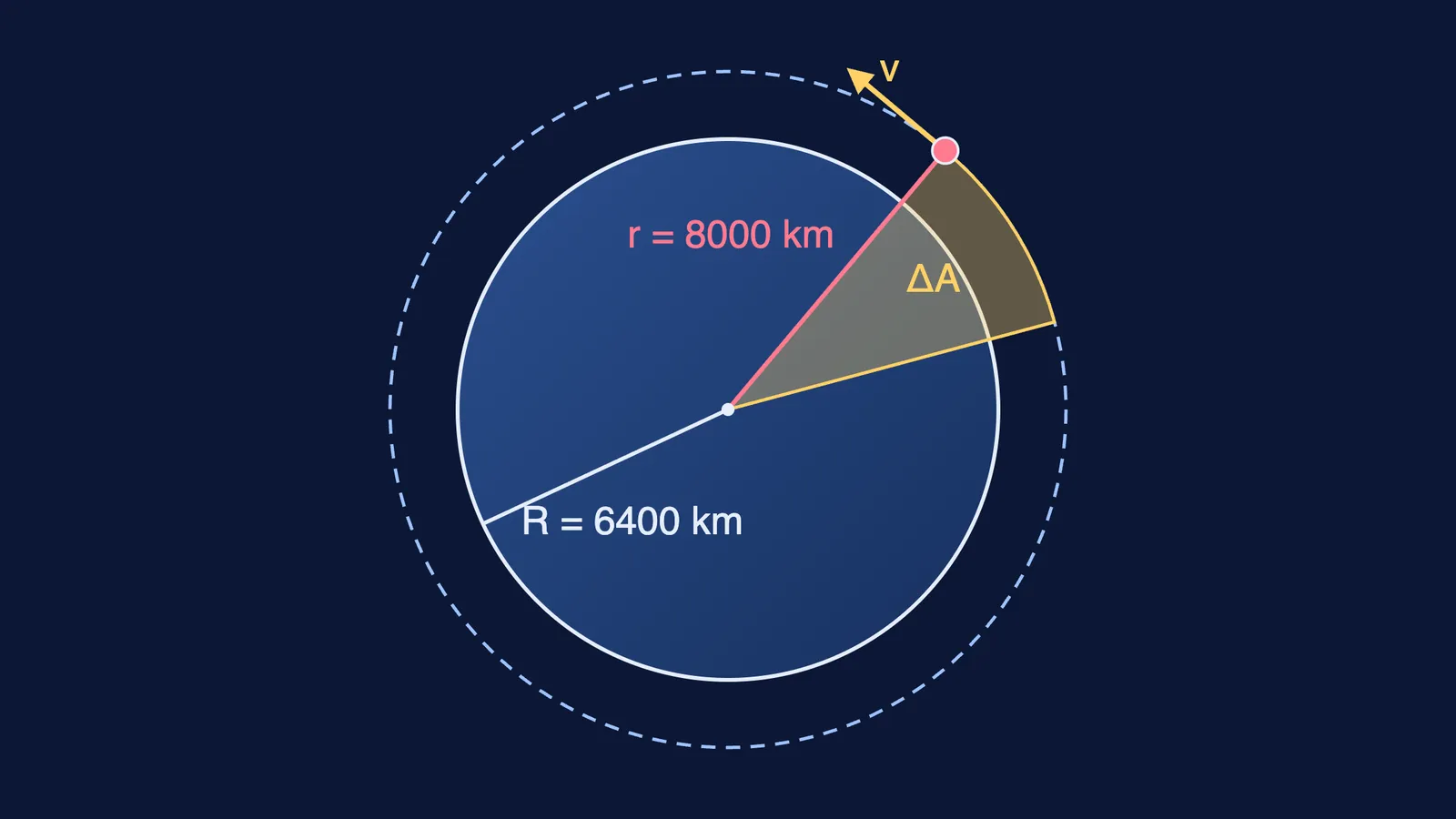
Q5 (medium). A satellite circles Earth at 8000 km from the centre. Find the rate at which the line from Earth's centre to it sweeps out area, in units of 10⁹ m²/s, to the nearest integer.
Answer: 28. In time dt the line sweeps a triangle of area rv dt/2, so the rate is rv/2. Speed v = √(gR²/r) = 6.4 × 10⁶ × √(9.8/8 × 10⁶) = 7084 m/s. The rate is 8 × 10⁶ × 7084/2 = 2.83 × 10¹⁰ m²/s, or 28.3 in units of 10⁹ m²/s.
Trap: 57, which forgets the half in the triangle's area.
Q6 (medium). A small probe is released from rest at a height of 4800 km above Earth's surface. Find its speed just before it reaches the ground, in m/s, to the nearest integer.
Answer: 7332. It starts at r = 11,200 km = 1.75R. Per kilogram: v²/2 = GM/R − GM/1.75R = (3/7)gR, using GM = gR². So v = √(6gR/7) = √(5.376 × 10⁷) = 7332 m/s.
Trap: 9699, from v² = 2gh, which keeps g at 9.8 m/s² all the way down.
Hard: working back from energy and potential
Q7 (hard). A 600 kg satellite is in a circular orbit around Earth. The least extra energy that would send it to infinity is 6.0 × 10⁹ J. Find its height above the surface, in km, to the nearest integer.
Answer: 13670. Orbit energy is −GMm/2r, so escape needs GMm/2r = 6.0 × 10⁹ J. With GM = gR² = 4.014 × 10¹⁴ m³/s², r = (4.014 × 10¹⁴ × 600)/(1.2 × 10¹⁰) = 2.007 × 10⁷ m = 20,070 km. Height = 20,070 − 6400 = 13,670 km.
Trap: 20070, the orbit radius, not the height.
Q8 (hard). At a planet's surface the gravitational potential is −5.0 × 10⁷ J/kg and the field is 10 N/kg. A satellite circles it at a height equal to its radius. Find its period in minutes, to the nearest integer.
Answer: 209. V = −GM/R and g = GM/R², so R = |V|/g = 5.0 × 10⁶ m and GM = |V|R = 2.5 × 10¹⁴ m³/s². The orbit radius is 2R = 1.0 × 10⁷ m, so T = 2π√(r³/GM) = 2π√(10²¹/(2.5 × 10¹⁴)) = 2π × 2000 = 12,566 s, or 209.4 minutes.
Trap: 74, which uses r = R instead of 2R.
How do you get the number right in Gravitation?
Convert to the stem's unit, then round. Q8 wants minutes: typing 12566 seconds scores −1.
Round once, at the end. Carry four significant figures; early rounding can flip a value near .5.
Mind the sign. U and V are negative; work needed is positive. In Q1 you type 66, not −66.
Height is not radius. Formulas return r from the centre; stems often ask for height. In Q7, r = 20,070 km but the answer is r − R.
Compare with constant g. A body falling from rest from height h lands slower than √(2gh), since g weakens with height, and below the escape speed of about 11.2 km/s worked out in the NCERT Gravitation chapter. If Q6 gives exactly √(2gh), you kept g fixed.
Stuck on a step? The Fermi Problem Library has worked problems with a step-by-step solver that explains the reasoning rather than printing an answer.
Redo every miss two days later, from a blank page.


