

On this page
Diamond is not the stable form of carbon at room conditions. Graphite is, by 2.9 kJ/mol in Gibbs energy. Yet diamonds form deep in the Earth, and factories make them in bulk. The thing that tips the balance is pressure, and you can estimate how much is needed with one line of thermodynamics and two densities. The answer, about 15,000 bar at room temperature, is a JEE Advanced question and a neat case of Le Chatelier's principle put into numbers.
Why does pressure favour diamond over graphite?
Diamond is much denser than graphite. Its carbon atoms sit in a tight three-dimensional network, while graphite has flat sheets stacked with large gaps between them. So one mole of diamond takes up less space than one mole of graphite.
Le Chatelier's principle says that if you squeeze a system at equilibrium, it shifts towards the side with smaller volume. For graphite ⇌ diamond, the smaller-volume side is diamond. That tells you the direction. To get the size of the pressure, you need the Gibbs energy.
If you want to see why diamond survives at 1 bar even though graphite is more stable, read thermodynamic vs kinetic stability, the diamond and graphite example. This post deals with the other question: where does diamond become the stable form?
How does Gibbs energy change with pressure?
At constant temperature, the change of G with pressure is the molar volume:
(∂G/∂p) at constant T = V
So every phase gets more Gibbs energy as you squeeze it, and a phase with a larger molar volume gains G faster. Graphite has the larger volume, so its G rises more steeply.
For a solid, V hardly changes with pressure, so you can treat it as constant. Then, for the change graphite → diamond:
ΔG(p) = ΔG° + ΔV × (p − p°)
Here ΔG° is +2.9 kJ/mol at 1 bar and 298 K, and ΔV = V(diamond) − V(graphite) is negative. As p rises, the second term grows more negative. At some pressure it cancels ΔG° exactly, and the two forms are in equilibrium. Above that pressure, ΔG is negative and diamond is the stable form. You can see where ΔG° itself comes from in why diamond releases more heat on burning than graphite, which compares the enthalpies of combustion.
How do you calculate the graphite–diamond equilibrium pressure?
Here is the full estimate. The densities used are graphite 2.25 g/cm³ and diamond 3.51 g/cm³. Tables give slightly different values (graphite is often quoted between 2.25 and 2.27 g/cm³), so treat the answer as approximate.
Molar volume of graphite. V = M/ρ = 12.01/2.25 = 5.34 cm³/mol.
Molar volume of diamond. V = 12.01/3.51 = 3.42 cm³/mol.
Volume change. ΔV = 3.42 − 5.34 = −1.92 cm³/mol. Convert to SI: −1.92 × 10⁻⁶ m³/mol.
Set ΔG to zero. 0 = 2900 J/mol + (−1.92 × 10⁻⁶ m³/mol) × Δp.
Solve. Δp = 2900 / (1.92 × 10⁻⁶) = 1.51 × 10⁹ Pa.
Convert. 1 bar = 10⁵ Pa, so Δp ≈ 15,100 bar. Add the starting 1 bar and the equilibrium pressure is about 15,100 bar, or about 1.5 GPa.
Check the units once: J/mol divided by m³/mol is J/m³, and 1 J/m³ = 1 N·m/m³ = 1 N/m² = 1 Pa. If you leave ΔV in cm³/mol, you will be off by a factor of a million.
A quick sanity check: at 5 GPa (50,000 bar), ΔG = 2900 + (−1.92 × 10⁻⁶)(5 × 10⁹) ≈ −6.7 kJ/mol. Diamond is now clearly favoured, which matches the high pressures used in real synthesis.
How did JEE Advanced 2017 set this question?
JEE Advanced 2017 gave the standard Gibbs energies of formation of graphite (0) and diamond (2.9 kJ/mol) at 298 K, and said the conversion reduces the volume by 2 × 10⁻⁶ m³/mol. It then asked for the pressure at which the two are in equilibrium.
The working is the same as above with a rounded ΔV:
Δp = 2900 / (2 × 10⁻⁶) = 1.45 × 10⁹ Pa = 14,500 bar
p = 1 bar + 14,500 bar = 14,501 bar
Notice the final 1 bar: the question asks for the pressure, not the change in pressure. The unit conversion from Pa to bar is the other place marks are lost. Your answer from real densities, about 15,100 bar, differs only because ΔV is 1.92 rather than 2.00 cm³/mol.
What does this simple estimate leave out?
The model makes three assumptions, and you should know them:
Incompressible solids. It treats both molar volumes as fixed. Real solids compress a little, so ΔV changes slightly with pressure.
Constant ΔV. Even without compression, using one ΔV across 15,000 bar is an approximation.
Only 298 K. The whole calculation is at one temperature. Diamond has lower entropy than graphite (about 2.4 versus 5.7 J K⁻¹ mol⁻¹), so heating favours graphite. The equilibrium pressure therefore rises as temperature rises.
The bigger point is kinetic. Being on the "diamond stable" side does not make graphite turn into diamond. Breaking graphite's sheets and rebuilding a 3D network has a huge activation energy, so at room temperature nothing happens, even at 15 kbar. Industrial high-pressure, high-temperature (HPHT) synthesis runs at roughly 5–6 GPa and 1,300–1,600 °C with molten metal catalysts such as iron, nickel or cobalt. The heat and the catalyst make the change fast enough; the pressure keeps diamond on the stable side at that temperature.
The same "denser phase wins under pressure" reasoning explains why squeezing ice can melt it, because liquid water is denser than ice. If you want to play with how pressure shifts an equilibrium, the Simulation Lab has interactive simulations for ideas that are easier to see than read.
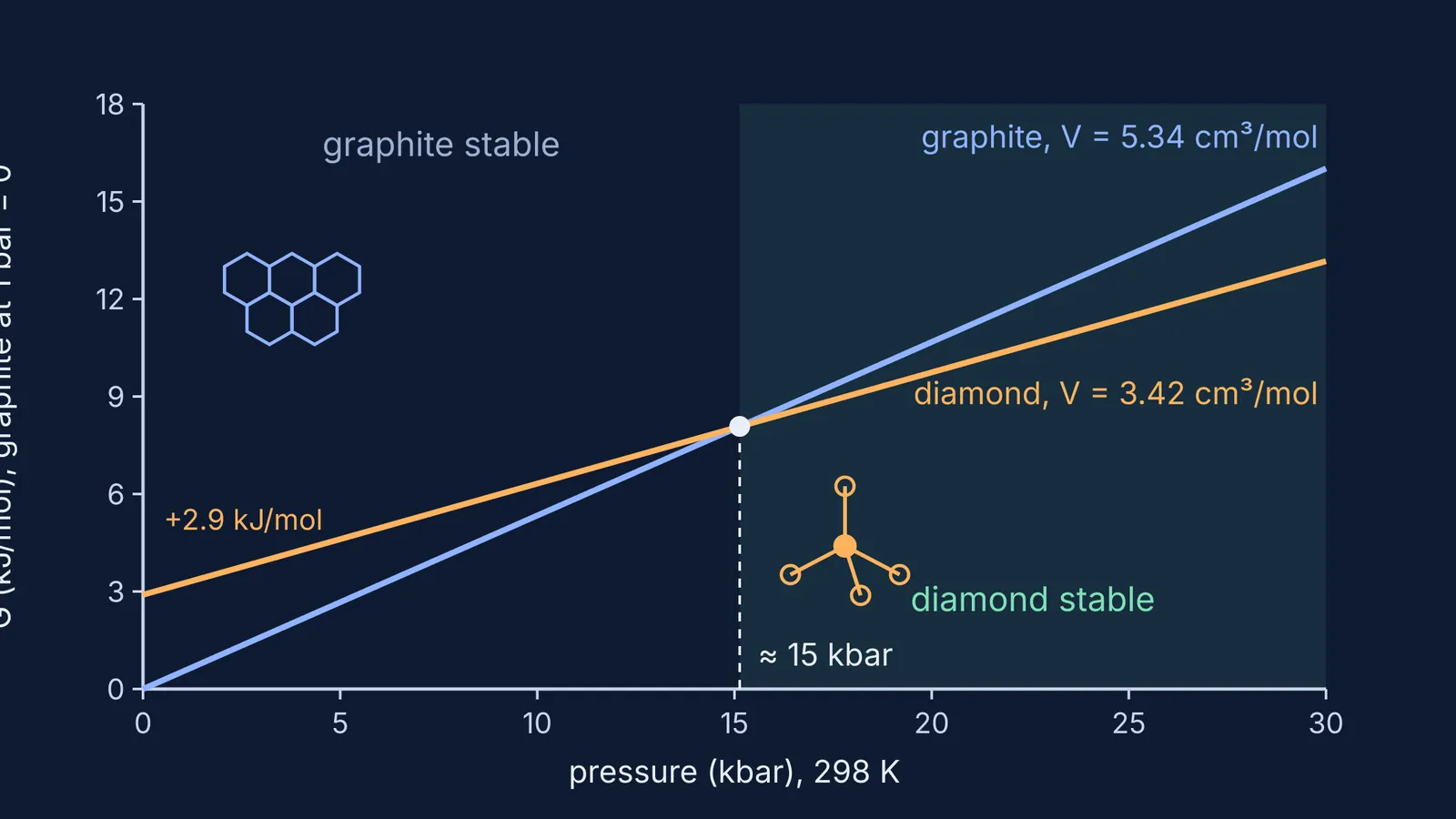
How do you read the G against pressure graph?
Plot G for each form against pressure at 298 K. Each line is straight, with slope equal to its molar volume:
Graphite starts at 0 and climbs with slope 5.34 cm³/mol.
Diamond starts 2.9 kJ/mol higher and climbs with the smaller slope 3.42 cm³/mol.
Because the diamond line is shallower, it catches up. The lines cross at about 15 kbar. To the left, graphite has lower G and is stable. To the right, diamond does. The crossing point is the equilibrium pressure you just calculated.
Quick checklist
(∂G/∂p) at constant T = V, so the denser phase is favoured at high pressure.
ΔG(p) = ΔG° + ΔV·Δp for solids treated as incompressible.
Graphite 2.25 g/cm³ and diamond 3.51 g/cm³ give ΔV ≈ −1.92 cm³/mol.
Equilibrium at about 1.5 × 10⁹ Pa, or roughly 15,000 bar, at 298 K.
JEE Advanced 2017 used ΔV = 2 × 10⁻⁶ m³/mol and got 14,501 bar.
The estimate ignores compression and temperature; real synthesis also needs heat and a catalyst for speed.


