

On this page
Why does diamond release more heat on combustion than graphite?
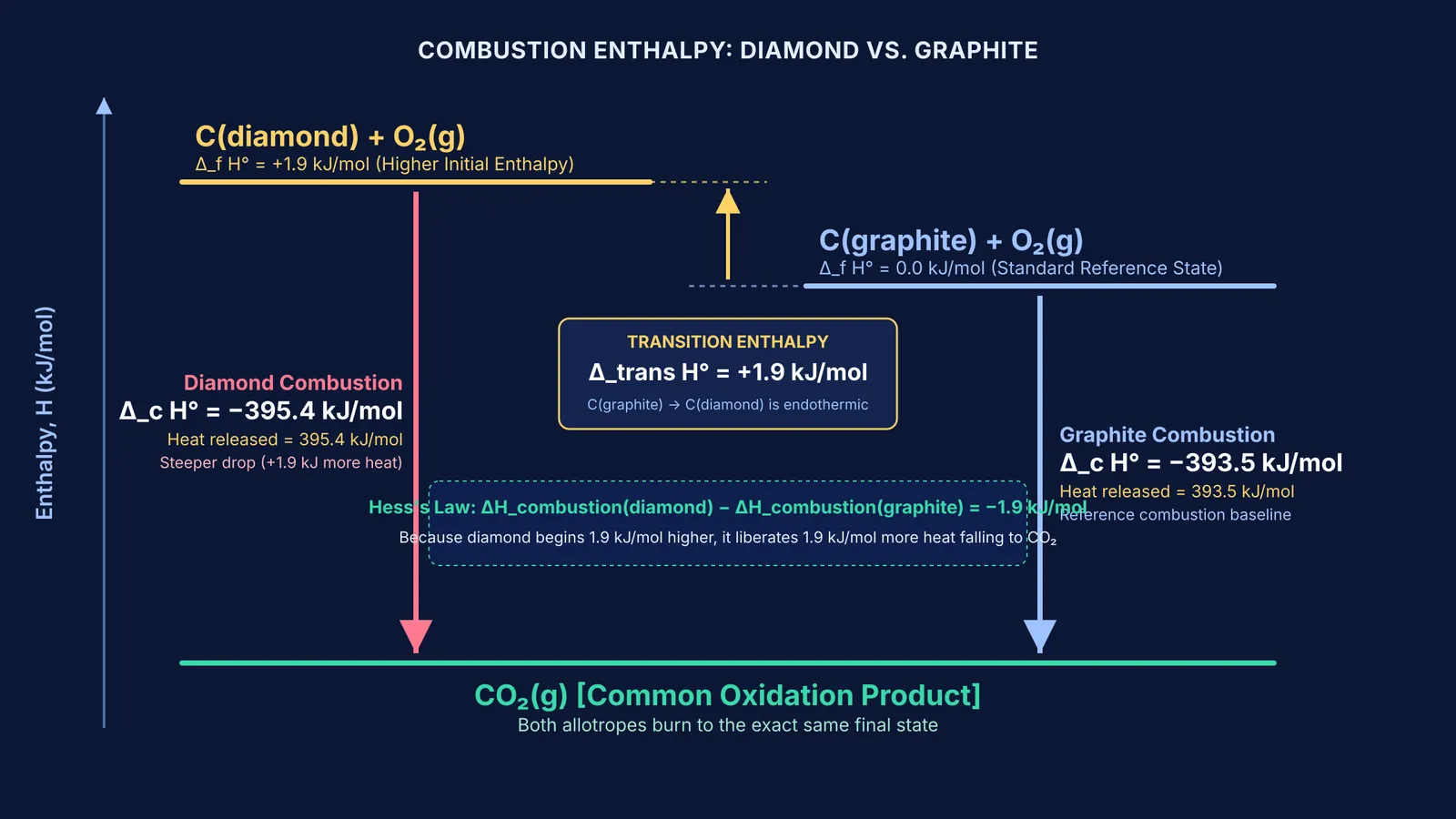
When diamond burns completely in excess oxygen, it releases more thermal energy than graphite. Both reactions produce the exact same substance: one mole of carbon dioxide gas, CO₂(g).
The standard enthalpy of combustion for graphite is −393.51 kJ/mol according to the NIST Chemistry WebBook. For diamond, the standard enthalpy of combustion is −395.40 kJ/mol (NIST Chemistry WebBook).
Because combustion is an exothermic process, thermochemical convention assigns these values negative signs. Diamond's combustion enthalpy is approximately 1.9 kJ/mol more negative than that of graphite, meaning diamond liberates 1.9 kJ more heat per mole into its surroundings.
In thermodynamics, the heat released at constant pressure equals the enthalpy difference between reactants and products: ΔH = H(products) − H(reactants). Because both reactions end at identical CO₂(g) energy levels, diamond releases more heat simply because it starts on a higher enthalpy shelf. Our guide to measuring reaction energies in a bomb calorimeter explains how laboratories measure these combustion values experimentally.
How does Hess's law reveal the transition enthalpy?
Transforming graphite directly into diamond cannot be measured directly in an ordinary laboratory calorimeter because the solid-phase transition requires extreme geological pressures. Instead, chemists apply Hess's law of constant heat summation to standard combustion measurements, as outlined in NCERT Chemistry.
Hess's law states that because enthalpy is a state function, the net enthalpy change depends only on the initial and final states, not on the intermediate path. In a landmark study, researchers Prosen, Jessup, and Rossini (1944) used bomb calorimetry of combustion to determine the heat of transition between carbon allotropes.
Consider the two thermochemical equations:
C(graphite) + O₂(g) → CO₂(g), with Δ_c H° = −393.5 kJ/mol
C(diamond) + O₂(g) → CO₂(g), with Δ_c H° = −395.4 kJ/mol
Reversing equation (2) gives CO₂(g) → C(diamond) + O₂(g), with ΔH = +395.4 kJ/mol. Adding this reversed equation to equation (1) cancels out O₂(g) and CO₂(g):
C(graphite) → C(diamond), with Δ_trans H° = −393.5 kJ/mol + 395.4 kJ/mol = +1.9 kJ/mol
The standard enthalpy of transition from graphite to diamond was determined as +1.896 kJ/mol by Prosen, Jessup, and Rossini (1944), matching the modern standard value of +1.895 kJ/mol.
Converting graphite to diamond is endothermic (ΔH > 0), meaning diamond stores more internal enthalpy. For more cycle techniques, see our guide to Hess's law thermochemistry cycles. To practice multi-step cycles, the Fermi Problem Library provides worked problems with a step-by-step solver that explains the reasoning rather than printing an answer.
Why is graphite more stable if diamond is harder?
Many students assume diamond must be thermodynamically more stable because its rigid lattice of sp³ carbon atoms makes it the hardest natural mineral.
Thermodynamic stability is governed by enthalpy and free energy, not mechanical hardness. In diamond, each carbon atom forms four localized sigma bonds in a 3D tetrahedral network. In graphite, carbon atoms are sp² hybridised in planar hexagonal sheets. Each carbon atom forms three sigma bonds and contributes one electron to a delocalised π-electron system across the entire sheet.
This delocalised π-bonding gives graphite substantial resonance stabilisation energy, lowering its molar enthalpy beneath diamond. The standard enthalpy of formation for graphite at 298.15 K and 1 bar is defined as 0.0 kJ/mol because graphite is carbon's most stable allotrope, as confirmed by NCERT Chemistry.
Diamond does not transform into graphite spontaneously at room temperature because it is kinetically persistent. Converting the 3D network into planar sheets requires breaking strong C−C bonds, creating an activation barrier of 728 kJ/mol on {110} faces (Davies and Evans (1972)). For more on bond energetics, see our article on estimating enthalpy from bond energies. The Fermi Concept Library maps every concept in physics, chemistry, biology, mathematics and computing, each with its own lesson and its place in the map.
Worked example: calculating combustion heat for an exam problem
Problem: A student burns 6.00 g of diamond completely in oxygen, and separately burns 6.00 g of graphite under conditions outlined in NCERT Chemistry. Calculate the heat released by each sample and the difference.
Solution:
Moles of carbon:
With carbon's molar mass at 12.011 g/mol, n = 6.00 g / 12.011 g/mol = 0.4995 mol.
Heat released by graphite:
Using Δ_c H° = −393.51 kJ/mol from the NIST Chemistry WebBook: q_graphite = 0.4995 mol × 393.51 kJ/mol = 196.56 kJ.
Heat released by diamond:
Using Δ_c H° = −395.40 kJ/mol from the NIST Chemistry WebBook: q_diamond = 0.4995 mol × 395.40 kJ/mol = 197.50 kJ.
Energy difference:
Difference = 197.50 kJ − 196.56 kJ = 0.94 kJ.
Burning 6.00 g of diamond releases about 0.95 kJ more heat than burning 6.00 g of graphite. For 0.500 mol of carbon, this matches half the 1.9 kJ/mol molar gap.
Key exam takeaways:
Graphite is the standard reference state with Δ_f H° = 0.0 kJ/mol; diamond has Δ_f H° = +1.895 kJ/mol (NIST Chemistry WebBook).
Combustion enthalpy is negative, but "heat released" is stated as a positive quantity.
To find transition enthalpy, subtract the combustion enthalpy of the product allotrope from that of the reactant.


