

On this page
Your tongue is anchored at the back of your mouth. A frog's is anchored at the front, and that one difference explains how a frog catches an insect faster than you can blink.
Why is a frog's tongue attached at the front of its mouth?
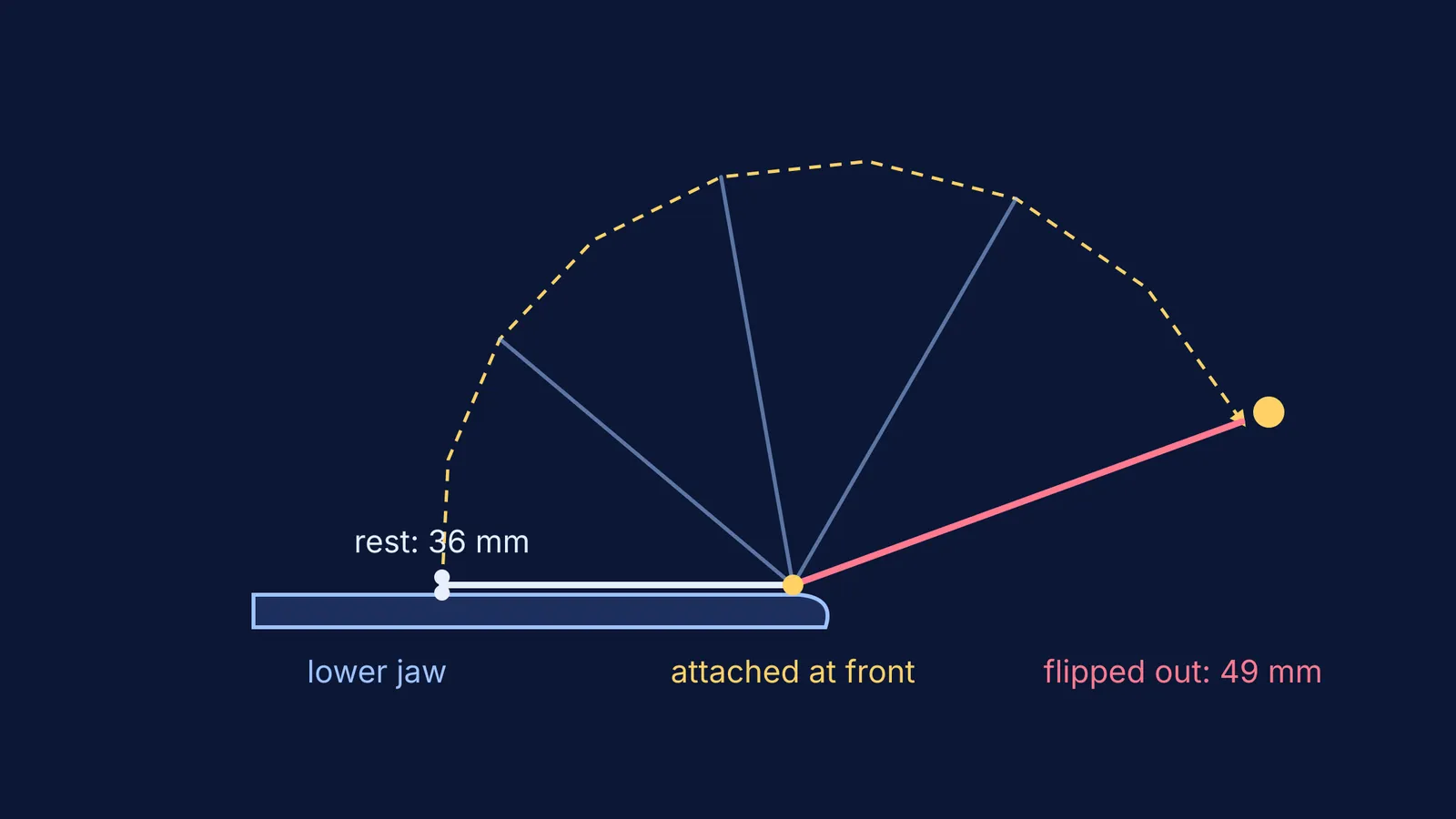
In most mammals the tongue is attached at the throat, but in frogs and toads it is attached to the front of the lower jaw, according to a 2018 review by Alexis Noel and David Hu in the Journal of Experimental Biology. The review describes frogs using this attachment point to throw the tongue out like a mousetrap.
A school dissection guide makes the same point: the frog's tongue is attached at the front of the mouth and not at the rear as in humans (Brooklyn Tech frog dissection lab). At rest, the tongue lies folded back along the floor of the mouth, with its free end pointing towards the throat.
That free end is the bilobed part. Notes based on the NCERT Class 11 chapter put it simply: food is captured by the bilobed tongue and then enters the buccal cavity (NCERT chapter notes). Our frog morphology explainer for Class 11 covers the rest of the body plan.
How does a frog's tongue flip out so fast?
A hinge at the front means the tongue does not have to slide out. It only has to rotate. Noel and Hu's review describes two main ways frogs do this:
Mechanical pulling: the genioglossus muscle contracts and rotates the tongue forward out of the mouth. The tongue can shrink by as much as 60% of its resting length, so these frogs lunge forward to reach prey.
Inertial elongation: the frog also drops its jaw very quickly, which flings the tongue forward at up to 4 m/s. In the northern leopard frog, jaw dropping reaches 3,700 degrees per second, and the tongue stretches from 36 mm to 49 mm.
The speed is real. In a 2017 study of leopard frogs, Noel and colleagues filmed the tongue catching an insect in under 0.07 seconds, five times faster than a human blink (Journal of the Royal Society Interface). The insect accelerated at up to 120 m/s², about 12 times the acceleration of gravity.
So why doesn't the insect bounce off? The same 2017 study measured the leopard frog tongue as 10 times softer than a human tongue. On impact it gives way like a car's shock absorber, and the saliva changes thickness: it runs thin to spread over the insect, then turns thick and grips while the tongue pulls back. The authors calculated the tongue has 50 times greater work of adhesion than a sticky-hand toy.
Chameleons solve the same problem differently; see our piece on chameleon tongue speed.
What do vomerine and maxillary teeth do after the catch?
Once the tongue folds back, the prey lands in the mouth. The maxillary teeth are very small and line the edge of the upper jaw, while the vomerine teeth are paired bumps on the roof of the mouth between the internal nostrils (dissection lab).
None of these teeth chew. Amphibians swallow their prey whole, so they do not need teeth for chewing (Burke Museum). With no chewing to do, their job is to grip a struggling insect so it cannot slip back out before it is swallowed.
The lower jaw is toothless. A 2021 survey of frog skulls found that all frog species lack teeth on the lower jaw except one, Gastrotheca guentheri, and that vomerine teeth were present in 202 species and absent in 226 (Paluh and colleagues, eLife).
The eyes help as well. Most frogs pull their eyes down into the head while swallowing. When researchers cut the nerves to those eye muscles, leopard frogs needed 74% more swallows per cricket (Levine, Monroy and Brainerd, 2004).
How do you write this in an exam answer?
Learn it as five steps:
Fixed point: the tongue is attached at the front of the lower jaw and free and bilobed at the back.
Flip: the jaw drops and the tongue rotates forward over the jaw.
Stick: the soft tongue and saliva hold the insect.
Grip: the tongue folds back, and the maxillary and vomerine teeth on the upper jaw and palate hold the prey.
Swallow: the prey goes down whole, helped by the eyes pressing down.
Then check your answer against three common slips:
Writing that frog teeth chew food. They only hold it.
Putting teeth on both jaws. The lower jaw has none.
Saying the tongue is attached at the back, like ours.
If the frog chapter is still patchy, the Fermi Concept Library gives each biology concept its own lesson and shows where it fits. Our Class 11 guide to structural organisation in animals puts the frog in the context of the full chapter.


