

On this page
Most hydrogen-spectrum questions give you two values of n and ask for a wavelength. Two NCERT Class 11 exercises turn this around. One gives you a wavelength and asks which orbit the electron started from. The other gives you two orbit radii and asks what light comes out. The formulas are the same ones you already know. The difference is the algebra, plus one habit: checking that the n you get is really a whole number before you round it.
How do you find n from a spectral line?
Start from the frequency form of the Rydberg equation used in the NCERT Class 11 chapter on the structure of atom:
ν = 3.29 × 10¹⁵ Hz × (1/n₁² − 1/n₂²)
Here n₁ is the lower level and n₂ the upper one. Put the lower level first so the bracket stays positive. If the question names the series, it has already told you n₁: Lyman 1, Balmer 2, Paschen 3, Brackett 4, Pfund 5.
The steps are:
Convert the wavelength to frequency with ν = c/λ, keeping λ in metres.
Divide ν by 3.29 × 10¹⁵ Hz to get the value of the bracket.
Subtract that from 1/n₁² to get 1/n₂².
Take the reciprocal to get n₂², then the square root.
Check that n₂ comes out close to a whole number before you round it.
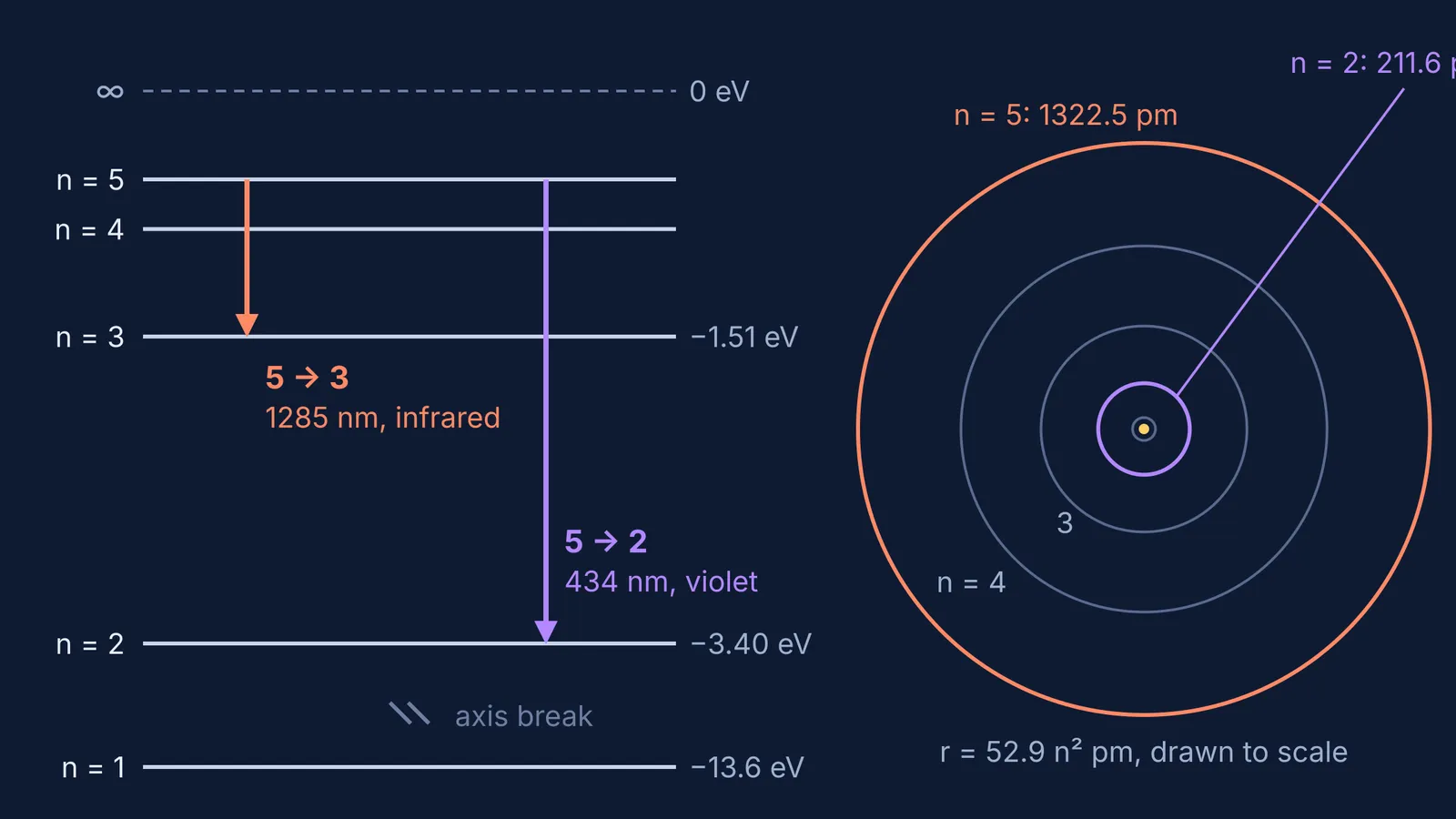
Worked example 1: which level gives a 1285 nm Paschen line?
The question says the line belongs to the Paschen series, so n₁ = 3.
Frequency. ν = 3.00 × 10⁸ ÷ (1285 × 10⁻⁹) = 2.335 × 10¹⁴ Hz.
Bracket. 2.335 × 10¹⁴ ÷ 3.29 × 10¹⁵ = 0.0710.
Subtract from 1/9. 1/n₂² = 0.1111 − 0.0710 = 0.0401.
Reciprocal. n₂² = 1 ÷ 0.0401 = 24.9, so n₂ = 4.99.
Round. n₂ = 5. The transition is 5 → 3.
Why is it safe to round 24.9 up to 25? Because the nearest other possible answers are far away. If n₂ were 4, n₂² would be 16. If it were 6, n₂² would be 36. The value 24.9 sits next to 25 and nowhere near either neighbour. Put n = 5 back into the formula and you get 1282 nm, so the 1285 nm in the question is a rounded value. The NIST table of strong hydrogen lines lists this Paschen line at 1281.8 nm, measured in air.
This line is in the infrared, not the visible. Every Paschen line lies beyond 820 nm, the Paschen series limit, so none of them can be seen.
How do you find n from an orbit radius?
For hydrogen, the Bohr radius of the nth orbit is r = 52.9 n² pm (0.529 n² Å). Running it backwards is a single division: n² = r ÷ 52.9 pm. Our post on the radius and speed of the electron in the nth Bohr orbit explains where the n² comes from and how it changes to n²/Z for He⁺ and Li²⁺.
The trap is units. If a radius is given in nanometres and you divide it by 52.9 without converting, you get nonsense. 1.3225 ÷ 52.9 = 0.025, which is not the square of any whole number. Convert first: 1.3225 nm = 1322.5 pm.
Worked example 2: an electron drops from 1322.5 pm to 211.6 pm
An electron in a hydrogen atom moves from an orbit of radius 1.3225 nm to one of radius 211.6 pm. Find the wavelength of the light emitted.
Convert. 1.3225 nm = 1322.5 pm.
Upper level. n² = 1322.5 ÷ 52.9 = 25.0, so n = 5.
Lower level. n² = 211.6 ÷ 52.9 = 4.00, so n = 2.
Name the series. The lower level is 2, so this is a Balmer line, transition 5 → 2.
Wavenumber. 1/λ = 109 677 cm⁻¹ × (1/2² − 1/5²) = 109 677 × (0.25 − 0.04) = 109 677 × 0.21 = 23 032 cm⁻¹.
Wavelength. λ = 1 ÷ 23 032 cm⁻¹ = 4.342 × 10⁻⁵ cm = 434 nm.
Check with energies. E₅ − E₂ = −0.544 − (−3.40) = 2.86 eV, and 1240 ÷ 2.86 = 434 nm. This is violet light, the line called Hγ.
NIST lists Hγ at 434.05 nm. The Rydberg constant gives 434.18 nm. The small gap is not an error in your working. Measured lines are usually quoted in air, where light travels a little slower than in a vacuum, so the measured wavelength is slightly shorter.
What mistakes cost marks on backward Bohr questions?
Forgetting to convert units. Nanometres and picometres differ by a factor of 1000. Wavelengths must be in metres when you use ν = c/λ.
Swapping the levels in the bracket. If 1/n₁² − 1/n₂² comes out negative, you have the levels the wrong way round.
Rounding too early. Keep three or four significant figures until you reach n². Rounding 0.0710 to 0.07 changes n² from 24.9 to 24.3, which looks less convincing even though n is still 5.
Calling a Paschen line visible. Lyman is ultraviolet, Balmer has the visible lines, and Paschen, Brackett and Pfund are infrared.
Using the hydrogen radius for an ion. For He⁺ or Li²⁺, r = 52.9 n²/Z pm, so you must multiply by Z before taking the square root.
For forward questions, where n is given and you need a wavelength, see our hydrogen spectrum problems on energy levels and wavelengths. For the shortest wavelength in each series, read the series limit in the hydrogen spectrum.
How can you practise finding n?
Make up your own questions by running the forward calculation first and then hiding the answer. For example, work out the wavelength for 4 → 2 (486 nm), then give yourself only "486 nm, Balmer" and find n again. If your backward answer does not match, the slip is in one specific step. The Fermi Problem Library has a step-by-step solver that explains the reasoning, so you can compare each line of your working against it.
Quick checklist
Name the series first: it fixes the lower level n₁.
For a wavelength: ν = c/λ, divide by 3.29 × 10¹⁵ Hz, subtract from 1/n₁², take the reciprocal.
For a radius: convert to pm, divide by 52.9, take the square root.
Round only if n² is already near a perfect square.
1285 nm Paschen line: n = 5, infrared.
1322.5 pm to 211.6 pm: 5 → 2, Balmer, about 434 nm, violet.


