

On this page
Most Bohr-model questions in Class 11 chemistry, Class 12 physics and JEE Main come back to two results: how big the nth orbit is, and how fast the electron moves in it. Once you have those, the period, frequency and current follow in one line each, and He⁺ and Li²⁺ ratio questions need no constants at all.
What are the radius and speed of the electron in the nth Bohr orbit?
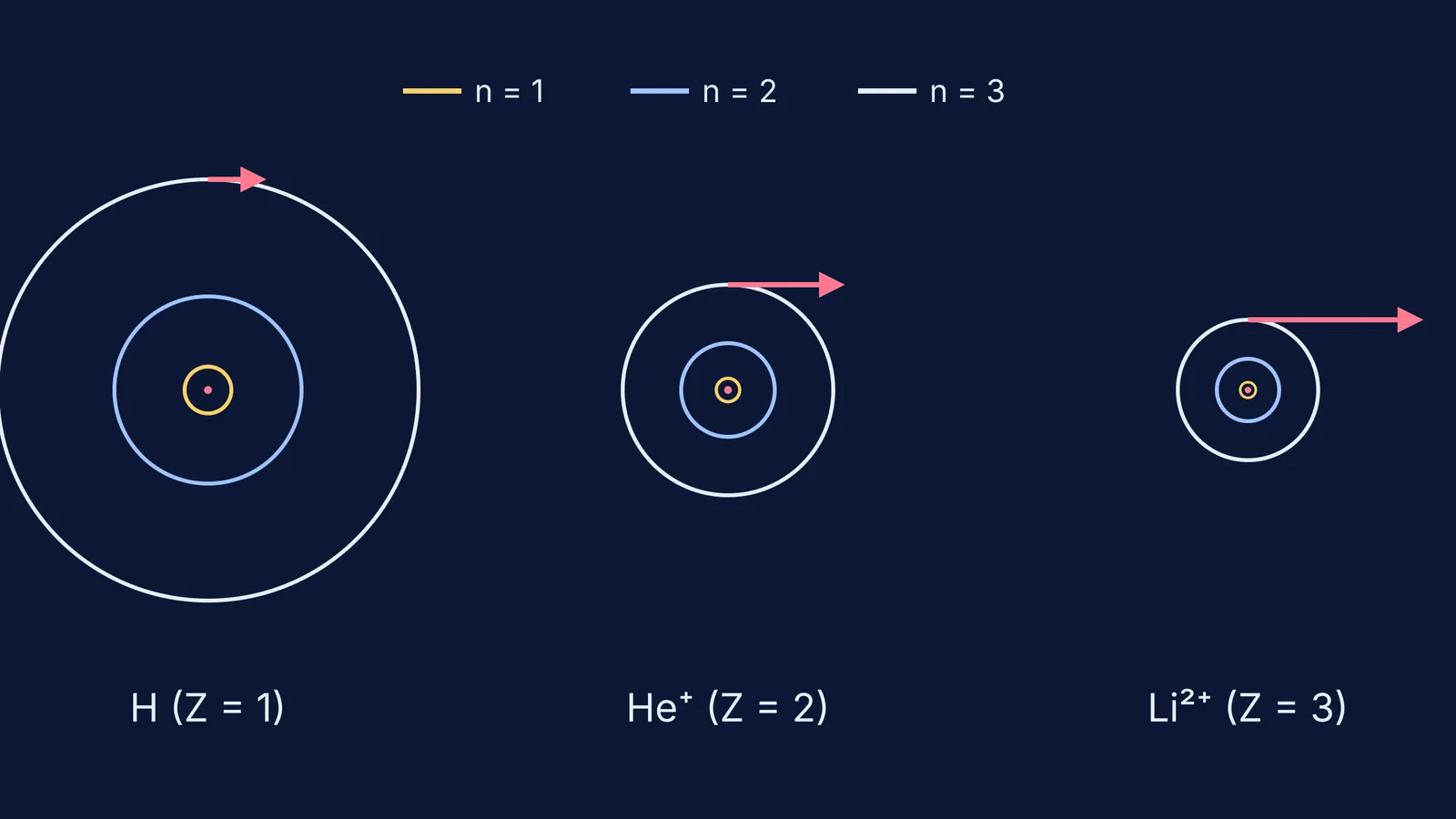
A hydrogen-like ion is any nucleus of charge Ze with just one electron: H (Z = 1), He⁺ (Z = 2), Li²⁺ (Z = 3), Be³⁺ (Z = 4). In the Bohr model, the radius of the nth orbit of such an ion is rₙ = a₀n²/Z, as set out in OpenStax University Physics, Volume 3.
The Bohr radius a₀ is 5.29177210544 × 10⁻¹¹ m, or about 0.529 Å, in the CODATA 2022 values published by NIST.
The speed in the nth orbit is vₙ = v₁Z/n, where v₁ is the speed in hydrogen's first orbit. That v₁ = ħ/(mₑa₀), which is the atomic unit of velocity, 2.18769126216 × 10⁶ m/s according to NIST.
So, rounded for exam use:
rₙ = 0.529 × n²/Z Å
vₙ = 2.19 × 10⁶ × Z/n m/s
He⁺ ground state: r₁ = 0.265 Å, v₁ = 4.38 × 10⁶ m/s
Li²⁺ ground state: r₁ = 0.176 Å, v₁ = 6.56 × 10⁶ m/s
Why does the radius go as n²/Z but the speed as Z/n?
Two conditions fix the orbit. The Coulomb pull supplies the centripetal force: mv²/r = kZe²/r². And Bohr's rule says angular momentum comes in whole units: mvr = nħ, as written in the OpenStax chapter.
From the second, v = nħ/(mr). Put that into the first and you get r ∝ n²/Z. Put r back into v = nħ/(mr) and you get v ∝ Z/n. A bigger nucleus pulls the electron closer and speeds it up; a higher n does the opposite.
What is the orbital period and current of the electron?
The period is the circumference over the speed: T = 2πr/v. Using the scalings above, T ∝ (n²/Z) ÷ (Z/n) = n³/Z².
For hydrogen's first orbit, T₁ = 2π times the atomic unit of time, and NIST lists that unit as 2.4188843265864 × 10⁻¹⁷ s. That gives T₁ ≈ 1.52 × 10⁻¹⁶ s, or about 6.58 × 10¹⁵ revolutions per second.
An electron going round a loop is a tiny current, I = e/T. With e fixed at exactly 1.602176634 × 10⁻¹⁹ C, hydrogen's ground-state current comes out at about 1.05 × 10⁻³ A, roughly 1.05 mA. Since I ∝ 1/T, the current scales as Z²/n³: about 4.22 mA in ground-state He⁺ and 9.49 mA in ground-state Li²⁺.
That current loop is also what gives the atom its orbital magnetic moment, which we work through in magnetic moment of an orbiting electron and the Bohr magneton.
How do you solve Bohr ratio questions for He⁺ and Li²⁺?
Keep this table of powers in your head instead of the constants:
Radius r ∝ n²/Z
Speed v ∝ Z/n
Period T ∝ n³/Z²
Frequency and current ∝ Z²/n³
Energy E ∝ −Z²/n²
Write the ratio with the powers, plug in each ion's Z and n, simplify, and multiply by a constant only if a value is asked for. Five worked examples:
Ratio of the radius of He⁺ (n = 3) to Li²⁺ (n = 2): (9/2) ÷ (4/3) = 27/8.
Ratio of their speeds: (2/3) ÷ (3/2) = 4/9. Check: v × r is (4/9)(27/8) = 3/2, the same as the ratio of n values, 3/2.
Which orbit of Li²⁺ has the same speed as hydrogen's first orbit? You need Z/n = 1, so n = 3.
Is there a Li²⁺ orbit with the same radius as hydrogen's first orbit? You need n²/3 = 1, so n = √3. That is not a whole number, so no.
Period of He⁺ (n = 2) compared with hydrogen (n = 1): n³/Z² = 8/4 = 2, so twice as long.
These Bohr results are a model, not the full quantum picture, and they work well only for one-electron systems. For how the model was built and what later replaced it, read Niels Bohr's atom model: what it got right. To carry the same scaling into line spectra, try our hydrogen spectrum problems on energy levels and wavelengths.
If a ratio keeps coming out wrong and you cannot see which power you dropped, the Fermi Problem Library has worked problems with a step-by-step solver that explains the reasoning rather than printing an answer. If the idea of quantised angular momentum itself feels shaky, start from its lesson in the Fermi Concept Library.
Next time you see He⁺ or Li²⁺ in a question, write the powers first and the numbers last.


