

On this page
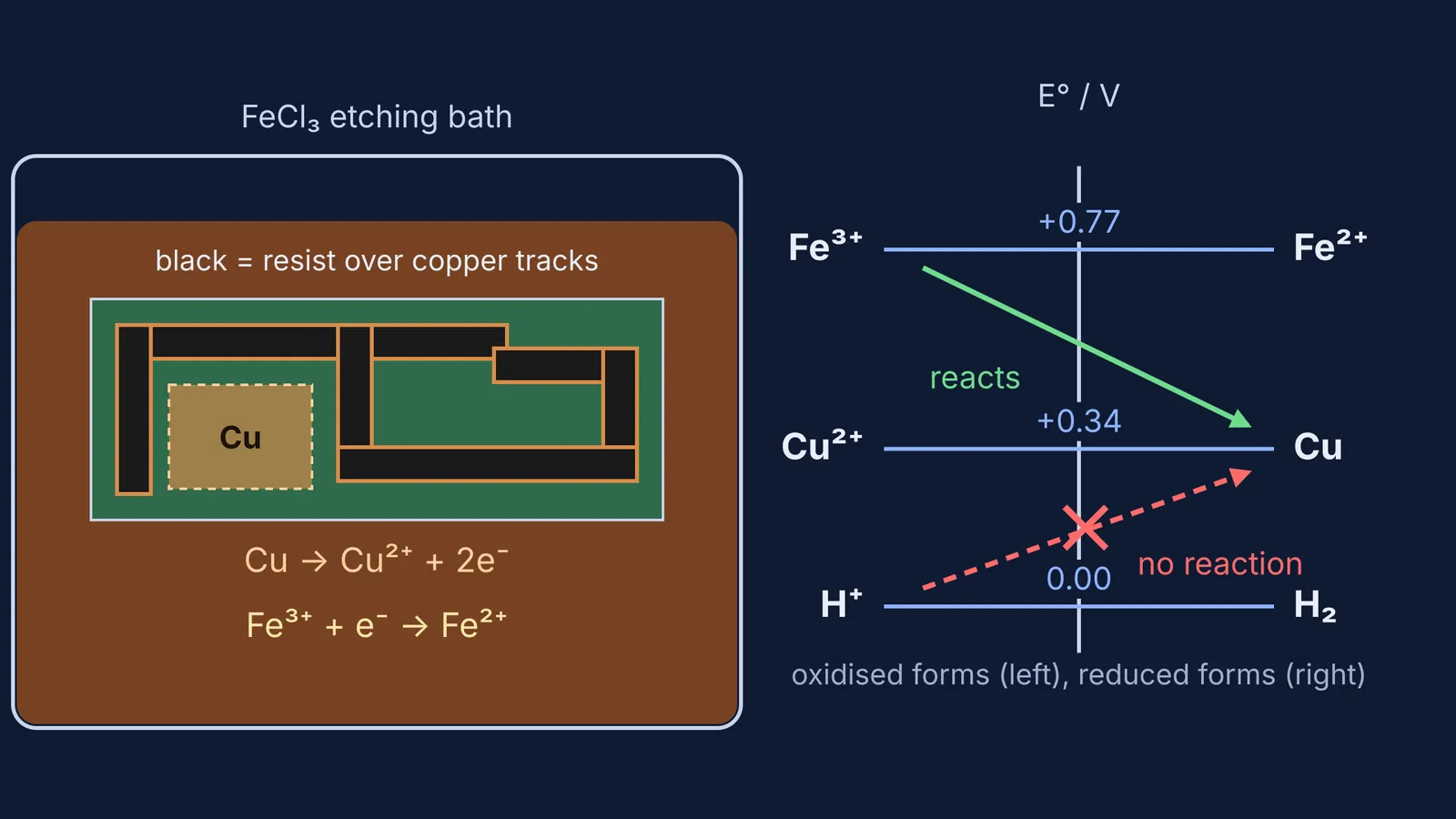
Drop a strip of copper into hydrochloric acid and nothing happens. Drop the same strip into a brown solution of iron(III) chloride and within minutes the copper starts to disappear. Hobbyists use exactly this to make printed circuit boards. They draw the circuit tracks on a copper-clad board with a resist, and the FeCl₃ bath dissolves all the copper that is not covered. Two E° values from your NCERT table explain the difference between the two liquids, and they also tell you how much copper a bottle of etchant can remove.
Why does copper not dissolve in hydrochloric acid?
For copper to dissolve, something must accept its electrons. In HCl the only oxidising agent is H⁺. The cell would be H⁺ reduced (0.00 V) and Cu oxidised (+0.34 V):
E°cell = 0.00 − 0.34 = −0.34 V.
The value is negative, so the reaction is not feasible. Our post on predicting reactions with the electrochemical series works this case and six others. Chloride ions cannot help either, because Cl⁻ is not an oxidising agent at all; it is already reduced.
One detail is worth knowing. Copper left in HCl open to the air does dissolve very slowly, because dissolved oxygen (O₂ + 4H⁺ + 4e⁻ → 2H₂O, E° = 1.23 V) is a strong enough oxidant. The oxidant is oxygen, not H⁺, and the reaction is limited by how fast oxygen dissolves.
How does ferric chloride dissolve copper?
Fe³⁺ is a much stronger oxidising agent than H⁺. The two half-reactions are:
Oxidation, on the board: Cu → Cu²⁺ + 2e⁻ (E° of Cu²⁺/Cu = +0.34 V)
Reduction, in the liquid: Fe³⁺ + e⁻ → Fe²⁺ (E° of Fe³⁺/Fe²⁺ = +0.77 V)
Double the second half-reaction so the electrons cancel:
2Fe³⁺ + Cu → 2Fe²⁺ + Cu²⁺
As molecules, 2FeCl₃ + Cu → 2FeCl₂ + CuCl₂. Check it: 2 Fe, 1 Cu and 6 Cl on each side, and the ionic charge is +6 on both sides.
The shortcut from the E° table works here. A species on the left of the table can oxidise any species on the right that sits below it. Fe³⁺ at +0.77 V sits above Cu²⁺/Cu at +0.34 V, so Fe³⁺ oxidises Cu. H⁺ at 0.00 V sits below copper, so it cannot.
Why does iron stop at Fe²⁺ instead of going all the way to iron metal? Reducing Fe²⁺ to Fe needs a couple at −0.44 V, and E°(Fe³⁺/Fe) is only about −0.04 V. Both are far below copper, so copper cannot push iron that far. Our post on why iron and HCl give ferrous chloride, not ferric looks at the same Fe²⁺/Fe³⁺ couple from the iron side.
How far does the etching reaction go?
Here is the worked calculation with NCERT's E° values at 298 K.
Standard cell EMF. Fe³⁺ is reduced, Cu is oxidised: E°cell = 0.77 − 0.34 = +0.43 V.
Free energy. n = 2, so ΔG° = −nFE° = −2 × 96 485 × 0.43 = −83 kJ per mole of copper.
Equilibrium constant. log K = nE°/0.0591 = (2 × 0.43)/0.0591 = 14.55, so K ≈ 4 × 10¹⁴. The reaction goes essentially to completion.
As the bath is used up. Fe²⁺ builds up and Fe³⁺ runs down. The Fe³⁺/Fe²⁺ potential is E = 0.77 − 0.0591 log([Fe²⁺]/[Fe³⁺]). When 90% of the Fe³⁺ has been used, the ratio is 9 and the cell EMF is still 0.37 V. At 99% it is 0.31 V.
So a tired bath does not stop because the reaction becomes unfavourable. It slows down because there is less Fe³⁺ to reach the copper surface, and because the liquid is crowded with copper and iron(II) salts. Warming and gently agitating the bath speeds it up for the same reason.
How much copper can a kilogram of FeCl₃ etch?
The 2 : 1 ratio of Fe³⁺ to Cu sets the capacity. The answer depends on which solid you weigh out.
Anhydrous FeCl₃ (molar mass 162.2 g mol⁻¹): 1000 / 162.2 = 6.17 mol Fe³⁺. That removes 6.17 / 2 = 3.08 mol Cu, which is 3.08 × 63.55 = 196 g of copper.
FeCl₃·6H₂O (molar mass 270.3 g mol⁻¹): 1000 / 270.3 = 3.70 mol Fe³⁺, which removes 1.85 mol Cu, or 118 g of copper.
The hexahydrate is 40% water by mass, so the same kilogram does only about 60% of the work. Always check which form a question, or a shop, means.
Now a real board. A 10 cm × 15 cm board with the common 35 µm copper layer (see the printed circuit board overview on Wikipedia) holds 150 cm² × 0.0035 cm = 0.525 cm³ of copper. With a density of 8.96 g cm⁻³, that is 4.70 g. If 70% of it is etched away, you remove 3.29 g, or 0.0518 mol of Cu. That needs 0.104 mol of Fe³⁺: about 17 g of anhydrous FeCl₃ or 28 g of the hexahydrate, at the very least. Real baths use a large excess so the etching stays fast.
If stoichiometry with redox still slips, the Fermi Problem Library has worked problems with a step-by-step solver that explains the reasoning.
Why is the etchant acidified, and why does it turn green?
Fe³⁺ is a small, highly charged ion, so its hydrated form gives up H⁺ to water: [Fe(H₂O)₆]³⁺ + H₂O ⇌ [Fe(H₂O)₅(OH)]²⁺ + H₃O⁺. Left alone, this hydrolysis goes further and a brown sludge of basic iron(III) salts and hydroxide settles out, taking Fe³⁺ with it. A little added HCl pushes the equilibrium back to the left and keeps the iron in solution. Our post on why aluminium and ferric chloride solutions are acidic explains this hydrolysis in detail. Notice the HCl is there to stop hydrolysis, not to attack the copper.
Chloride also matters in a second way. In a chloride-rich bath, Cu²⁺ can itself attack more copper: Cu + Cu²⁺ + 2Cl⁻ → 2CuCl. Fe³⁺ then oxidises the CuCl to Cu²⁺, as the Wikipedia page on iron(III) chloride notes for copper etching: FeCl₃ + CuCl → FeCl₂ + CuCl₂. So do not assume the same chemistry runs in a sulphate solution.
The colour of the bath tells you how far it has gone. Fresh etchant is orange-brown from Fe³⁺. As it is used, pale green Fe²⁺ and green-blue copper(II) chloride complexes build up, and the liquid turns a murky green-brown.
FeCl₃ is not the only etchant. Industry also uses acidified copper(II) chloride and ammoniacal solutions. If you try this at home or in a school lab, use gloves and eye protection, because FeCl₃ is corrosive and stains skin and clothes. Never pour the spent liquid down the drain; it is full of dissolved copper and must go to a hazardous-waste collection.
Quick checklist
Cu with H⁺: E° = 0.00 − 0.34 = −0.34 V, no reaction.
Cu with Fe³⁺: E° = 0.77 − 0.34 = +0.43 V, so 2Fe³⁺ + Cu → 2Fe²⁺ + Cu²⁺.
n = 2, ΔG° ≈ −83 kJ per mol Cu, K ≈ 4 × 10¹⁴.
Fe³⁺ goes to Fe²⁺, never to Fe metal.
1 kg anhydrous FeCl₃ etches about 196 g Cu; 1 kg hexahydrate about 118 g.
HCl in the etchant stops Fe³⁺ hydrolysis; it does not dissolve the copper.


