

On this page
Eight original questions in two NEET-UG formats many students find slow, with reasons and traps. New to the unit? Read how to prepare Experimental Skills for NEET.
What do these questions cover?
The NMC syllabus for NEET (UG)-2026 makes Experimental Skills Physics Unit 20; every question uses only experiments on its list. Theory follows 2026-27 NCERT: Class 11 Chapter 6 and Chapter 9, Class 12 Chapter 3 and Chapter 9.
Key for Q1 and Q3: (1) Both correct (2) Both incorrect (3) I correct, II incorrect (4) I incorrect, II correct.
Statement questions: which ones are true?
Q1 (easy, statements). Statement I: At a metre bridge's balance point, no current flows through the galvanometer. Statement II: The balance length changes if the cell is replaced by one of twice the emf.
Answer: (3). I: balance means null deflection. II is false: the balance condition contains only resistances.
Trap: (1) lets a stronger cell move the null point.
Q2 (easy, statements). A brass sphere falls through castor oil. Which are correct?
A. Terminal velocity is reached when viscous force plus buoyancy equals weight. B. Terminal velocity ∝ (radius)². C. Terminal velocity ∝ viscosity. D. An aluminium sphere of equal radius reaches the same terminal velocity. E. At terminal velocity, acceleration is zero.
(1) A, B and C only (2) A, B and E only (3) B, D and E only (4) A, B, D and E only
Answer: (2). A, E: zero net force. B, C: v_t = 2a²(ρ − σ)g/(9η), so v_t ∝ a² and ∝ 1/η. D: aluminium has a different ρ.
Trap: (4) forgets the ball's density.
Q3 (medium, statements). For a prism of angle A, Statement I: At minimum deviation D_m, the angle of incidence equals A + D_m. Statement II: At minimum deviation, the ray inside the prism is parallel to its base.
Answer: (4). I: NCERT gives i = (A + D_m)/2, with i = e. II: stated in NCERT.
Trap: (1) drops the half.
Q4 (hard, statements). A uniform metre scale on a knife edge at 50.0 cm balances an object at 15.0 cm against 50 g at 92.0 cm. With only the 50 g, at 4.0 cm, it balances on a knife edge at 30.0 cm. Which are correct?
A. The object's mass is 60 g. B. In the first balance, the scale's weight has no moment. C. The scale's mass is 65 g. D. On the Moon, the first balance would need the 50 g at a different mark. E. In the second balance, the scale's weight is negligible.
(1) A, B and C only (2) A, C and D only (3) B, C and E only (4) A, B, C and D only
Answer: (1). A: m × 35.0 = 50 × 42.0. B: the weight acts at the pivot. C: M × 20.0 = 50 × 26.0. D: g cancels. E: it acts 20.0 cm from the pivot and balances the 50 g.
Trap: (4) lets gravity shift the balance.
Match-the-list questions: can you pair them in one pass?
Q5 (easy, match). List-I: (A) Speed of sound, resonance tube (B) Viscosity, terminal velocity (C) Surface tension, capillary rise (D) Unknown resistance X, metre bridge. List-II: (I) S = hρga/(2 cos θ) (II) v = 2ν(l₂ − l₁) (III) X = R l/(100 − l) (IV) η = 2a²(ρ − σ)g/(9v_t).
(1) A-II, B-I, C-IV, D-III (2) A-II, B-IV, C-I, D-III (3) A-III, B-IV, C-I, D-II (4) A-II, B-IV, C-III, D-I
Answer: (2). A: successive closed-pipe resonances differ by λ/2. B: rearranged v_t. C: from hρg = 2S cos θ/a. D: l measured on X's side.
Trap: (1) swaps the two fluid formulas.
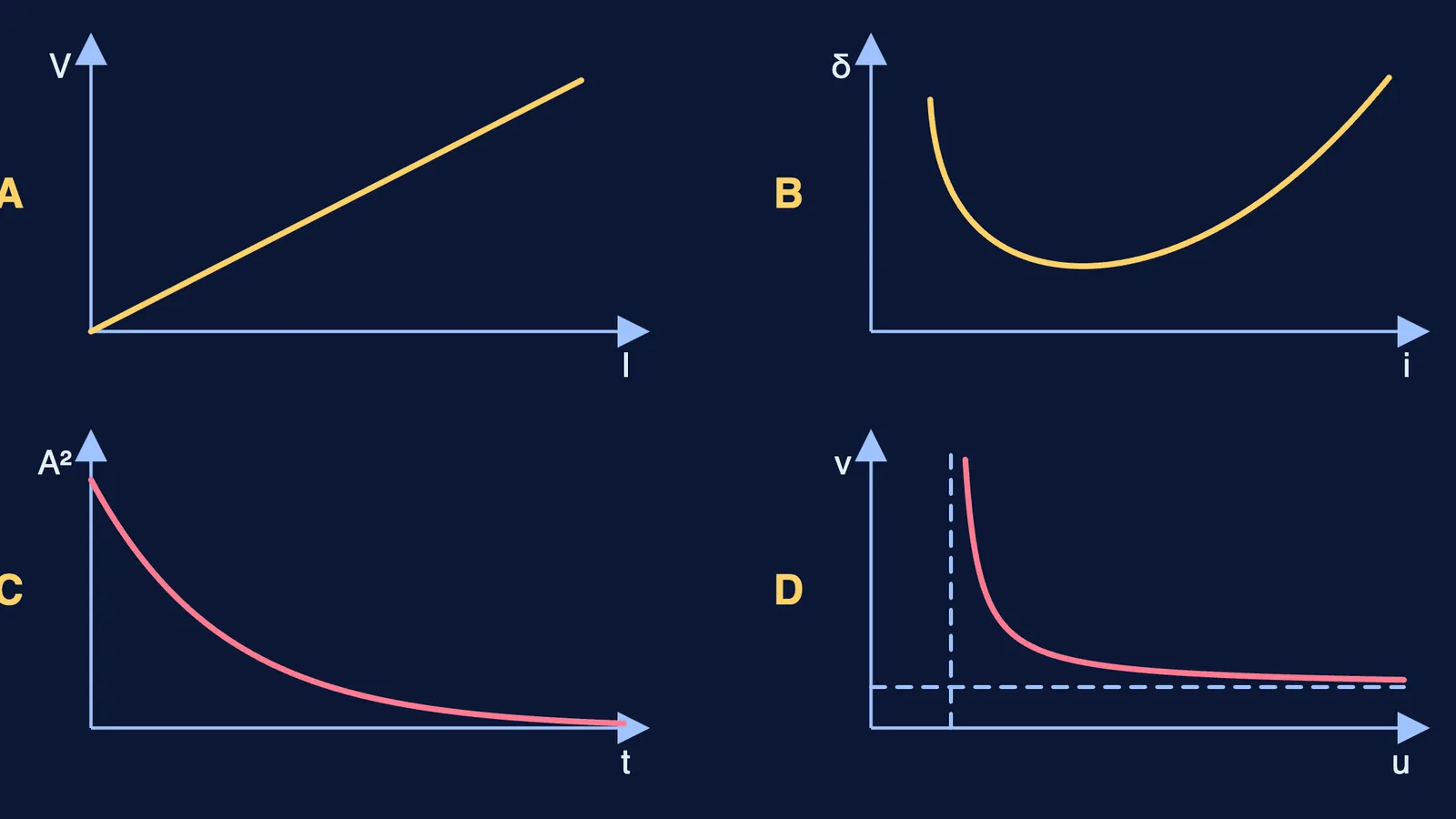
Q6 (medium, match). See the diagram above. List-I: (A) V against I for a wire at constant temperature (B) δ against i for a prism (C) Square of amplitude against time for a pendulum in air (D) v against u for real images in a concave mirror. List-II: (I) Curve with a single minimum (II) Straight line through the origin (III) Curve levelling off towards v = f (IV) Curve that keeps falling with time.
(1) A-II, B-I, C-III, D-IV (2) A-I, B-II, C-IV, D-III (3) A-II, B-I, C-IV, D-III (4) A-II, B-IV, C-I, D-III
Answer: (3). A: V = RI. B: every δ except D_m occurs at two values of i. C: energy is ½kA², and air drains it. D: from 1/v + 1/u = 1/f, v → f for large u.
Trap: (1) swaps the two falling curves.
Q7 (medium, match). List-I: (A) Liquid of twice the viscosity: terminal velocity (B) Resonance-tube fork struck harder: l₂ − l₁ (C) Capillary of half the radius: height of rise (D) Wire of twice the diameter, same material, length and load: extension. List-II: (I) Unchanged (II) Doubles (III) Halves (IV) Becomes one-fourth.
(1) A-III, B-I, C-II, D-IV (2) A-III, B-II, C-I, D-IV (3) A-II, B-I, C-III, D-IV (4) A-IV, B-I, C-II, D-III
Answer: (1). A: v_t ∝ 1/η. B: l₂ − l₁ = v/(2ν); loudness changes neither. C: h ∝ 1/a. D: Y = (F/A)/(ΔL/L), so ΔL ∝ 1/d².
Trap: (4) takes area as proportional to diameter.
Q8 (hard, match). Parallax readings: object distance, then real-image distance. List-I: (A) Concave mirror, 16.0 cm, 48.0 cm (B) Convex lens, 42.0 cm, 56.0 cm (C) Concave mirror, 14.0 cm, 35.0 cm (D) Convex lens, 30.0 cm, 150.0 cm. List-II: (I) 10.0 cm (II) 12.0 cm (III) 24.0 cm (IV) 25.0 cm.
(1) A-III, B-II, C-I, D-IV (2) A-II, B-IV, C-I, D-III (3) A-I, B-III, C-II, D-IV (4) A-II, B-III, C-I, D-IV
Answer: (4). Mirror: 1/f = 1/v + 1/u; lens: 1/f = 1/v − 1/u. A: −1/48 − 1/16 = −1/12. B: 1/56 + 1/42 = 1/24. C: −1/35 − 1/14 = −1/10. D: 1/150 + 1/30 = 1/25.
Trap: (1). The lens formula on mirror A gives 24.0 cm.
How do you work these faster?
For any balance, write the condition and cross out what cancels.
Keep v_t ∝ a²/η, h ∝ 1/a and ΔL ∝ L/d² ready.
Sign u and v before the formula; mirror and lens differ by one sign.
In a match, fix your surest pair first.
Next: how to solve NEET match-the-list questions and the Experimental Skills NEET practice set.
Wrong method? The Fermi Problem Library has worked problems with a step-by-step solver that explains the reasoning rather than printing an answer.


