

On this page
Statement and match-the-list questions appear in recent JEE Main papers. Here are eight original Electrostatics questions, easy to hard.
What do these Electrostatics questions cover?
All fit Unit 11 of the NTA's Syllabus for JEE (Main) 2027. The JEE (Main) 2027 information bulletin marks MCQs +4 or −1. Results follow NCERT Chapter 1 and Chapter 2. New to the chapter? Start with how to prepare Electrostatics for JEE Main.
Take k = 9 × 10⁹ N m² C⁻².
Statement questions
Q1 (easy, Statement I/II). A thin spherical shell of radius 10 cm carries +5 nC. Statement I: The potential 4 cm from the centre is 450 V. Statement II: The field there is about 2.8 × 10⁴ N/C.
(1) Both correct (2) Both incorrect (3) I correct, II incorrect (4) I incorrect, II correct
Answer: (3). I is correct: inside, V = kQ/R = 450 V. II is incorrect: a Gaussian sphere there encloses no charge, so E = 0.
Trap: (1) uses kQ/r² inside.
Q2 (medium, statements). A dielectric (K = 5) fills an isolated capacitor holding charge Q. Which are correct? A. The field between the plates falls to one-fifth. B. The capacitance becomes five times. C. The potential difference becomes five times. D. Each dielectric face carries induced charge of magnitude 4Q/5. E. The stored energy falls to one-fifth.
(1) A, B and C only (2) B, C and D only (3) A, D and E only (4) A, B, D and E only
Answer: (4). A true: E₀/K. B true: KC₀. C false: V = Q/C falls. D true: σ − σₚ = σ/K gives σₚ = 4σ/5. E true: U = Q²/2C.
Trap: (1) lets V rise, as if C fell.
Q3 (medium, Statement I/II). Charges +4 µC and +9 µC are fixed 50 cm apart. Statement I: The net field is zero 20 cm from the +4 µC charge. Statement II: A positive charge there, nudged along the line, is pushed back.
(1) Both correct (2) Both incorrect (3) I correct, II incorrect (4) I incorrect, II correct
Answer: (1). I is correct: 2/x = 3/(0.50 − x) gives x = 0.20 m. II is correct: displaced towards either charge, that charge's push grows faster.
Trap: (3) applies the result for a negative charge.
Q4 (hard, statements). A 3 µF capacitor at 200 V is disconnected and joined, like plates together, to an uncharged 1 µF. Which are correct? A. The common voltage is 150 V. B. The energy falls by 15 mJ. C. With ideal zero-resistance wires, no energy is lost. D. Had the 1 µF been at 200 V and joined opposite plates together, the common voltage would be 100 V. E. In case D, 40 mJ is lost.
(1) A, B and C only (2) A, B and D only (3) A, D and E only (4) B, C and E only
Answer: (2). A true: 600 µC over 4 µF. B true: 60 mJ becomes ½ × 4 µF × 150² = 45 mJ. C false: the loss C₁C₂ΔV²/2(C₁ + C₂) is independent of resistance. D true: (600 − 200) µC / 4 µF. E false: 80 mJ falls to 20 mJ, so 60 mJ is lost.
Trap: (3) forgets the 1 µF capacitor's 20 mJ in case D.
Match-the-list questions
Q5 (easy, match). Dimensions. List-I: (A) capacitance (B) electric field (C) electric potential (D) ε₀E². List-II: (I) [M L² T⁻³ A⁻¹] (II) [M⁻¹ L⁻² T⁴ A²] (III) [M L T⁻³ A⁻¹] (IV) [M L⁻¹ T⁻²].
(1) A-II, B-I, C-III, D-IV (2) A-IV, B-III, C-I, D-II (3) A-II, B-III, C-I, D-IV (4) A-IV, B-I, C-III, D-II
Answer: (3). A-II: Q/V. B-III: N/C. C-I: field × length. D-IV: twice the energy density, J m⁻³.
Trap: (1) swaps field and potential.
Q6 (medium, match). Three 4 µF capacitors sit across a 12 V battery. Match the charge drawn. List-I: (A) all in series (B) all in parallel (C) two in series, parallel to the third (D) two in parallel, in series with the third. List-II: (I) 16 µC (II) 32 µC (III) 72 µC (IV) 144 µC.
(1) A-I, B-IV, C-II, D-III (2) A-II, B-IV, C-III, D-I (3) A-I, B-IV, C-III, D-II (4) A-I, B-III, C-IV, D-II
Answer: (3). Q = 12 V × C. A-I: 4/3 µF. B-IV: 12 µF. C-III: 2 + 4 = 6 µF. D-II: 8 µF in series with 4 µF is 8/3 µF.
Trap: (1) swaps the mixed arrangements.
Q7 (medium, match). Potential. List-I: (A) on a short dipole's perpendicular bisector (B) inside a charged thin shell (C) outside it, at r from the centre (D) at r from a long charged wire. List-II: (I) zero everywhere (II) one non-zero value everywhere (III) proportional to 1/r (IV) changes as ln r.
(1) A-II, B-I, C-III, D-IV (2) A-I, B-II, C-IV, D-III (3) A-III, B-II, C-I, D-IV (4) A-I, B-II, C-III, D-IV
Answer: (4). A-I: equidistant charges cancel. B-II: E = 0, so V = kQ/R. C-III: point-charge behaviour. D-IV: integrating λ/2πε₀r gives ln r.
Trap: (1) reads zero field as zero potential.
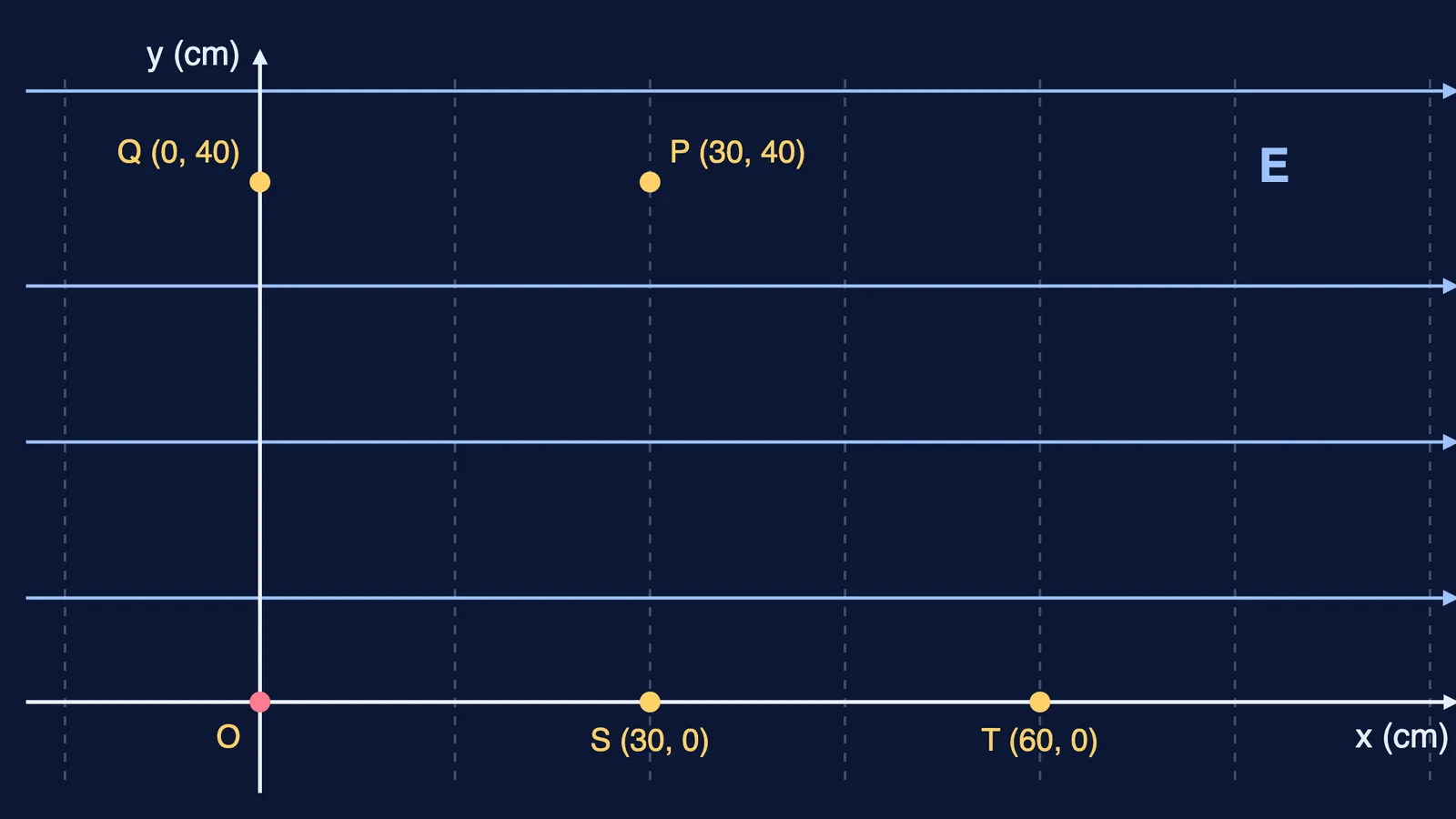
Q8 (hard, match). A uniform field of 2 × 10⁴ N/C points along +x. Points in cm: O (0, 0), P (30, 40), Q (0, 40), S (30, 0), T (60, 0). List-I: (A) work by the field, +2 µC from O to P (B) work by the field, +2 µC from O to Q (C) change in potential energy, +2 µC from O to S (D) work by the field, −2 µC from O to T. List-II: (I) 0 (II) +12 mJ (III) −12 mJ (IV) −24 mJ.
(1) A-II, B-I, C-III, D-IV (2) A-II, B-I, C-IV, D-III (3) A-III, B-I, C-II, D-IV (4) A-II, B-III, C-I, D-IV
Answer: (1). Force 0.04 N. A-II: only the 30 cm along x counts. B-I: OQ is perpendicular to E. C-III: ΔU = −W. D-IV: force along −x, W = −0.04 × 0.60 J.
Trap: (3) swaps work and ΔU.
How do you work these faster?
Inside a shell or conductor: E = 0, V = surface value.
For capacitors, write "Q fixed" or "V fixed" first.
Work by the field and change in potential energy have opposite signs.
Cannot see where your reasoning broke? The Fermi Problem Library has worked problems with a step-by-step solver that explains the reasoning rather than printing an answer.
For longer problems, try set 1 of our Electrostatics JEE Main practice questions.


