

On this page
In a numerical-value question there are no options to check against. You type a number, so units, signs and rounding matter as much as the physics. Here are eight original Electrostatics questions, easy to hard.
What do JEE Main numerical-value questions look like?
The JEE (Main) 2027 information bulletin gives each subject a Section B of numerical-value questions. You enter an integer on an on-screen keypad, and the answer should be rounded off to the nearest integer. A correct answer scores +4 and a wrong one −1, so a guess can cost you.
Every question here sits inside Unit 11 of the NTA's Syllabus for JEE (Main) 2027 and NCERT Class 12 Chapter 1 and Chapter 2. New to the chapter? Start with our guide on how to prepare Electrostatics for JEE Main.
Take k = 9 × 10⁹ N m² C⁻², ε₀ = 8.85 × 10⁻¹² C² N⁻¹ m⁻² and π = 3.14. Give each answer to the nearest integer in the unit stated.
Easy
Q1 (easy). Charges +3 µC, +2 µC and −9 µC are fixed on the x-axis at x = 0, 20 cm and 50 cm. Find the net force on the +2 µC charge, in units of 10⁻² N.
Answer: 315. The +3 µC charge pushes it along +x with 9 × 10⁹ × 6 × 10⁻¹² / 0.04 = 1.35 N. The −9 µC charge, 30 cm away, pulls it along +x with 9 × 10⁹ × 18 × 10⁻¹² / 0.09 = 1.80 N. Both point the same way: 3.15 N.
Trap: 45, from subtracting because one charge is negative.
Q2 (easy). A dipole is made of ±2 nC charges 3 mm apart. It sits aligned with a uniform field of 4 × 10⁴ N/C. Find the work an external agent does to turn it slowly through 120°, in nJ.
Answer: 360. p = 6 × 10⁻¹² C m. W = pE(cos 0° − cos 120°) = 6 × 10⁻¹² × 4 × 10⁴ × 1.5 = 3.6 × 10⁻⁷ J.
Trap: 120, from taking cos 120° as +0.5.
Q3 (easy). The field in a region is E = 400x î N/C, with x in metres. A cube of side 30 cm has faces at x = 0.3 m and x = 0.6 m. Find the charge inside the cube, in pC.
Answer: 96. Only faces normal to x carry flux. Out through the far face: 400 × 0.6 × 0.09 = 21.6 N m² C⁻¹. In through the near face: 10.8. Net flux 10.8, so q = ε₀Φ = 95.58 pC, which rounds to 96.
Trap: 191, from counting only the far face.
Medium
Q4 (medium). A very long straight wire carries 5 nC per metre. Find the work done by the field as a +3 µC charge moves from 2 cm to 16 cm from the wire, in µJ. Take ln 2 = 0.693.
Answer: 561. By Gauss's law, E = 2kλ/r = 90/r V/m. Integrating, V(2 cm) − V(16 cm) = 90 × ln 8 = 90 × 2.079 = 187.1 V. W = qΔV = 3 × 10⁻⁶ × 187.1 J = 561 µJ.
Trap: 244, from using log₁₀ 8 instead of ln 8.
Q5 (medium). A charge of 10 nC is spread uniformly along a thin semicircular wire of radius 10 cm. Find the field at the centre of the semicircle, in units of 10² N/C.
Answer: 57. Components along the diameter cancel in pairs. Adding the rest: E = 2kλ/R with λ = Q/πR, so E = 2kQ/(πR²) = 180/0.0314 ≈ 5732 N/C.
Trap: 90, from treating the arc as a point charge at distance R.
Q6 (medium). Uncharged capacitors of 2 µF, 3 µF and 5 µF have one plate each joined at a common point O. Their other plates are then held at 30 V, 0 V and 10 V. Find the charge on the 3 µF capacitor, in µC.
Answer: 33. The plates joined at O form an isolated conductor that started neutral, so the charges on them sum to zero: 2(V − 30) + 3V + 5(V − 10) = 0. So V = 110/10 = 11 V, and the 3 µF holds 3 × 11 = 33 µC.
Trap: 40, from taking V at O as the plain average of 30, 0 and 10.
Hard
Q7 (hard). The gap of a parallel-plate capacitor holds two slabs, 2 mm of dielectric constant 4 and 3 mm of dielectric constant 2, filling it completely. The plates are connected to 120 V. Find the potential difference across the K = 2 slab, in volts.
Answer: 90. The free charge is the same through both layers, so E falls as 1/K. The voltages split as t/K: 0.5 mm and 1.5 mm. The K = 2 slab takes 1.5/2.0 of 120 V.
Trap: 72, from splitting by thickness alone.
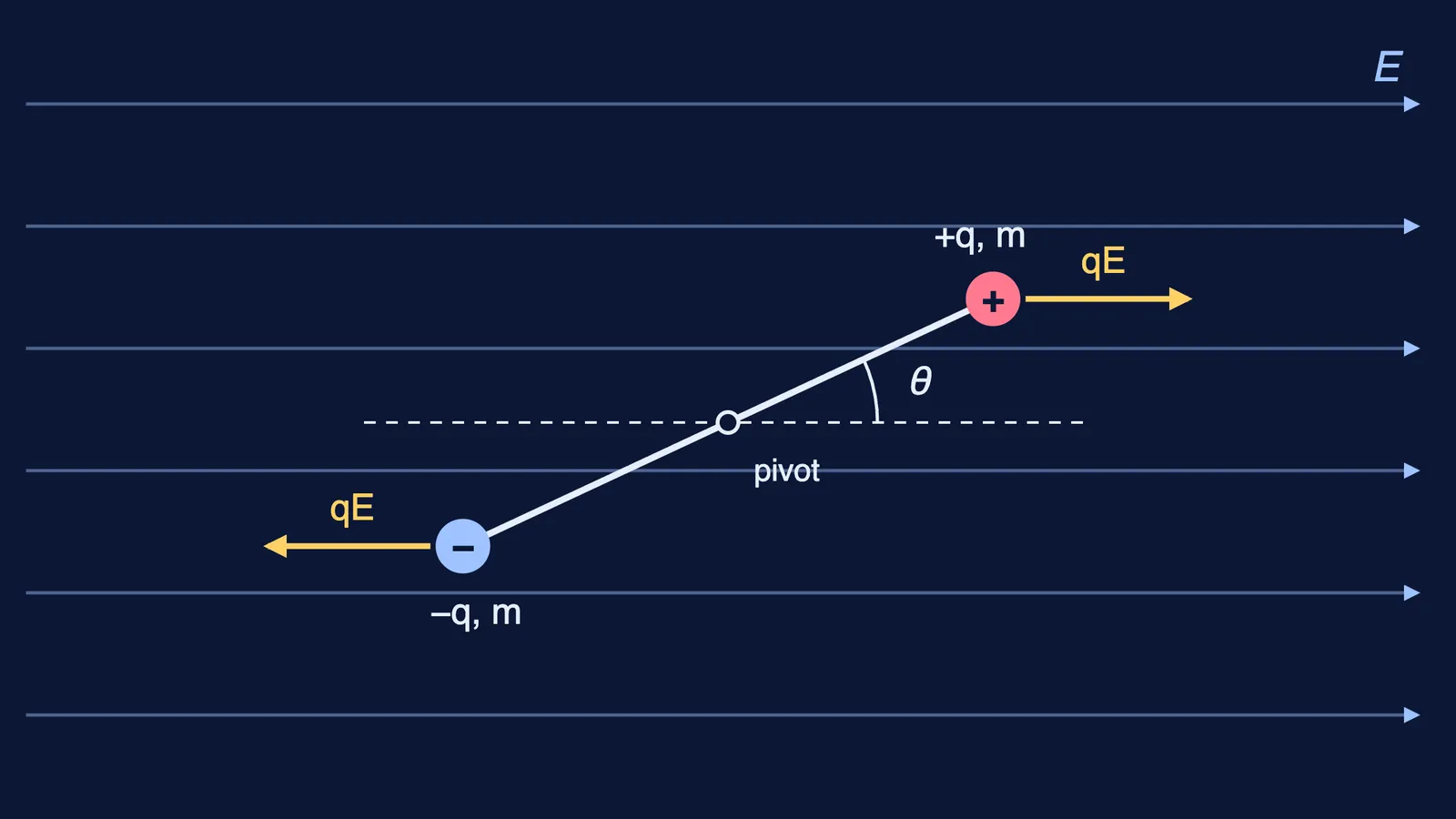
Q8 (hard). A light insulating rod 10 cm long has small balls of 2 g at its ends, charged +1 µC and −1 µC. It is pivoted at its centre and can turn in a horizontal plane, in a horizontal uniform field of 10⁴ N/C. Find the period of small oscillations about equilibrium, in ms.
Answer: 628. Torque pE sin θ ≈ pE θ, with pE = 10⁻⁷ × 10⁴ = 10⁻³ N m. I = 2 × 0.002 × 0.05² = 10⁻⁵ kg m². T = 2π√(I/pE) = 2π × 0.1 = 0.628 s.
Trap: 1257, from using the full rod length, not half, as each ball's distance from the pivot.
How do you get the number right?
Convert every prefix (nC, µC, cm, mm) to SI before substituting, and convert back only at the end.
Round once, at the last step. Q3 is 95.58 pC; rounding the flux early can move it.
Use the constants the question gives. The bulletin asks you to calculate with them.
Decide the sign from physics: work by the field, work by an agent and change in potential energy differ.
Field adds as vectors, potential as numbers. Draw arrows before any field sum.
Still unsure why your number came out wrong? The Fermi Problem Library has worked problems with a step-by-step solver that explains the reasoning rather than printing an answer.
For mixed multiple-choice practice, try set 1 of our Electrostatics JEE Main practice questions.


